
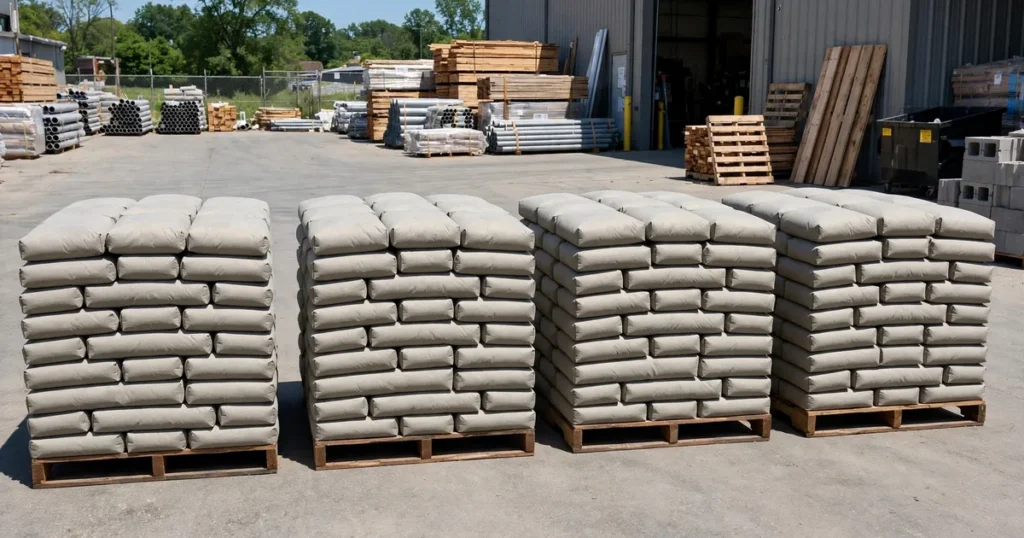
One cubic yard of concrete needs 45 × 80 lb bags, 72 × 50 lb bags, 60 × 60 lb bags, or 90 × 40 lb bags. Add 10% for waste, so in practice buy 50 × 80 lb bags, 80 × 50 lb bags, 66 × 60 lb bags, or 99 × 40 lb bags per cubic yard. These numbers come straight from the yield printed on each bag.
Bags Per Cubic Yard (US)
| Bag size | Yield per bag | Bags per cubic yard | Buy with 10% waste |
|---|---|---|---|
| 80 lb | 0.60 ft³ | 45 | 50 |
| 60 lb | 0.45 ft³ | 60 | 66 |
| 50 lb | 0.375 ft³ | 72 | 80 |
| 40 lb | 0.30 ft³ | 90 | 99 |
The 80 lb bag is the most popular choice. Fewer bags to carry, fewer bags to mix, and the lowest cost per yard in most stores. The yields above are the standard figures published by major manufacturers such as Quikrete and Sakrete, and they are printed on every bag.
Bags Per Cubic Metre (UK)
| Bag size | Yield per bag | Bags per cubic metre | Buy with 10% waste |
|---|---|---|---|
| 25 kg | 0.0117 m³ | About 86 | About 95 |
| 20 kg | 0.0094 m³ | About 107 | About 118 |
For metric jobs, use our concrete calculator in metric mode to get your volume in m³, then multiply by the bag count above.
Why Bag Weight Does Not Decide Yield
A heavier bag does not automatically make more concrete. Yield depends on the mix, not just the weight:
- Water content matters. The yield figure is the volume of concrete after water is added. Two bags of the same weight can yield different volumes if their mixes differ.
- Aggregate type matters. Coarse aggregate bulks the mix out differently than fine sand. That is why mortar mix and concrete mix of the same weight give different yields.
- The printed yield is the truth. Manufacturers test each product and print the yield on the bag. Trust that number over any rule of thumb.
So always read the yield on the bag you are buying. The table above uses the standard yields, but a speciality mix may differ.
The Maths Behind the Numbers
A cubic yard is 27 cubic feet (3 × 3 × 3). An 80 lb bag yields 0.60 cubic feet of mixed concrete. Divide the total volume by the yield per bag:
27 ÷ 0.60 = 45 bags
The same maths works for every size:
- 60 lb bag: 27 ÷ 0.45 = 60 bags
- 50 lb bag: 27 ÷ 0.375 = 72 bags
- 40 lb bag: 27 ÷ 0.30 = 90 bags
Once you know your project’s volume in cubic yards, multiply by the bag count for your chosen bag size. Our concrete bag calculator does this for you, including the waste allowance.
How to Calculate for Any Volume
Follow these steps:
- Measure your project in feet: length × width × thickness (in feet).
- Divide thickness in inches by 12 to convert to feet. A 4 in slab is 0.33 ft.
- Multiply to get cubic feet, then divide by 27 to get cubic yards.
- Multiply cubic yards by the bags-per-yard figure for your bag size.
- Add 10% for waste and round up.
- 10 × 10 × (4 ÷ 12) = 33.3 ft³
- 33.3 ÷ 27 = 1.23 yd³
- 1.23 × 45 = 55.4 → 56 bags (no waste)
- With 10% waste: 1.23 × 1.10 = 1.36 yd³ → 62 bags
- Spillage during mixing and pouring
- Uneven ground under the slab (low spots need extra concrete)
- Forms that are slightly out of square
- Concrete left in the mixer or wheelbarrow
- Forgetting the waste allowance. Buying exactly 45 bags for a yard leaves you short. Buy 50.
- Mixing bag sizes in one pour. Different bag sizes can have slightly different mixes. Stick to one size per pour.
- Using the wrong mix type. Mortar mix and sand mix are not concrete mix. They have different yields and strengths. Buy concrete mix for slabs and footings.
- Underestimating the work. Mixing 50+ bags takes hours. For 2 yd³ or more, get help or price ready-mix.
- Ignoring the sub-base. Soft or uneven ground eats concrete. Compact the base first so your volume estimate holds.
- Rounding down. Always round bag counts up. A half bag short still means a trip back to the store.
Example: a 10×10 ft slab at 4 in thick.
Our slab concrete calculator runs this whole calculation and shows the working, so you can check every step.
Worked Examples: Bag Counts for Common Volumes
All figures below include 10% waste, rounded up to whole bags. These are the numbers to actually buy.
| Project volume | 80 lb bags | 60 lb bags | 50 lb bags | 40 lb bags |
|---|---|---|---|---|
| 0.25 yd³ (small repair) | 13 | 17 | 20 | 25 |
| 0.5 yd³ (fence posts, small pad) | 25 | 33 | 40 | 50 |
| 1 yd³ | 50 | 66 | 80 | 99 |
| 2 yd³ (small driveway section) | 99 | 132 | 159 | 198 |
| 3 yd³ | 149 | 198 | 238 | 297 |
Notice how fast the numbers grow. A 2 yd³ job needs nearly 100 × 80 lb bags. At that point, price a ready-mix delivery. Our concrete cost calculator compares bags against ready-mix for any volume.
A side note on weight: a cubic yard of mixed concrete weighs about 4,000 lb. If you are carrying the bags yourself, the 40 lb bag suddenly looks more appealing, even though you need twice as many.
Why You Should Add 10% Waste
Bag yields are measured in perfect lab conditions. On a real job you lose concrete to:
Ten percent covers normal jobs. Add 15% for rough ground, deep footings, or your first DIY pour. Running short mid-pour is far worse than having one bag left over.
Which Bag Size Should You Buy?
80 lb bags
Best for most jobs. Fewest bags to buy, carry, and mix. A full bag is heavy (about 36 kg), so this size suits jobs where you can work close to the pour site.
60 lb bags
A good middle ground. Easier to lift and carry than 80 lb bags. Useful when you need to move bags up steps or across a garden.
50 lb bags
Popular with DIYers who find 60 lb bags tiring over a long day. You need 72 per yard, so the bag count climbs, but each lift is easier.
40 lb bags
Easiest to handle, but you need twice as many as 80 lb bags. Best for small repairs, setting a few posts, or jobs where you carry bags a long distance. Cost per yard is usually highest.
Whichever size you pick, the total concrete is the same. The only differences are handling and price per yard.
Common Mistakes to Avoid
FAQ
How many 80 lb bags of concrete are in a yard?
There are 45 × 80 lb bags in a cubic yard, based on a yield of 0.60 ft³ per bag. Add 10% for waste and buy 50 bags. This is the standard figure printed on the bag and confirmed by manufacturers.
How many 60 lb bags of concrete per cubic yard?
A cubic yard needs 60 × 60 lb bags, since each bag yields 0.45 ft³. With a 10% waste allowance, buy 66 bags. The 60 lb bag is a popular choice when 80 lb bags are too heavy to carry comfortably.
How many 50 lb bags of concrete per cubic yard?
A cubic yard needs 72 × 50 lb bags, since each bag yields 0.375 ft³. With 10% waste, buy 80 bags. The 50 lb size suits DIYers who want easier lifting over a long mixing session.
How many 25 kg bags of concrete per cubic metre?
About 86 × 25 kg bags make one cubic metre, based on a yield of roughly 0.0117 m³ per bag. Add 10% for waste and buy about 95 bags. For 20 kg bags, you need about 107 per m³, or about 118 with waste.
Does the type of concrete mix affect the number of bags per cubic yard?
Yes. Standard concrete mix, mortar mix, and sand mix have different yields because they contain different aggregates. Always use the yield printed on the specific product you are buying.
Should I include waste when buying concrete bags?
Yes, always add at least 10%. Spillage, uneven ground, and concrete left in the mixer all eat into your total. Without a waste allowance you will run short, and a second trip to the store mid-pour can ruin the finish.
Conclusion
The core numbers are simple: 45 × 80 lb bags, 72 × 50 lb bags, 60 × 60 lb bags, or 90 × 40 lb bags per cubic yard, plus 10% waste. Measure your project, do the maths (or use the calculator), and buy one size of bag for the whole pour. For jobs above 2 cubic yards, compare the bag total against a ready-mix quote before you commit.