
Size your strip or pad footings correctly. Enter length, width and depth: get cubic yards, bags and cost instantly.
Estimates only. Bag yields per manufacturer specs (80 lb ≈ 0.60 ft³, 60 lb ≈ 0.45 ft³, 40 lb ≈ 0.30 ft³). Ready-mix trucks carry 8 to 10 yd³. Always round up and confirm with your supplier.
Footings spread the load of walls and columns onto the soil. Undersize them and the structure settles. Use the free footing concrete calculator below: enter length, width and depth to get cubic yards, bag counts and cost before you dig.
How to use the footing concrete calculator
- Measure the total length of your footing trench in feet.
- Enter the footing width in feet (2 ft is common for house walls).
- Enter the depth in inches (12 inches is typical).
- Add 10 percent waste for over-dig and uneven trench bottoms.
Formula
Volume = Length × Width × Depth ÷ 27. Convert depth to feet first, then divide cubic feet by 27 for cubic yards.
Practical tips
- Dig footings below the frost line in cold climates, or frost heave will lift them.
- A 20 ft long, 2 ft wide, 12 in deep footing needs 1.48 cubic yards.
- Keep trench bottoms level. Soft spots need compacting before the pour.
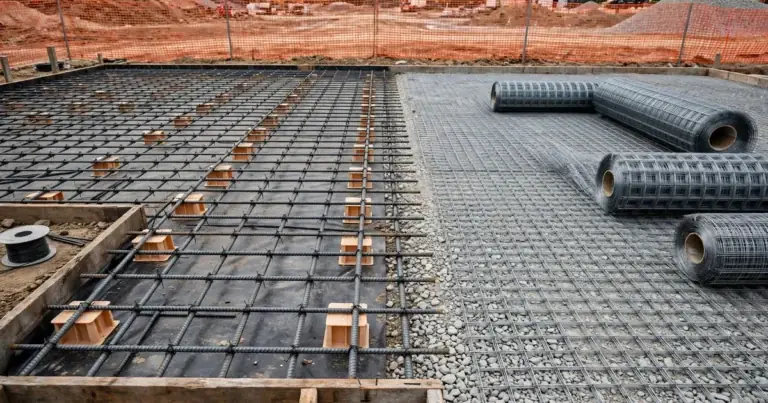
- Add rebar lengthwise in structural footings for extra strength.
Frequently asked questions
How wide should a concrete footing be?
For a single-storey wall, 2 ft wide by 12 in deep is standard. Wider footings suit heavier loads or soft soil.
How deep should footings be?
Below the local frost line, with 12 inches as a common minimum for garden walls and extensions.
Can I use bags for footings?
Yes for small runs. A 10 ft footing at 2 ft wide and 12 in deep needs about 34 bags of 80 lb mix. Larger pours suit ready-mix.
Need the full set? Open the concrete calculator hub or estimate rebar for your footings.
A footing is the quiet part of a building: nobody sees it, but it spreads the whole load of the wall or column onto the soil, and if it is undersized the structure settles. The volume is a simple trench, length times width times depth, but depth is decided by the frost line, not by the maths. In cold climates the footing must sit below the frost line or frost heave will lift it, and 12 in is the common minimum depth for garden walls and extensions.
Worked example
Take a 40 ft trench, 18 in wide, 12 in deep. Width is 18 / 12 = 1.5 ft. Depth is 12 / 12 = 1 ft. Volume is 40 x 1.5 x 1 = 60 cubic feet. Divide by 27: 60 / 27 = 2.22 cubic yards. Bags of 80 lb mix: 60 / 0.60 = 100 bags. With 10 percent waste for over-dig and uneven trench bottoms: 60 x 1.10 = 66 cubic feet, which is 2.44 cubic yards, or 110 bags.
Common mistake
The usual error is digging the trench to the depth on the drawing and pouring onto a soft or uneven bottom. Soft spots need compacting before the pour, and the trench bottom must be level, because a footing that bears on soft soil in one place and firm soil in another settles unevenly. The second error is skipping rebar: add bars lengthwise in structural footings for extra strength, and keep the trench free of loose soil and water before you pour.
Frequently asked questions
How wide should a concrete footing be?
For a single-storey wall, 2 ft wide by 12 in deep is standard. Wider footings suit heavier loads or soft soil.
How deep should footings be?
Below the local frost line, with 12 in as a common minimum for garden walls and extensions.
Can I use bags for footings?
Yes for small runs. A 10 ft footing at 2 ft wide and 12 in deep needs about 34 bags of 80 lb mix. Larger pours suit ready mix.
Written by Kaleemullah, who runs Concrete Quantity and writes the guides and builds the calculators. Every figure on this page comes from the formula shown on the page and the sources listed below, so you can check the working yourself. Where a figure is an estimate, the page says so.
Sources: Footing volume formula stated on this page, length times width times depth divided by 27, with a 20 ft by 2 ft by 12 in footing equal to 1.48 cu yd.
Last checked: 19 November 2026.
Last updated: November 2026