
Estimate concrete for retaining and garden walls. Enter length, height and thickness: get cubic yards and bags instantly.
Estimates only. Bag yields per manufacturer specs (80 lb ≈ 0.60 ft³, 60 lb ≈ 0.45 ft³, 40 lb ≈ 0.30 ft³). Ready-mix trucks carry 8 to 10 yd³. Always round up and confirm with your supplier.
Retaining walls, garden walls and foundation walls all start with an accurate volume. The free wall concrete calculator below turns length, height and thickness into cubic yards, bag counts and cost, so you order neither too little nor too much.
Estimating concrete blocks? Concrete blocks are now estimated on the Block Wall page.
How to use the wall concrete calculator
- Measure the wall length in feet.
- Enter the wall height in feet, from footing to top.
- Enter the wall thickness in inches (8 inches is standard for block-filled or poured walls).
- Add 10 percent waste for formwork gaps and spillage.
Formula
Volume = Length × Height × (Thickness ÷ 12) ÷ 27, giving cubic yards.
Practical tips
- An 8 inch thick wall, 20 ft long and 4 ft high needs 1.98 cubic yards (2.17 with 10% waste).
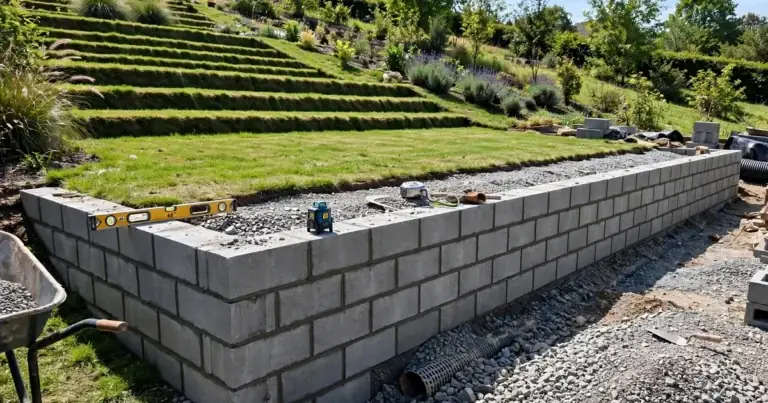
- Retaining walls over 3 ft high usually need drainage behind them and an engineer check.
- Pour walls in one go where possible to avoid weak cold joints.
- Vibrate or rod the concrete in the forms to remove air pockets.
Frequently asked questions
How thick should a concrete retaining wall be?
Eight inches is the minimum for most garden retaining walls. Taller walls need thicker sections or reinforcement.
How much concrete for a 20 ft wall?
A 20 ft long, 4 ft high, 8 in thick wall needs about 1.98 cubic yards, or 2.17 with 10% waste (98 bags of 80 lb mix).
Do I need drainage behind a retaining wall?
Yes. Water pressure is the top cause of wall failure. Add gravel backfill and a drain pipe.
Explore the full concrete calculator or price the job with the cost estimator.
Related: Block Wall Calculator
A poured wall is a slab turned upright, and the volume formula is the same, length times height times thickness, but the risks are different. A wall is poured into forms, so the concrete has to flow into a tall, narrow space without leaving air pockets, and the pressure of wet concrete on the forms is highest at the bottom. The calculator works out the volume; the pour itself needs to be done in one continuous run where possible, so the wall cures as one piece instead of forming a weak cold joint halfway up.
Worked example
Take a 30 ft long garden wall, 3 ft high, 6 in thick. Volume is 30 x 3 x (6 / 12) = 45 cubic feet. Divide by 27: 45 / 27 = 1.67 cubic yards. Bags of 80 lb mix: 45 / 0.60 = 75 bags. With 10 percent waste for formwork gaps and spillage: 45 x 1.10 = 49.5 cubic feet, which is 1.83 cubic yards, or 83 bags.
Common mistake
The usual error is pouring a retaining wall with no drainage behind it. Water pressure is the top cause of wall failure, so add gravel backfill and a drain pipe, whatever the volume maths says. The second error is treating 8 in as the thickness for every wall: 8 in is the minimum for most garden retaining walls, but taller walls need thicker sections or reinforcement, and any retaining wall over 3 ft high deserves an engineer check.
Frequently asked questions
How thick should a concrete retaining wall be?
Eight inches is the minimum for most garden retaining walls. Taller walls need thicker sections or reinforcement.
How much concrete for a 30 ft wall?
A 30 ft long, 3 ft high, 6 in thick wall needs about 1.67 cubic yards, or 1.83 with 10 percent waste, which is 83 bags of 80 lb mix.
Do I need drainage behind a retaining wall?
Yes. Water pressure is the top cause of wall failure. Add gravel backfill and a drain pipe.
Written by Kaleemullah, who runs Concrete Quantity and writes the guides and builds the calculators. Every figure on this page comes from the formula shown on the page and the sources listed below, so you can check the working yourself. Where a figure is an estimate, the page says so.
Sources: Wall volume formula stated on this page, length times height times thickness divided by 27, with a 20 ft by 4 ft by 8 in wall equal to 1.98 cu yd.
Last checked: 19 November 2026.
Last updated: November 2026