
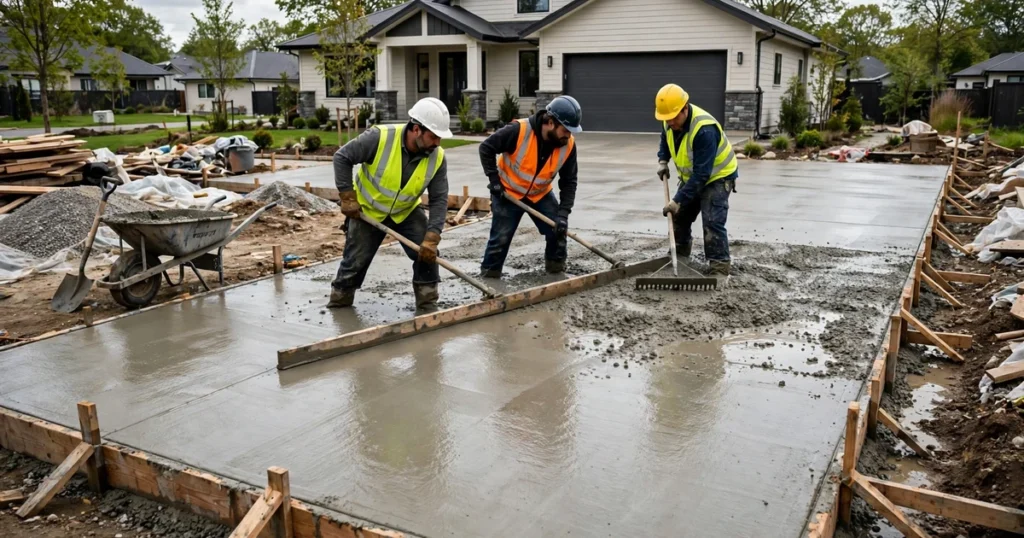
Square foot prices are the easiest way to compare concrete quotes, and the easiest way to be misled by them. Two quotes can both say $9 per square foot and cover very different work. One may include excavation, base, reinforcement, and finishing. The other may cover concrete alone. This guide explains what a square foot price should include, what drives it up or down, and how to check a quote before you sign.
Direct answer: In 2026 guides, a plain installed 4 inch slab most often costs $6 to $12 per square foot, including materials and labour. DIY materials alone run about $2.50 to $4.50 per square foot. Small pads cost more per square foot, thicker slabs cost more, and decorative finishes add several dollars per square foot. Always compare quotes on the same scope, not on the headline rate alone.
Why concrete is sold by the yard but priced by the foot
Concrete itself is sold by the cubic yard, which is 27 cubic feet. A square foot price is simply a shortcut that bundles that volume with labour, base, forms, and finishing. The shortcut only works when thickness is fixed. A 4 inch slab needs about 0.0123 cubic yards per square foot before waste, while a 6 inch slab needs about 50 percent more concrete for the same area. That is why a driveway at 6 inches should never be priced like a patio at 4 inches.
To check any quote, work out the volume yourself. Multiply length by width by thickness in feet, then divide by 27 for cubic yards, then add about 10 percent for waste and uneven ground. A 20 foot by 20 foot slab at 4 inches is 400 square feet, about 1.23 cubic yards before waste, and about 1.36 cubic yards with a 10 percent allowance. If a quote shows far less concrete than that, ask what thickness and waste allowance it assumes.
Installed cost by project type
| Project, plain broom finish | Typical installed range | Why it varies |
|---|---|---|
| Basic 4 inch slab | $6 to $12 per sq ft | Size, access, base, and labour rates |
| Driveway, 5 to 6 inches | $6 to $15 per sq ft | Thickness, reinforcement, demolition |
| Patio, plain finish | $4 to $12 per sq ft | Size and finish detail |
| Sidewalk | $6 to $12 per sq ft | Length, access, and kerb work |
| Resurfacing | $3 to $9 per sq ft | Surface condition and coating type |
These ranges come from several 2026 cost guides. The common band for plain flatwork is $6 to $12 per square foot. Wider ranges simply include decorative work and difficult sites in the same figure.
What the price is made of
Materials normally make up about 40 to 55 percent of an installed price in 2026 guides. Ready mix concrete is commonly quoted at $120 to $180 per cubic yard delivered for a standard mix. Labour, forms, base, reinforcement, finishing, and contractor overhead make up the rest. Labour alone is often quoted at $2 to $5 per square foot for placement and finishing, depending on crew size and region.
Small orders carry extra fees that do not show in a per foot rate. Batch plants commonly charge a short load fee on orders under 4 or 5 cubic yards, often $50 to $250 per yard in guides, or a flat delivery fee. Contractors also carry minimum charges, often $800 to $1,200, which is why a 10 foot by 10 foot pad can be priced at $10 to $15 per square foot even though a large slab is priced near $6. Fixed costs spread over less area.
Worked totals for common sizes
| Slab size, 4 inches thick | Area | Installed at $6 to $12 per sq ft |
|---|---|---|
| 10 ft by 10 ft | 100 sq ft | $600 to $1,200, often higher due to minimums |
| 12 ft by 12 ft | 144 sq ft | $864 to $1,728 |
| 20 ft by 20 ft | 400 sq ft | $2,400 to $4,800 |
| 20 ft by 30 ft | 600 sq ft | $3,600 to $7,200 |
| 30 ft by 30 ft | 900 sq ft | $5,400 to $10,800 |
Treat these totals as planning figures, not quotes. Your local labour rate, soil, access, and ready mix price can move a job well outside the band. Coastal city labour runs higher in guides, rural areas lower, with regional variation around 30 percent noted in one 2026 guide. Get local quotes and use the band only to spot an outlier.
What pushes the price up
- Thickness: moving from 4 inches to 6 inches adds about 50 percent more concrete.
- Reinforcement: mesh or rebar adds material and tying time, and is essential for driveways and heavy loads.
- Site work: excavation, tree roots, poor soil, slopes, and poor access all add labour.
- Demolition: removing an old slab can add $2 to $6 per square foot in removal guides.
- Finishes: colour adds about $1 to $3, exposed aggregate about $2 to $4, and stamped work about $6 to $16 per square foot over broom in one guide.
- Weather and timing: cold or hot weather work needs extra curing care and can slow a crew.
Decorative work deserves its own line in a quote. Stamped concrete is commonly quoted at $12 to $25 or more per square foot installed, not $6 to $12 plus a small extra. If a stamped quote looks close to a plain slab price, check whether colour, mats, release, sealing, and joints are all included.
DIY vs contractor: the honest comparison
| Route, 20 ft by 20 ft at 4 inches | Typical cost | What you give up or gain |
|---|---|---|
| DIY materials only | $1,000 to $1,800 | No labour cost, but all risk and physical work |
| DIY with tool hire | Add mixer and finishing tools | Still cheaper, but timing and finish are on you |
| Contractor installed | $2,400 to $4,800 | Crew, tools, insurance, and finish quality |
DIY saves labour but not concrete, base, forms, or tools. A 400 square foot slab needs about 56 bags of 80 lb mix before waste, which is slow and hard to keep consistent. Ready mix is normally sensible above about 1 cubic yard.
How to check a quote line by line
Ask for excavation depth, base type and thickness, slab thickness, mix strength, reinforcement type, joint spacing, finish type, curing method, and disposal. Ask whether demolition, permits, and sealing are included or extra. Ask how waste is handled and what happens if the ground is softer than expected. A good quote answers those questions without vague language.
Compare at least three local quotes on the same specification. If one quote is far lower, find out what it leaves out. Common gaps are base material, reinforcement, joints, and curing. If one quote is far higher, ask whether it includes demolition, thicker concrete, or a decorative finish that the others do not. For related budgeting, see our cost per cubic yard guide, patio cost guide, and bags vs ready mix comparison.
Frequently asked questions
How much does a 10 by 10 slab cost?
At $6 to $12 per square foot, a 100 square foot slab is $600 to $1,200 in theory, but contractor minimums often push a small pad to $900 or more. Get a local quote for small work.
Does thickness change the square foot price?
Yes. A 6 inch slab uses about 50 percent more concrete than a 4 inch slab of the same area, plus more labour and base work. Never compare prices without stating thickness.
Why is my small pad so expensive per square foot?
Fixed costs such as mobilisation, forms, delivery, and minimum charges spread over less area. That is normal, and it is why small work looks dear per foot.
Is ready mix cheaper than bags for a large slab?
Yes, above about 1 cubic yard. Bags suit small pads and repairs. Large slabs need ready mix for consistent strength, speed, and lower cost per yard.
What is not included in most square foot prices?
Demolition, permits, drainage, retaining work, and sealing are often extra. Ask for each item by name before you accept a headline rate.
Should I get a fixed quote or a per foot rate?
Get a fixed quote for a fixed specification, with thickness, mix, base, reinforcement, finish, and joints all written down. A per foot rate alone leaves too much open.
Conclusion
A square foot price is useful only when you know what sits behind it. Start with the $6 to $12 band for a plain 4 inch slab, adjust for size, thickness, and finish, and check every quote against a written specification. That discipline turns a vague headline rate into a budget you can trust, and it helps you spot the quote that looks cheap because it leaves out the work that matters.
Sources
- Remodel Calculators: Concrete Cost 2026
- DIY Concrete Calculator: Concrete Cost Calculator
- HouseCall Pro: Concrete Prices 2026
- DIY vs Pros: Concrete Slab Installation Cost 2026
- HomeCal Pro: Cost to Pour a Concrete Slab 2026
About the author
Kaleemullah Formulas use standard geometry and published bag yields; sources are linked in each article.