
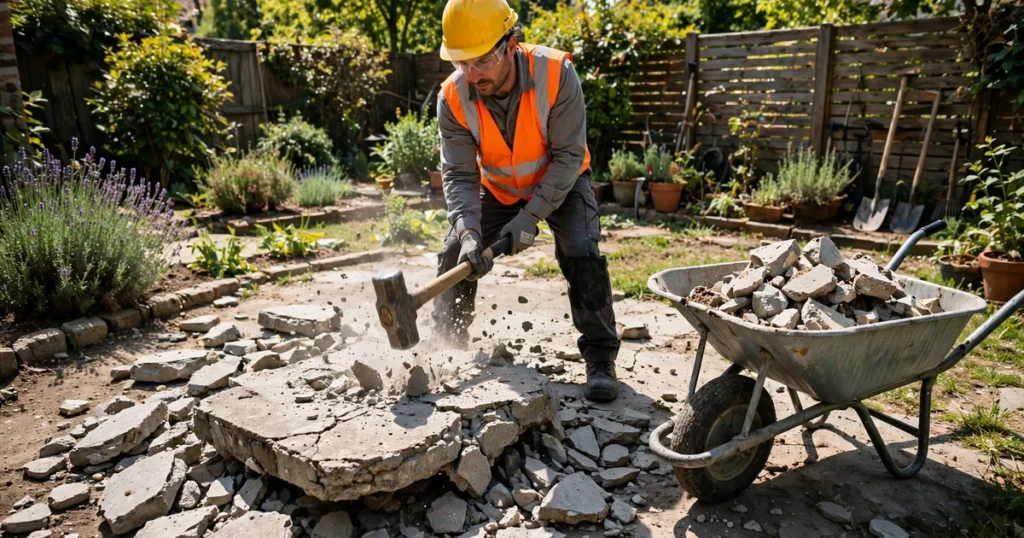
Old concrete does not leave quietly. It is heavy, dusty, and often tougher than it looks. A small patio can weigh several tonnes once broken up, and a driveway slab can hide steel mesh that holds every piece together. This guide shows you how to remove concrete safely, how to choose the right tool, and when to hire a pro instead.
Direct answer: Check thickness, size, and reinforcement first. Slabs up to 4 inches thick and smaller than about 300 square feet are often realistic DIY work with a sledgehammer and pry bar. Thicker, larger, or heavily reinforced slabs usually need an electric breaker or a contractor. Before you swing anything, check for buried utilities, plan disposal, and wear full protective gear.
Before you break anything
Measure the slab in several places. A slab that is 4 inches in the middle and 8 inches at the edge will behave like an 8 inch slab where it counts. Look for cracks and joints, and note where the slab meets a wall, a drain, or a foundation. Those junctions need care, because a careless blow can crack something you want to keep.
Call your local utility marking service before you dig or break near buried lines. In the United States this is 811. In other countries the service has a different name, so check your local authority. Also check local rules for work near a public footpath or road. A private patio is usually straightforward, but a driveway apron or pavement slab may need permission or a licensed contractor.
Plan disposal first. A cubic foot of concrete weighs about 140 to 150 pounds, so a 10 foot by 10 foot patio at 4 inches thick weighs well over 4,000 pounds. That weight decides whether you can haul loads in a trailer, need a skip, or should book a removal service. Ask your local recycling centre about weight limits and fees before work starts.
Safety gear and dust control
Concrete dust contains crystalline silica, which can harm your lungs when inhaled over time. Wear a properly fitted respirator rated for silica dust, sealed safety goggles, hearing protection for power tools, steel toe boots, gloves, and a hard hat if anything could fall or bounce. Keep children and pets away, and keep a first aid kit close by.
Wet the work area lightly to hold dust down. Take regular breaks and drink water. Most DIY injuries in this work come from fatigue, not from a single bad swing. Never force a breaker.
Choose the right tool for your slab
Tool choice follows thickness and size. A sledgehammer suits thin, unreinforced slabs. A breaker suits thick or stubborn slabs. A concrete saw suits clean cuts at edges. A pry bar suits every job, because lifting a broken piece creates the gap that lets the next blow work.
| Tool | Best for | Watch out for |
|---|---|---|
| Sledgehammer, 8 to 16 lb | Slabs up to 4 inches thick | Hard on shoulders and back |
| Electric breaker, 40 to 60 lb | Slabs over 4 inches, reinforced slabs | Heavy, loud, and tiring |
| Rotary hammer and chisel | Small areas and edges | Too slow for a full driveway |
| Concrete saw or grinder | Clean relief cuts | Dust and blade wear |
| Pry bar and digging bar | Lifting pieces for leverage | Pieces can slip |
Do a ten minute test before you commit. Strike near an edge or an existing crack with a sledgehammer. If the slab cracks and lifts in reasonable pieces, hand tools may carry the job. If ten minutes of solid work only chips the surface, rent a breaker or get a contractor quote.
Step by step: how to remove a concrete slab
1. Mark the area and cut relief lines
Mark the boundary with spray paint or chalk. If you are keeping part of the slab, cut a relief line along the keep line with a concrete saw. A cut 1 to 2 inches deep helps the break follow your line instead of wandering into the good section.
2. Start at an edge or a crack
Concrete breaks most easily where it is already weak. Start at a corner, an edge, or an existing crack. Dig a small void under the edge so the slab has somewhere to move. Strike about 6 inches from the edge, not in the middle of a solid section. Once a piece cracks free, pry it up and break it smaller.
3. Work in a grid and deal with steel as you go
Work across the slab in a steady pattern, breaking pieces roughly 12 to 18 inches across. When you meet wire mesh, cut it with bolt cutters as you lift each piece. When you meet rebar, cut it with a reciprocating saw fitted with a metal cutting blade. Do not leave sharp steel sticking out of rubble piles.
4. Haul, sort, and clear the base
Load rubble in small loads into a heavy duty wheelbarrow. Separate clean concrete from soil, wood, and metal where your disposal site asks for it. Recycled concrete is often crushed for road base or fill. Once the slab is gone, level the base and remove loose roots and soft spots.
How much does concrete removal cost
Published 2026 guides commonly put professional removal at about $2 to $6 per square foot. Small jobs often carry a minimum charge, and reinforced or hard to reach slabs cost more. A 200 square foot patio at that range would sit roughly between $400 and $1,200 before any replacement paving.
| DIY cost item | Typical guide range |
|---|---|
| Electric breaker rental | $60 to $120 per day |
| Hand tools if bought new | $75 to $200 total |
| Skip or dumpster rental | $300 to $600 |
| Self haul disposal fees | $30 to $60 per ton in many guides |
DIY is not automatically cheaper once rental, disposal, and your time are counted. For a large driveway the contractor price often includes the breaker, crew, haulage, and disposal in one figure. Get two or three quotes first.
When to hire a pro instead
Hire a contractor if the slab is thicker than 6 inches, if it is structural or post tensioned, if it sits over utilities you cannot confirm, or if it is tied into a foundation or a public pavement. Also hire help if the area is large, access is tight, or you doubt your fitness for heavy breaker work. When you replace the slab, many firms bundle removal into the new pour.
If you plan a new slab after removal, read our guide to slab thickness and how to cure concrete so the replacement lasts. Our slab replacement cost guide helps you budget the full job, not just demolition.
Common mistakes to avoid
- Starting in the middle of a solid slab instead of at an edge or crack.
- Skipping utility checks because the slab looks shallow.
- Breaking the whole slab before arranging disposal.
- Overloading a wheelbarrow or a skip and ignoring weight limits.
- Leaving cut mesh and rebar sticking out where someone can trip.
- Using a breaker for hours without breaks or a respirator.
Frequently asked questions
Can I remove concrete with a sledgehammer?
Yes, if the slab is up to about 4 inches thick and not heavily reinforced. Start at an edge or crack, use a pry bar for leverage, and break pieces small enough to lift safely.
How do I know how thick my slab is?
Look at an exposed edge or cut face. If none is visible, drill a small test hole at the edge and measure the depth. Check in more than one place, because thickness can vary.
Do I need a permit to remove concrete?
Private patios usually do not need one, but work on a driveway apron, kerb, or public footpath often does. Check with your local authority before you start.
What is the cheapest way to dispose of concrete?
Clean concrete taken to a recycling centre is often cheapest, and some centres accept it at a low fee. A skip is simpler but costs more.
Can I reuse broken concrete?
Yes, in limited ways. Clean rubble can work as hardcore under a new path or as buried fill. Do not use it as a structural base without proper compaction and advice.
How long does it take to remove a patio?
A small thin patio can take a day of steady work, including hauling. A larger or reinforced patio can take several days, and a driveway is normally a multi day job.
Conclusion
Removing concrete rewards planning more than strength. Check thickness, check utilities, and plan disposal before the first swing. Test with hand tools, switch to a breaker when needed, and cut steel as you go. If the slab is thick or structural, hiring a pro is sensible.
Sources
- Angi: How to Break Up Concrete
- This Old House: How To Break Up and Remove Concrete
- Engineer Fix: How to Remove a Concrete Slab
- Junk Guys: Concrete Removal Cost, Tools, and Expert Tips
- Angi: How Much Does Concrete Removal Cost?
About the author
Kaleemullah Formulas use standard geometry and published bag yields; sources are linked in each article.