
The finish you choose decides how concrete looks, how safe it feels underfoot and how easy it is to clean. Smooth trowel suits a garage, broom suits a driveway, and exposed aggregate suits a patio where looks and grip both matter. All three start the same way, then split at finishing.
Direct answer: After pouring, screed level, bull float, then wait until bleed water has left the surface. For a smooth trowel finish, hand float then steel trowel in overlapping arcs. For a broom finish, float lightly then drag a broom across the surface, across traffic. For exposed aggregate, spray surface retarder, then wash off the top paste after 12 to 24 hours to reveal stone. Cure the slab after finishing, and seal exposed aggregate as directed.
The shared first steps: screed, float, wait
Every finish begins with consolidation and levelling. Screed the concrete with a straight board across the forms to remove excess and set the level. Then use a bull float to push down coarse aggregate, fill low spots and bring up a workable paste layer. Work with the leading edge slightly raised so the float does not dig in.
Then wait. This is the step beginners rush. Bleed water must evaporate before floating and trowelling continue. Guides cite about 20 minutes to 4 hours, depending on temperature, humidity and wind. Finishing while bleed water is present weakens the surface. If a footprint leaves only a slight impression, the slab is close to ready.
Do not sprinkle dry cement or extra water on the surface to speed things up. Dry cement creates a weak dusty layer. Extra water weakens the top and increases dusting and scaling later. Patience at this stage protects every finish that follows.
Broom finish: the outdoor default
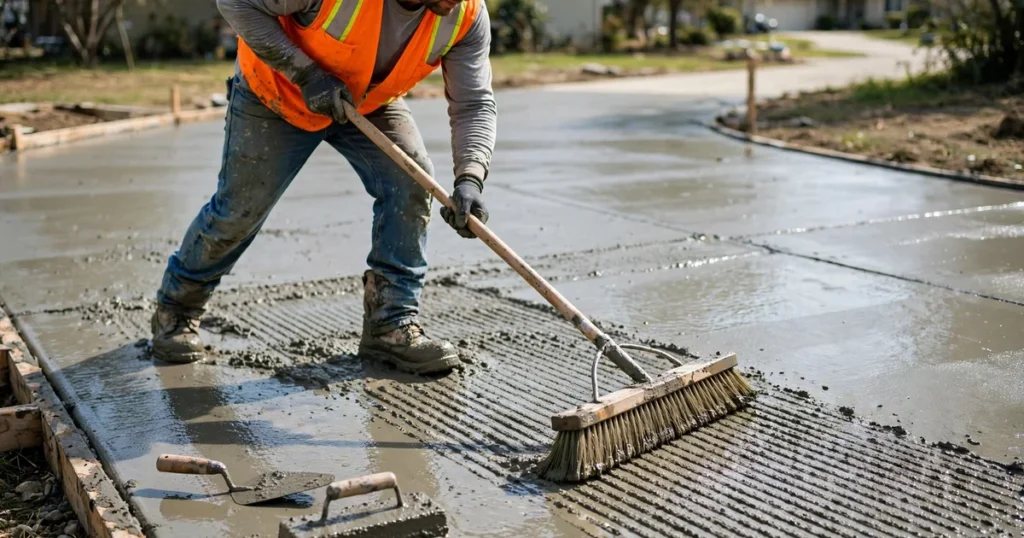
A broom finish is made by dragging a stiff broom across the surface after floating, and after a light trowel pass if the finisher prefers one. The bristles leave fine parallel ridges that give grip in rain. It is the standard finish for driveways, sidewalks, patios and pool surrounds, because it is cheap, durable and safe underfoot.
Broom across traffic, not along it. On a driveway, broom across the direction cars travel. On a path, broom across the walking direction. Ridges then act like tyre tread. Rinse broom bristles often so tips stay clean and lines stay even. Pull the broom toward you in straight, slightly overlapping strokes. Do not push it back and forth, as that tears the surface.
Texture can be tuned. A soft dry broom gives a light texture for a barefoot patio. A damp stiff broom gives a coarse texture for slopes. Broom too early and you tear the surface. Broom too late and ridges barely show. If the broom pulls up concrete, wait about 15 minutes and try again.
Smooth trowel finish: indoors and detail work
A smooth trowel finish is made with a steel hand trowel, or a power trowel on large floors, after the surface has partly hardened. The finisher works in broad sweeping arcs, overlapping each pass, holding the trowel nearly flat at first and adding pressure as concrete hardens. Repeated passes densify the surface and give a hard, smooth, easy to clean floor.
This finish suits interiors: garage floors, basements, warehouses and workshops. It is easy to sweep, it takes a sealer well, and it looks neat. It is a poor default outdoors. A smooth surface is slippery when wet, and dangerous on a slope or in ice. Over trowelling air entrained outdoor concrete can also damage the surface layer and lead to scaling in freeze and thaw weather.
Use a hand trowel for small slabs and edges, and a power trowel for large floors. Keep passes even. Burn marks from overworking one spot are hard to remove. For curing, see how to cure concrete and concrete drying and curing times.
Exposed aggregate finish: stone on show
Exposed aggregate reveals the stone in the mix by removing the top layer of cement paste. The result is textured, attractive and grippy, with colour and pattern from the stone itself. It suits driveways, paths and patios where appearance matters as much as safety.
Order the mix with decorative stone in mind. Some guides suggest ordering about 20 percent more stone than a standard mix for a seeded finish, or using a mix already designed for exposed work. After screeding and floating, spray surface retarder as soon as bleed water disappears. The retarder slows setting of the top paste only.
Wash off after about 12 to 24 hours, as directed on the retarder label. Use a hose and a soft broom at first, with gentle pressure washing only if needed, and work evenly so exposure depth stays consistent. Start gently. Aggressive washing dislodges stone and leaves pits. Once dry, seal the surface. Sealing deepens colour, protects stone and makes cleaning easier. One comparison guide cites resealing every 2 to 3 years, and an extra cost of about $2 to $5 per square foot over broom finish.
| Finish | Look and feel | Grip when wet | Best use | Upkeep |
|---|---|---|---|---|
| Broom | Fine parallel ridges | High | Driveways, paths, patios | Low, sweep and reseal if sealed |
| Smooth trowel | Dense, flat, smooth | Low | Garages, interiors, workshops | Low, easy to sweep |
| Exposed aggregate | Stone visible, textured | High | Driveways, patios, feature paths | Reseal every 2 to 3 years |
Choosing the right finish
Choose by location first, looks second. Indoors, choose smooth trowel. Outdoors on a budget, choose broom. Outdoors where looks and grip both matter, choose exposed aggregate. On a slope, avoid smooth trowel entirely. Around a pool, choose a finish with grip and avoid a surface that stays slick when wet.
Consider cleaning. Smooth floors sweep fast. Broom ridges collect dirt, but a hose clears them. Exposed aggregate needs sealing to stop stains. A coarse finish can feel harsh on bare feet, while a light broom suits a barefoot patio.
Budget also guides choice. Broom and smooth trowel cost similar for standard work, with smooth trowel sometimes slightly more for extra finishing time. Exposed aggregate costs more for stone, retarder, washing and sealing. Get that extra priced separately in a quote, so you can compare finishes fairly.
Mistakes that ruin a finish
- Finishing while bleed water is still on the surface.
- Adding water or dry cement to the surface to fix timing.
- Over trowelling outdoor air entrained concrete.
- Brooming along traffic instead of across it.
- Washing exposed aggregate too hard or too unevenly.
- Sealing before the slab is clean and dry.
- Skipping curing, which leaves a weak dusty surface.
Related choices affect the finish too. Slab thickness and joints must be right before finishing starts. See our concrete slab thickness guide, concrete control joint spacing and concrete sealer types guides, and avoid the errors listed in DIY concrete mistakes.
Tools for each finish
| Finish | Key tools |
|---|---|
| Broom | Float, stiff broom, edger, groover |
| Smooth trowel | Hand trowel or power trowel |
| Exposed aggregate | Surface retarder, hose, soft broom, sealer |
Frequently asked questions
When do I start finishing concrete?
After screeding and bull floating, wait until bleed water has evaporated. That takes about 20 minutes to 4 hours depending on weather. Finishing too early weakens the surface.
Can I broom finish a driveway myself?
Yes, for a small area, if you can screed, float and broom before the slab sets. Large driveways need a crew, as timing across the whole slab matters more than skill on one small patch.
Is a trowel finish slippery?
Yes, when wet. That is why it suits interiors and dry areas, not outdoor slopes, paths or pool surrounds. Add texture outdoors instead of relying on a smooth surface.
How do I get exposed aggregate without a retarder?
On small areas, you can brush and wash the top paste once the surface is firm enough not to dislodge stone. Retarder gives more even results on larger areas, so it is the usual professional method.
Do I need to seal a broom finish?
Not always. Sealing protects against stains and helps hold colour, but an unsealed broom finish still performs well. Exposed aggregate benefits more from sealing, as it protects paste and stone.
How long before I can walk or drive on a finished slab?
Walking is often possible after a day, but follow curing guidance and avoid heavy loads early. Driving should wait until the slab has gained strength, as directed by your contractor or mix guidance.
Conclusion
Finish choice is not decoration alone. It sets grip, cleaning and safety for the life of the slab. Wait for bleed water, finish at the right time, broom across traffic, trowel smooth only where it is safe, and wash exposed aggregate evenly. Do those steps well, cure the slab, and the finish will look good and last.
Sources
- Pro-Mix Concrete: How to Trowel Concrete
- Unicon: How to Finish Concrete
- Crafting With Concrete: Exposed Aggregate Sidewalk Guide
- Broom Finish vs Exposed Aggregate vs Smooth Trowel
- A1 Concrete: Types of Concrete Finishes
About the author
Kaleemullah Formulas use standard geometry and published bag yields; sources are linked in each article.