
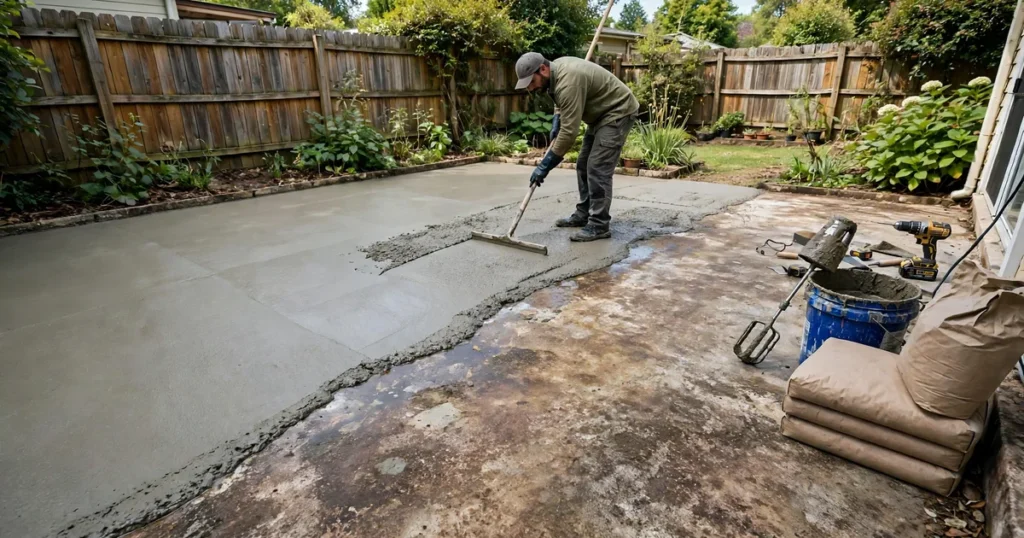
Skim coating is a thin cementitious overlay over sound concrete: a polymer-modified resurfacer for patios, paths and driveways, or a feather-finish compound for interior floors before new coverings. It is cosmetic renewal, not structural repair, and it is not waterproofing. The most common mistake is using the wrong product, and the worst advice online is to trowel drywall joint compound onto concrete. This guide shows the right product for each job, the prep that makes it bond, the coverage maths, and the weather and timing rules manufacturers specify.
What skim coating is (and is not)
A skim coat is a cement-based layer from a feather edge of 1/16 inch (1.6 mm) up to 1/2 inch (13 mm), bonded to an existing slab. It hides stains, minor damage and old finishes, and gives a fresh surface to walk on or build on. It adds no structural strength, bridges no moving cracks, and waterproofs nothing.
Only coat sound slabs: hairline cracks and worn surfaces are fine, but crumbling, heaving, rocking or moisture-damaged slabs are not, because reflective cracking returns through any overlay. Fix the underlying problem first, and use a self-levelling compound for badly uneven interior floors.
Pick the right product: skim coat is not one thing
This is where most DIY skim coats fail. These are different products for different jobs:
| Product type | Example | Thickness range | Use it for | Wear surface? |
|---|---|---|---|---|
| Polymer-modified concrete resurfacer | QUIKRETE Re-Cap | 1/16 in to 1/2 in | Patios, paths, driveways | Yes, once cured |
| Feather-edge smoothing compound | ARDEX Feather Finish | Feather edge to 3 mm | Interior floors before coverings | No, must be covered |
| Self-smoothing topping | ARDEX SD-T | 1/4 in to 2 in | Interior floors needing a new wearing layer | Yes, can be sealed and left |
| Self-levelling compound | Various | Per product | Uneven interior floors before coverings | Usually covered |
Match product to location: exterior work needs a resurfacer rated for outdoor exposure and traffic, while interior smoothing needs a feather-finish compound that goes on thin and flat. An interior compound on a patio guarantees failure.
Two popular claims you should ignore
The dominant advice site in this niche, ShunVogue, publishes auto-generated Q and A articles, and two of its claims need correcting:
Drywall joint compound does not belong on concrete. ShunVogue advises applying “all-purpose joint compound or drywall mud to the concrete surface”. Joint compound is gypsum-based, softens with water, and has no bond strength to concrete, so it fails outdoors and under traffic. Interior floors need feather-finish compounds, exterior slabs need polymer-modified resurfacers. Drywall mud is for drywall.
Skim coating does not waterproof or improve drainage. ShunVogue claims skim coating “extends their lifespan by improving drainage and waterproofing”. False. Skim coats are porous, drainage comes from falls and ground levels, and sealing adds stain and moisture resistance only. Never buy a skim coat expecting waterproofing.
ShunVogue also tells users to fill cracks with “a concrete and water mixture” and treats primer as optional. Weak site-mixed slurry is not a crack repair, and manufacturers agree that surface preparation is the decisive bonding step.
Step by step: skim coating a patio
This sequence follows QUIKRETE Re-Cap’s data sheet; other resurfacers vary, so read your product’s sheet first.
1. Prepare the surface (the step that decides everything)
- Pressure wash the slab; QUIKRETE specifies 2500 PSI for Re-Cap.
- Strip paint, grease, oil, sealers and loose material; resurfacer bonds to clean concrete, not old coatings.
- Fill hairline cracks with a proper concrete crack filler. Honour moving or wide cracks instead of hiding them; an overlay over a moving crack cracks in the same place.
- Grind high spots so coating thickness stays within the product’s range.
2. Mix correctly
- Mix only to the manufacturer’s ratio. ARDEX Feather Finish mixes 2 parts powder to 1 part water, with a 15-20 minute pot life.
- Never overwater to make spreading easier; it weakens the cured coat.
- Mix only what you can place within the working time.
3. Apply and finish
- First coat: squeegee at 1/16 to 1/8 inch, or trowel at 1/16 to 1/4 inch.
- Keep a wet edge so each pass blends into the last without seams.
- Broom finish when the surface is thumbprint hard: firm enough to hold a print, not so set the broom tears it.
- A second coat goes on within 24 hours of the first, total thickness at or under 1/2 inch.
4. Respect the weather and the clock
| Rule | Spec |
|---|---|
| Minimum application temperature | 50 F (10 C) for QUIKRETE Re-Cap; 5 C for ARDEX Feather Finish |
| Maximum application temperature | 90 F (32 C); finishing time shortens above this |
| Intercoat window | Second coat within 24 hours of the first |
| Walk on | 8 hours (Re-Cap); 2-3 hours at 70 F for ARDEX SD-T |
| Drive on | 24 hours (Re-Cap) |
Heat shortens working time, so mix smaller batches and work in the cool of the day. Cold below the minimum stops cement hydrating properly and leaves a weak coat. Seal exterior work once cured.
How many bags you need: coverage maths
Decide thickness first, divide area by coverage per bag, round up, and buy one extra bag for waste and thin spots.
| Product and bag | Thickness | Coverage per bag |
|---|---|---|
| QUIKRETE Re-Cap, 40 lb bag | 1/4 in | ~17 ft2 |
| QUIKRETE Re-Cap, 40 lb bag | 1/16 in | ~65 ft2 |
| ARDEX Feather Finish, 5 kg bag | 1 mm | 4.5 m2 (~22.5 m2 as scratch coat) |
Worked example: 10 x 12 ft patio (120 ft2)
At 1/16 inch: 120 / 65 = 1.85, so 2 x 40 lb bags. At 1/4 inch: 120 / 17 = 7.1, so 8 bags. UK: a 3 x 3.5 m patio is 10.5 m2; with ARDEX Feather Finish at 1 mm that is 10.5 / 4.5 = 2.4, so 3 x 5 kg bags, tripled at 3 mm. Run your own numbers with our concrete bag calculator, and check prep against the DIY concrete mistakes list first.
The honest limits of a skim coat
Competitors imply a skim coat equals a permanent new floor. The manufacturers are more honest:
- Thin repairs to sound concrete only. QUIKRETE positions Re-Cap for “thin repairs to sound concrete”; it renews the surface but cannot rescue a failed slab.
- Feather finish is not a wear surface. The ARDEX US data sheet states it is “not to be used as a permanent wear surface, even if coated or sealed”. It must be covered by a floor covering.
- Honour moving joints and cracks. Per ARDEX SD-T, moving joints and cracks must be carried up through the topping; burying an expansion joint just moves the crack somewhere more expensive.
- Expect reflective cracking eventually. Any crack still moving in the base slab will show through in time; a skim coat buys years of good appearance, not a lifetime guarantee.
- It is not waterproofing. Seal exterior work for stain and moisture resistance, but do not confuse a sealed skim coat with a waterproofing system.
FAQs
Can I skim coat over old concrete?
Yes, if structurally sound: no crumbling, heaving, rocking or moisture damage. Pressure wash, strip coatings and grease, repair hairline cracks, and grind high spots so the coat bonds to clean concrete.
Can I use drywall joint compound to skim coat concrete?
No. Joint compound is gypsum-based, softens with water and has no bond to concrete, so it fails outdoors and under traffic. Use a cementitious resurfacer outside and a feather-finish compound indoors.
How thick can a skim coat be?
QUIKRETE Re-Cap applies from a feather edge of 1/16 inch up to 1/2 inch total. ARDEX Feather Finish goes from a true feather edge to 3 mm in one application, or up to 12 mm built up in thin layers.
How long does a concrete skim coat last?
A well-prepared resurfacer on a sound slab lasts for years, but it is a renewal layer, not a new slab. Its life depends on prep, product, traffic, weather and whether moving cracks were honoured.
Can I skim coat an indoor floor before laying new flooring?
Yes, that is what feather-finish compounds are for. Smooth the floor, let it cure, then lay tiles, wood or vinyl over it. It is not a wear surface and must be covered.
Do I need to seal a skim-coated patio?
Yes for exterior work. Sealing adds stain and moisture resistance once cured, but does not make the slab waterproof or change its drainage.
Conclusion
Skim coating works when the slab is sound, the product matches the location, and the prep is thorough. Use a polymer-modified resurfacer for patios and driveways, a feather-finish compound for interior floors under new coverings, and never drywall mud near concrete. Do the coverage maths before buying, respect the temperature limits and 24-hour intercoat window, and be honest about the slab’s condition. A skim coat renews a good slab beautifully; it cannot save a bad one.
Sources
- QUIKRETE Re-Cap Concrete Resurfacer technical data sheet: https://cdn.littlehardware.com/items/docs/Quikrete_103028811_Specification_Sheet.pdf
- QUIKRETE Re-Cap application guidance, Lowe’s: https://www.lowes.com/collections/QUIKRETE-Repairing-Your-Driveway-Concrete-Resurfacer-Kit/GR_7120
- ARDEX Feather Finish specifications (UK): https://www.tilingsuppliesdirect.co.uk/product/ardex-feather-finish-smoothing-compound
- ARDEX Feather Finish US technical data sheet: https://unitisonline.com/Attachment/DownloadFile?downloadGuid=4684a772-1761-4f4c-9af5-805a0291047a
- ARDEX SD-T guide specifications: https://www.buildsite.com/pdf/ardex/ARDEX-SD-T-Guide-Specifications-2246313.pdf
Last verified: October 2026.
About the author
Kaleemullah Formulas use standard geometry and published bag yields; sources are linked in each article.