
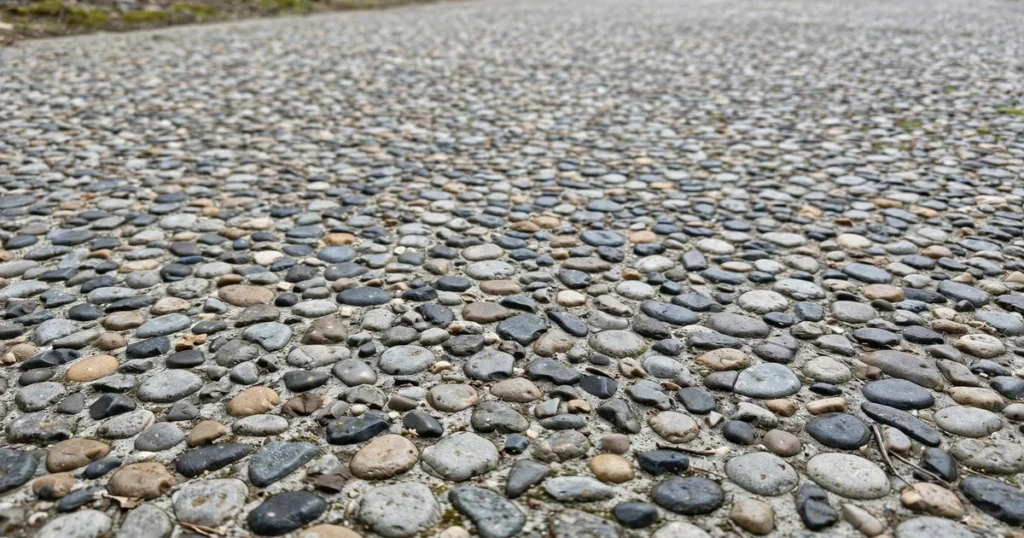
Exposed aggregate concrete is a decorative finish made by removing the thin surface layer of cement paste from a freshly placed slab to reveal the stone, pebbles or crushed rock within. In the US it costs about $8 to $12 per square foot installed, roughly $2 to $3 more than plain concrete. It is made in one of three ways, seeded, monolithic or topping, and the stone is revealed by washing, abrasive blasting or spraying a chemical retarder.
What is exposed aggregate concrete?
Normal concrete hides its aggregate under a smooth skin of cement paste. Exposed aggregate does the opposite. The top skin of paste is stripped away while the slab is still young, so the decorative stone becomes the wearing surface. The aggregate can be rounded river pebbles, crushed rock, recycled glass or even shells.
The textured surface grips better than smooth concrete, suiting pool decks, driveways and slopes. It hides tyre marks, road salt and dirt far better than a plain finish, wears harder than a paste surface, and costs less than full stamping or pavers. One design point: the surface is non-permeable, so falls and drainage must be designed in, with a proper slope away from buildings.
The three ways it is made
This is the heart of the topic, and most guides blur it. There are three production routes.
Seeded. Decorative aggregate is broadcast over the fresh slab after screeding, then floated into the surface. You get exactly the stone you chose, right on top.
Monolithic (integral). The decorative aggregate is batched through the whole mix, so the entire slab carries the same stone. This suits large pours needing uniform exposure.
Topping course. A thin decorative layer is placed over a base slab. This is the route for renovating a sound existing slab, because you do not need decorative stone through the full depth.
| Route | How it works | Best for |
|---|---|---|
| Seeded | Aggregate is broadcast onto the fresh surface and floated in | Patios and driveways where you want a specific stone on show |
| Monolithic | Decorative aggregate is mixed through the whole batch | Large pours needing uniform exposure through the depth |
| Topping course | A thin decorative layer goes over a base slab | Renovating a sound slab, or thin overlays |
The three ways the stone is revealed
Most guides mention only “washing off”. There are three exposure methods.
Washing and brushing. The oldest method. The surface mortar is washed and brushed away once the concrete has set just enough, when the mortar comes off without knocking the aggregate out. Timing-critical, and best for small projects.
Abrasive blasting. Sand or shot blasting removes the paste after the concrete hardens. It gives a uniform result but can fracture the aggregate, so avoid it where the decorative feature of the stone matters most.
Chemical surface retarder. The professional default for larger work. Retarder sprayed on the finished wet slab slows the surface set while the slab body hardens normally. The uncured paste is then washed off without dislodging the stone, often after the slab sits under plastic sheeting for around 24 hours. That extended wash window is why contractors prefer it on big pours.
Timing is the critical skill. Spray after bull floating, once bleed water has evaporated. The workable window is typically 6 to 24 hours depending on weather: wash too early and stones pull out, too late and they stay buried. The Deco-Crete Retarder F tech sheet gives verified numbers: about 150 square feet per gallon for a standard 1/8 inch etch, expose within 8 to 24 hours with a low-pressure hose and stiff broom, substrate between 40F and 80F, never over-force removal.
Step by step: how it is made
- Prepare the base. Compacted sub-base, formwork and reinforcement, exactly as for any quality slab. A decorative finish does not rescue a bad base.
- Pour, screed and bull float. Place the concrete, level it and float the surface.
- Seed the aggregate (seeded method only). Broadcast the stone evenly and float it in.
- Spray the retarder. After bull floating, once bleed water has evaporated.
- Wait. Typically 6 to 24 hours, depending on temperature and weather.
- Wash and brush. Remove the uncured paste with a low-pressure hose and stiff broom. Never force it.
- Cure and seal. Cure the slab properly, see our guide to how to cure concrete, then seal to protect the surface and enrich the colour.
One specification note: older guides call for a “six-bag mix”. That is bag-mix jargon for cement content, roughly 564 lb of cement per cubic yard. In modern terms, specify a strength grade instead, such as 4000 psi (C32/40), with aggregates meeting ASTM C33.
What it costs, honestly explained
Online figures look contradictory until you see they measure different things. Angi, updated July 2026, quotes $8 to $12 per square foot installed, about $2 to $3 more than standard concrete: a contractor price with labour, materials, margin and overhead in one number. HowMuch.net works up a 500 square foot job as materials at about $2.91 per square foot plus 32 hours of labour at $36 per hour, totalling about $6.29 per square foot ($3,145): a materials-plus-labour estimate with no contractor margin. Neither is wrong; they are different bases.
| Source | Figure | What it actually covers |
|---|---|---|
| Angi (2026) | $8 to $12 per sq ft | Installed contractor price, all in |
| HowMuch.net | About $6.29 per sq ft on a 500 sq ft job | Materials plus labour estimate, no margin |
| Markon Group (Australia, 2025) | $120 to $180 per m2 | Installed, varies with blend, access and thickness |
A 500 square foot driveway at $8 to $12 per square foot costs $4,000 to $6,000 installed. The premium over plain concrete is about $2 to $3 per square foot, roughly $1,000 to $1,500 extra. Check quantities with our concrete cost calculator and concrete cost per cubic yard pricing. For UK readers: we found no verified UK installed price, so get quotes from local suppliers and ask which aggregate blends they stock.
Pros and cons
Pros:
- Better slip resistance than smooth concrete, ideal for pool decks, driveways and slopes.
- Hides tyre marks, road salt and dirt far better than a plain finish.
- Hard wearing: exposed stone resists abrasion better than a paste surface.
- Cheaper than full stamping or pavers for a similar decorative effect.
Cons, stated honestly:
- Repairs usually show. Most guides imply repairs are simple. In practice the aggregate size, colour, exposure depth and sealer must all match, or the patch stands out. For large failures, cut out and replace a full panel between joints.
- It needs resealing every 2 to 4 years to hold its colour and protection.
- Drainage is on you. The surface is non-permeable, so falls must be designed in from the start.
- Not a forgiving first DIY pour. The wash timing is a genuine skill.
Maintenance and lifespan
Reseal every 2 to 4 years, about every 3 years per Angi. With a good base, reinforcement, correct jointing and a steady resealing rhythm, 25 plus years is realistic. On slip safety, the nuance most guides miss: the finish is usually less slippery than smooth concrete, but heavy wet-look sealers fill the texture and raise slip risk, so use a traction-preserving sealer on pool decks and driveways. In the UK, ask your supplier about freeze-thaw exposure classes and suitable aggregate.
FAQs
What is exposed aggregate concrete?
A decorative finish where the thin surface layer of cement paste is removed to reveal the stone, pebbles, crushed rock, recycled glass or shells embedded in the slab.
How much does exposed aggregate concrete cost?
About $8 to $12 per square foot installed in the US (Angi, 2026), roughly $2 to $3 more than plain concrete. Materials-plus-labour estimates run lower, near $6.29 per square foot, because they exclude contractor margin.
Can I do exposed aggregate as a DIY project?
Small areas, yes, with the wash and brush method, but the timing is critical and unforgiving. Wash too early and stones pull out; too late and they stay buried. Leave large driveways to contractors.
Is exposed aggregate slippery?
Usually less slippery than smooth concrete. The exception is heavy wet-look sealers, which raise slip risk. Use a traction-preserving sealer on pool decks and driveways.
How long does exposed aggregate concrete last?
25 years or more with a good base, reinforcement, correct jointing and resealing every 2 to 4 years.
Can exposed aggregate be repaired invisibly?
Rarely. Aggregate size, colour, exposure depth and sealer must all match, so patches usually show. For large failures, replace the full panel between joints.
Sources
- https://www.concreteideas.com/exposed-aggregate-concrete-finishes/
- https://conceptconcrete.com.au/blog/how-to-apply-exposed-aggregate-concrete-on-your-driveway/
- https://www.deco-cretesupply.com/sites/default/files/Retarder%20F%20Tech%20Sheet.pdf
- https://engineerfix.com/how-to-build-an-exposed-aggregate-patio/
- https://www.angi.com/articles/exposed-aggregate-concrete.htm?page=33
- https://howmuch.net/costs/exposed-aggregate-concrete-install
- https://www.markongroup.com.au/driveway-materials-that-last-exposed-aggregate-vs-pavers-vs-concrete
- https://civilengineeringdaily.com/exposed-aggregate-concrete/
Conclusion
Exposed aggregate earns its place on driveways and patios: better grip, a surface that hides daily wear, and a price below stamping or pavers. Respect the wash timing and the resealing rhythm. Budget $8 to $12 per square foot installed, and accept that repairs usually show.
Last verified: October 2026.
About the author
Kaleemullah Formulas use standard geometry and published bag yields; sources are linked in each article.