
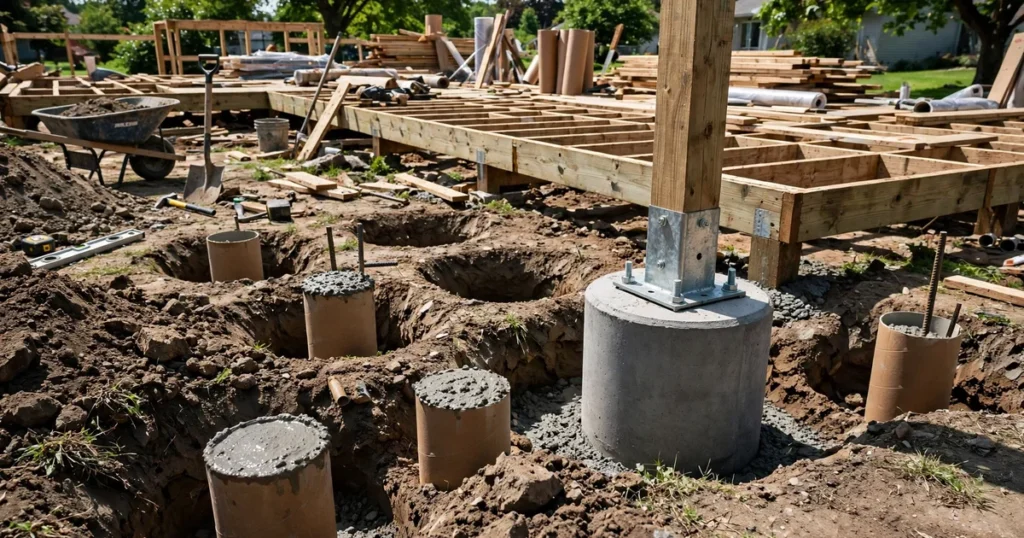
A deck is only as solid as what sits underneath it, so here is the direct answer. Deck footings should extend at least 12 inches below undisturbed soil, and the bottom of each footing should sit at least 6 inches below your local frost line. For sizing, a common rule of thumb is 1 inch of footing diameter for every foot of joist span, so a 10 foot span calls for roughly a 10 inch diameter pier.
Why Footing Depth Matters: Frost Heave
Soil holds water. When that water freezes it expands, pushing the soil upward. This is frost heave, and it can lift a shallow footing several centimetres in a single cold winter. Piers sunk below the frost line stay put because the frozen layer cannot get underneath them.
The 2021 International Residential Code (IRC) states it plainly: footings must bear at least 12 inches below undisturbed soil, and the footing bottom must sit at least 6 inches below the local frost line. In the UK, Approved Document Part A takes the same approach, requiring foundations below the depth of frost penetration on undisturbed, load-bearing ground. Frost lines vary enormously by region, so always check your local building code before you dig.
Frost Line Depth by Climate
The frost line is the deepest point that groundwater in the soil is expected to freeze in an average winter. It ranges from 12 to 18 inches in warm southern US states to 4 to 6 feet or more in the far north. The UK sees only shallow frost, but hard frosts can still shift poorly founded decks.
The table below gives broad frost-line bands by climate as a planning guide only. Your local building department or county code publishes the official frost depth for your area, and that is the number your footings must satisfy.
| Climate zone | Typical frost line | Suggested footing depth |
|---|---|---|
| Warm southern US (e.g. Florida, Gulf Coast) | 12 to 18 inches | 24 to 30 inches |
| Mid-latitude US and southern UK | 18 to 24 inches | 30 to 36 inches |
| Cool northern US (e.g. New York, Chicago) | 36 to 48 inches | 42 to 54 inches |
| Cold northern climates (e.g. Minnesota, Scandinavia) | 48 to 72 inches | 54 to 78 inches |
Never skimp on depth: digging an extra 6 inches is far easier than repairing a heaved deck.
How Wide Should Deck Footings Be?
Depth resists frost heave, but width carries the load. A footing spreads the deck’s weight over enough soil for the ground to support it. The 2021 IRC includes Table R507.3.1, which sets minimum footing sizes from the tributary area each footing supports, the live load, and the soil bearing capacity. Check it before you plan your layout.
For quick planning, builders use a rule of thumb: 1 inch of pier diameter for every foot of joist span, so a 10 foot span calls for a 10 inch pier and a 14 foot span for a 12 inch or larger pier. Longer spans load each footing more, so the footing needs more bearing area.
Cardboard tube forms, commonly called sonotubes, come in standard diameters that map neatly onto these sizes. The 10 inch and 12 inch tubes are the most common DIY choice, poured 3 to 4 feet deep depending on the frost line. In soft or sandy soil, bell out the bottom of the hole before setting the tube. A bell-shaped bottom adds bearing area and resists uplift at no extra cost but a little concrete.
How Much Concrete Does Each Footing Need?
Most DIY deck guides go vague here, so here is the maths. A cylindrical footing holds a volume of pi times radius squared times depth (V = pi r squared h). Divide that by the yield of a bag of concrete mix to get the bag count, then round up and add 10 percent for spillage and bell-shaped bottoms.
Standard bag yields are 0.60 cubic feet per 80 lb bag and 0.45 cubic feet per 60 lb bag. The table below calculates the most common sonotube sizes for a 4 foot deep pour, with the 10 percent contingency included.
| Tube diameter | Volume per 4 ft pour | 80 lb bags needed | 60 lb bags needed |
|---|---|---|---|
| 8 inches | 1.39 cubic feet | 3 bags | 4 bags |
| 10 inches | 2.18 cubic feet | 4 to 5 bags | 6 bags |
| 12 inches | 3.14 cubic feet | 6 bags | 8 bags |
Worked example: six 10 inch tubes poured 4 feet deep need 2.18 cubic feet per footing, or 13 cubic feet in total. At 0.60 cubic feet per 80 lb bag that is 22 bags before contingency, about 24 with it. Run your own numbers with our concrete bag calculator, and read concrete bags vs ready mix if the project grows past a dozen footings.
Post Base vs Buried Post: The Rot Trade Off
Once the piers are cured, connect the timber posts in one of two ways: a galvanised post base bolted to the pier top, or the post set directly into the ground with concrete packed around it.
- Post bases keep timber out of ground contact. The post sits a small distance above the concrete, air circulates around the end grain, and water drains away instead of pooling. Inspectors prefer this option, and it can add years to the life of the post.
- Buried posts are simpler to align and feel solid during construction. The trade off is moisture: timber touching soil or buried in concrete wicks up water and rots from the inside out. Buried posts must be pressure treated for ground contact, and they still die sooner than posts on bases.
Buried posts work for a while but rot first at the concrete interface. For a 20-year deck, spend the extra on post bases. Skipping them is one of the most common DIY concrete mistakes.
Do Deck Blocks Count as Footings?
Precast deck blocks sit on the surface and need no digging, which suits low, freestanding decks. But they do not meet code for attached or elevated decks in most areas: no frost protection, no uplift resistance, no bearing below disturbed topsoil. If the deck is attached to the house or rises more than a couple of feet, pour proper piers to the frost line.
Frequently Asked Questions
How deep should deck footings be in the UK?
UK regulations require foundations below the depth of frost penetration, on undisturbed soil. In practice that means well below the seasonal frost zone, typically at least 450 mm in the south and deeper in exposed northern areas. Confirm with your local building control office.
Can I pour deck footings in winter?
You can, but fresh concrete must stay above freezing for the first 24 to 48 hours and warm while it gains strength over the first week. Use insulated blankets and read our guide on how to cure concrete.
How many bags of concrete for one 12 inch sonotube?
A 12 inch diameter tube poured 4 feet deep holds about 3.14 cubic feet. At 0.60 cubic feet per 80 lb bag that is just over 5 bags, so buy 6 to cover spillage and a bell-shaped bottom. See our bags per cubic yard guide for the full yield table.
What is the 1 inch per foot rule for deck footings?
It is a builder rule of thumb: footing diameter should be roughly 1 inch for every foot of joist span. A 10 foot span suggests a 10 inch pier, a 14 foot span a 12 inch or larger pier. It is a planning shortcut only; the 2021 IRC Table R507.3.1 and your local code set the binding minimums.
Should I use 60 lb or 80 lb bags for footings?
Both work. The 80 lb bags give more concrete per bag (0.60 cubic feet versus 0.45), so there are fewer bags to haul and mix. The 60 lb bags are easier to carry. For a typical deck, the 80 lb bag is the better value and the standard choice.
How long should I wait before setting posts on new piers?
Wait 3 to 7 days before loading footings, depending on temperature. Concrete reaches roughly 70 percent of design strength in 7 days, and footings carry the whole deck. In cold weather, give them the full week or longer.
Conclusion
Get the depth right and the rest follows: 12 inches below undisturbed soil, 6 inches below the frost line, diameter sized by the 1 inch per foot rule of thumb, and bag counts worked out from the cylinder volume before you visit the merchant. Set posts on galvanised post bases, and the foundation will outlast the deck boards above it.
Sources
- IRC 2021 deck footing sizing, Table R507.3.1, cited at https://plasticinehouse.com/building-deck-footings/
- IRC footing depth rule (12 in below undisturbed soil, 6 in below frost line): https://plasticinehouse.com/building-deck-footings/
- Quikrete Concrete Mix data sheet 1101, bag yields, referenced at https://www.diyconcretecalculator.com/quikrete-calculator.html
- Sonotube bag table: https://plasticinehouse.com/how-many-bags-of-concrete-in-a-yard/
- Fine Homebuilding worked example, 8 piers: https://www.finehomebuilding.com/project-guides/decks/a-solid-deck-begins-with-concrete-piers
Last verified: October 2026.
About the author
Kaleemullah Formulas use standard geometry and published bag yields; sources are linked in each article.