
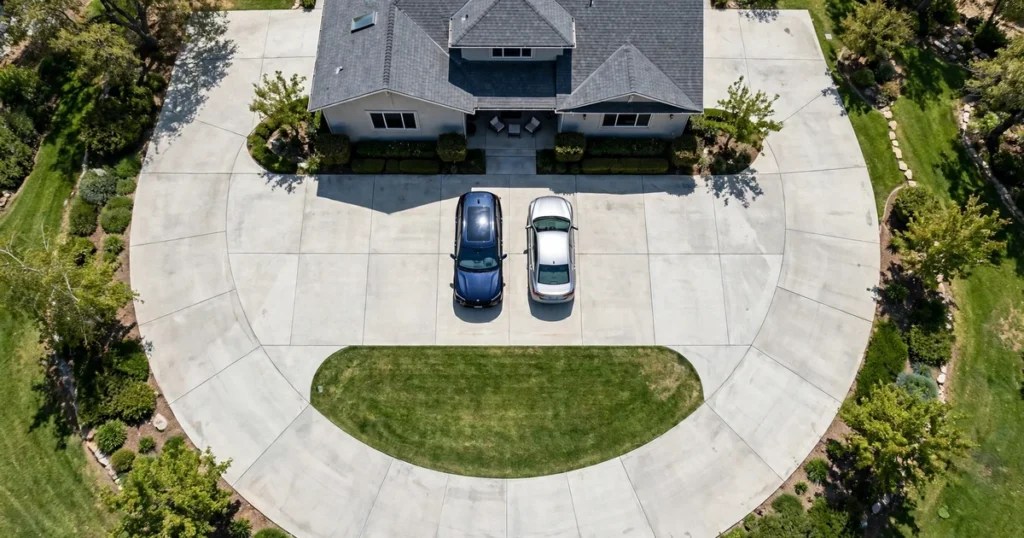
Driveway width is decided once and lived with every day. Too narrow, and every trip becomes a careful shuffle, doors hit walls, and tyres chew the lawn. Too wide, and you pay for concrete you do not need and lose garden or drainage space. This guide gives the standard widths for single, double, and three car driveways, plus turning space, so you can choose a width that works for your cars, your garage, and your street.
Direct answer: A single car driveway is normally 10 to 12 feet wide. A double car driveway is normally 20 to 24 feet wide, with 24 feet comfortable for two cars opening doors side by side. Allow 18 to 20 feet of length per car, add turning space if you face a busy road, and add 1 to 2 feet per side beside walls. Check local rules before you pour, because minimums vary by area.
Standard driveway widths at a glance
| Driveway type | Minimum width | Comfortable width |
|---|---|---|
| Single car | 9 to 10 feet | 12 feet |
| Double car | 20 feet | 24 feet |
| Three cars side by side | 30 feet | 36 feet |
| Circular driveway lane | 12 feet | 12 to 14 feet |
| Single car with walls both sides | 14 feet | 14 to 16 feet |
These figures come from several driveway guides, and they agree on the key point. Minimum width gets a car through. Comfortable width lets people get in and out, carry shopping, and open doors without damage. If you can only afford the minimum, be honest about the daily cost. A 10 foot single driveway works for a small car, but it feels tight for a large SUV, a child seat, or a wheelchair.
Single car driveways
A single car driveway at 10 feet lets most cars pass and park, but it leaves little room beside the car. At 12 feet you can open a door fully and step out onto concrete. That extra 2 feet also helps with bins and loading. If walls run along both sides, add 1 to 2 feet per side.
Length matters as much as width. Allow 18 to 20 feet per car so you can walk around the car and open a garage door without moving the car first. A short driveway that only just fits a car will block the footpath or force you to park partly on the road. Measure your longest vehicle, add walking room at each end, and use that total as your length.
Double car driveways
A 20 foot double driveway lets two cars pass and park, but it does not let two drivers open doors at the same time without care. At 24 feet, two cars can park side by side with door room on both sides and a walking gap between them. That is why 24 feet is the comfortable figure in most guides, even though 20 feet meets the minimum.
Match the driveway to the garage. A single garage normally pairs with a 10 to 12 foot driveway. A double garage normally pairs with a 20 to 24 foot driveway. A flare near the garage, where the driveway widens for a short length, can give door room without paving the full length at full width. That flare is a useful compromise on a narrow plot, but it must be wide enough to be useful, not just a token widening.
Turning space and turnarounds
Turning space is the part most plans miss. A car does not turn on the spot. It sweeps a path, and that path needs width. For most cars a comfortable inner turning radius is about 15 to 20 feet, with larger SUVs and pickups needing more. A curved driveway should be 2 to 4 feet wider than a straight one, so tyres stay on concrete through the curve.
| Turning layout | Typical size | When to use it |
|---|---|---|
| Single width turnaround | 10 feet wide by 14 to 20 feet deep | Busy road, long driveway, single car |
| Double width turnaround | 20 feet by 20 feet | Busy road, double driveway |
| Circular driveway | Lane 12 feet, outside about 24 to 28 feet | Large plot, two street entries |
| Hammerhead or T turnaround | Arms sized for one car turn | Garage at right angles to street |
A turnaround is most valuable on a busy road, where reversing into traffic is unsafe. On a quiet street, reversing out is normal and a turnaround may waste space. If you do add one, place it near the garage or parking area, not halfway down a long drive where it helps no one. Test the layout with your largest vehicle before you pour, by marking it with paint or cones and driving the turn slowly.
Layouts for real plots
Straight driveways suit most homes. They are simple, cheap to form, and easy to drain. Side loading garages need a wider apron, because the car must turn 90 degrees into the garage. Allow extra width and a gentle curve there, not a sharp corner.
Circular driveways suit large plots with two street entries. They let a car enter, loop past the house, and leave facing forward. They need a lot of land and two kerb crossings, so check local rules first.
Long driveways benefit from a passing place. A short widened section lets one car pull aside while the other passes. Place it where sight lines are clear, not on a bend.
Concrete specifics: thickness, joints, and cost
Width alone does not make a good driveway. A concrete driveway for cars is commonly 4 to 6 inches thick, with 5 to 6 inches preferred for regular car use and heavier vehicles. Thinner concrete cracks under repeated wheel loads, especially at edges and joints. Reinforcement with mesh or rebar helps, and control joints let the slab crack where you choose, not where it wants to.
Each extra foot of width adds area, concrete, and cost. A driveway 20 feet long and 12 feet wide is 240 square feet. Widening it to 14 feet adds 40 square feet, which at a plain installed rate of $6 to $12 per square foot adds roughly $240 to $480 before any extra base or edge work. That maths helps you judge whether comfort width is worth it. For thickness and joints, read how thick a driveway should be and control joint spacing. For budgeting, see cost per cubic yard.
Rules, drainage, and neighbours
Local rules often set minimum and maximum driveway width, kerb crossing width, and setback from boundaries. Some areas limit how much of a front garden can be paved, to protect drainage. Check those rules before you order concrete.
Plan drainage with width, not after it. A wider driveway collects more rain. Slope the surface away from the house toward a drain or permeable area, and avoid sending runoff onto a neighbour or footpath.
Common width mistakes
- Choosing minimum width for a large SUV or pickup and regretting it daily.
- Forgetting door swing room beside walls, fences, and other cars.
- Ignoring the turning path into a side loading garage.
- Building a turnaround too small to turn in, so it becomes dead paving.
- Pouring without checking local width and paving limits.
- Forgetting a walking route past a parked car to the front door.
Frequently asked questions
How wide should a single driveway be?
10 to 12 feet is standard, with 12 feet comfortable. Some areas allow 9 feet as a minimum, but that leaves almost no room beside the car.
Is 20 feet wide enough for two cars?
Yes for passing and parking, but tight for opening doors side by side. Choose 24 feet if you park two cars there every day.
How much turning space do I need?
A single width turnaround of about 10 feet by 14 to 20 feet suits most cars. A double width turnaround of 20 feet by 20 feet suits a double driveway.
Do I need a turnaround?
Not on a quiet street, where reversing out is normal. On a busy road or a long driveway, a turnaround lets you leave facing forward and is much safer.
Can I widen an existing concrete driveway?
Yes, but match thickness, base, and joints to the old slab, and check local rules. A poorly tied widening can crack at the joint or settle differently.
How wide should a circular driveway be?
The lane is normally about 12 feet wide, with outside dimensions of about 24 to 28 feet for the loop. Check that your plot and street entries can fit it.
Conclusion
Choose width by use, not by minimum. Start with 12 feet for one car and 24 feet for two, add room beside walls, add turning space where needed, and check local rules before you pour. A driveway that fits your cars and turning path will feel right every day.
Sources
- Angi: Driveway Width Guide
- Designing Idea: Driveway Dimensions
- Engineer Fix: How Wide Should a Driveway Be?
- Hunker: How to Size a Driveway
- Homepros: Is Your Driveway Wide Enough?
About the author
Kaleemullah Formulas use standard geometry and published bag yields; sources are linked in each article.