
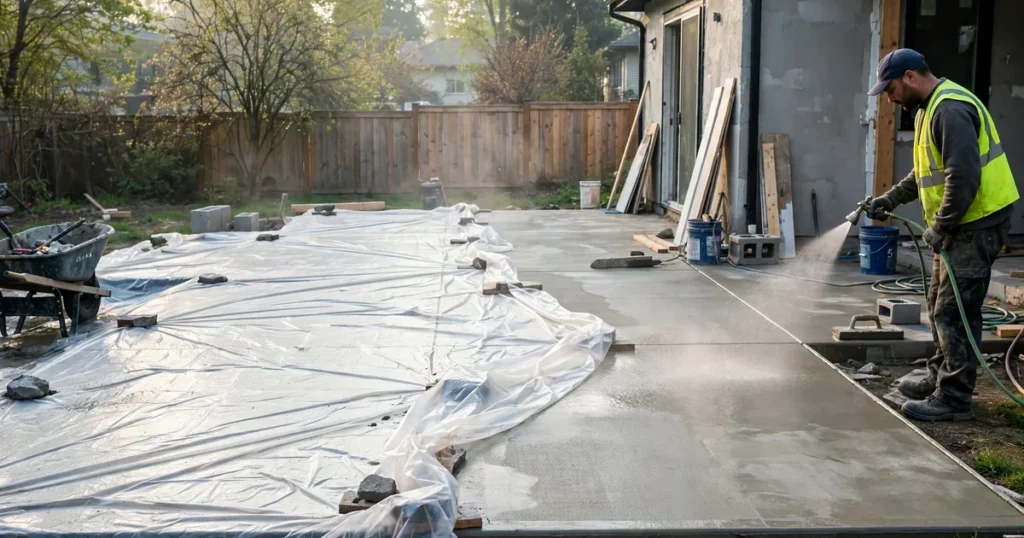
Curing concrete means keeping it moist and at a moderate temperature for at least 7 days after pouring so the cement fully hydrates. Keep the surface damp by misting or covering it with plastic sheeting or wet hessian, and avoid foot traffic for 24 to 48 hours. Concrete reaches about 70% strength at 7 days and full strength at 28 days.
Why Curing Matters
Curing is the chemical reaction between cement and water, called hydration. Without enough water, hydration stops. The concrete stays weak and cracks more easily.
Poor curing causes lower strength, surface cracking from rapid moisture loss, poor freeze resistance, and a shorter working life for the slab. Good curing costs almost nothing. It only takes a little time each day. Skipping it wastes the money you spent on the concrete itself.
What You Need
Gather your curing supplies before the pour, not after:
- A garden hose with a mist or shower setting (or a sprinkler on a timer)
- Your covering: plastic sheeting, hessian sacks, or a curing compound sprayer
- Timber, bricks, or soil to weigh down sheeting at the edges
- Insulating blankets if frost is possible
The 7-Day Curing Plan
Start curing as soon as the surface is firm enough to walk on without leaving marks. In warm weather this can be a few hours after pouring. In cool weather it may take a day.
Day 1: Get it covered
Apply your chosen method as soon as the surface sets. Do not let the surface dry out on the first day. This is the most critical day of all.
Day 2: Check and rewet
Check the moisture level. Rewet hessian, refill ponding, or re-spray curing compound if needed. Look for dry patches at edges and corners.
Day 3: Keep it consistent
Maintain the same moisture level. Edges dry faster than the centre, so pay them extra attention.
Day 4: Continue the routine
Concrete is still gaining strength rapidly. Keep water on it and keep the covering in place.
Day 5: Inspect the surface
Look for fine cracks (crazing), which appear when moisture was lost early. You cannot fix them now, but continued moisture still helps the concrete below.
Day 6: Prepare for normal use
Light foot traffic is fine on most slabs by now. Avoid heavy loads, vehicles, and dragging equipment.
Day 7: Finish the job
After 7 full days of moist curing, remove the coverings. The concrete has reached roughly 70% of its design strength. Avoid heavy point loads for another few weeks while it keeps hardening.
Strength and Access Timeline
When can you walk on it, drive on it, or build on it?
| Time after pouring | Strength (approx.) | What you can do |
|---|---|---|
| 24 to 48 hours | Low, surface still soft | Walk carefully in soft shoes |
| 3 days | Around 40% | Light foot traffic; keep curing |
| 7 days | Around 70% | Drive a car on driveways; start building |
| 28 days | Full design strength | Heavy loads, sealers, and finishes |
These are guidelines, not guarantees. Cold weather (see drying and curing times) slows everything down. When in doubt, wait longer.
Curing Methods Compared
Water curing (ponding)
Build small dams around the slab and flood it with a few inches of water. The most effective method, best for flat slabs with a water supply on site.
Wet hessian or burlap
Lay hessian over the concrete and keep it wet. Simple and cheap, but you must rewet it regularly or it stops helping.
Plastic sheeting
Cover the concrete and seal the edges with soil or timber. Cheap and low effort, but it can leave colour variations on the surface.
Curing compounds
Spray a liquid membrane that seals in moisture. Easiest for large areas, but it can interfere with paint or tile adhesion later, so check compatibility first.
Sprinklers or soaker hoses
Run a sprinkler or soaker hose on a timer. Avoid a strong jet that can erode the fresh surface.
Curing method comparison
| Method | Cost | Effort | Effectiveness | Best for |
|---|---|---|---|---|
| Ponding | Low | Medium | Excellent | Flat slabs and patios |
| Wet hessian | Low | High (rewet often) | Very good | Small slabs, footings, posts |
| Plastic sheeting | Very low | Low | Good | Most DIY slabs |
| Curing compound | Medium | Low | Good | Large areas, driveways |
| Sprinkler/soaker hose | Low to medium | Low | Very good | Automated curing |
| Insulating blankets | Medium | Low | Very good | Cold weather, frost protection |
How Often to Mist
If you water cure without a covering, mist the surface 5 to 10 times per day in hot or windy weather. The goal is continuous dampness. Letting the surface dry between soakings undoes the good work, because wetting and drying cycles damage young concrete.
In cool, damp weather, 2 to 3 times per day is enough. A simple routine works well: mist morning, midday, and evening, plus extra rounds in the hottest part of the day. A sprinkler on a timer removes the guesswork.
Weather Adjustments
Hot weather
Heat speeds up evaporation. Start curing sooner, sometimes within an hour of finishing. Use windbreaks, rewet more often, and pour early in the morning.
Cold weather
Keep concrete above about 5°C (40°F) while it cures; the ideal band is roughly 10 to 15°C. Cover with insulated blankets if frost is forecast. Protect fresh concrete from freezing for at least the first 48 hours, until it has gained enough strength (commonly cited as about 500 psi), and keep it above 5°C (41°F). UK autumn and winter pours need frost protection as standard. Extend curing beyond 7 days in cold spells, because cold slows strength gain.
Windy weather
Wind dries the surface fast and causes plastic shrinkage cracks. Cover the concrete immediately after finishing, even on mild days.
Rain
Light rain after the surface has set is harmless, even helpful. Heavy rain in the first few hours can wash out cement paste and weaken the surface. Cover the slab if a downpour is likely.
Curing vs Sealing: Do Not Confuse Them
Curing builds strength. Sealing protects the surface. They are different jobs, and the order matters.
Cure first: keep the concrete moist for 7 days so it reaches roughly 70% strength. Seal much later: wait about 28 days before applying a concrete sealer. Sealing too early traps moisture inside, which can make the sealer peel or blister. Rule of thumb: cure at 7 days, seal at 28 days.
Mistakes to Avoid
- Letting the surface dry out. Even one dry day early on permanently weakens the top layer.
- Alternate wetting and drying. Soaking, drying, then soaking again damages young concrete. Keep moisture continuous.
- Walking on it too early. Footprints in soft concrete are permanent.
- Stopping after 2 to 3 days. Short curing leaves a dusty, weak surface. Go the full 7 days.
- No frost protection. Fresh concrete that freezes can spall and fail.
- Sealing before 28 days. Trapped moisture ruins sealers and damages the surface.
FAQ
How often should I water new concrete?
Mist it 5 to 10 times per day in hot or windy weather for the first 7 days. In cool, damp weather, 2 to 3 times per day is enough. Aim for continuous dampness, never a full dry out between waterings.
Can you overwater concrete while curing?
Once the concrete has set, extra surface water does little harm, but a strong jet can erode the finish. The real danger is wetting and drying cycles. Keep it steadily moist, not alternately soaked and dry.
Can I walk on concrete while it is curing?
Light foot traffic is fine after 24 to 48 hours, once the surface is firm enough to walk on without marking. Wear soft shoes. Avoid dragging tools across it for the full 7 days.
Can you drive on concrete after 5 days?
It is risky. Concrete is only around half strength at 5 days. Wait the full 7 days before driving onto a driveway, and longer in cold weather. Heavy vehicles should wait closer to 28 days.
When should I seal concrete after pouring?
Wait about 28 days. The concrete needs full strength and must release its internal moisture first. Sealing too early traps water under the sealer, causing peeling and blistering.
What if it rains after I pour concrete?
Light rain after the surface has set is harmless and even helps curing. Heavy rain in the first few hours can wash cement paste out of the surface and weaken it. Cover the slab with plastic sheeting if a downpour is likely.
Conclusion
Curing is the cheapest part of any concrete job and one of the most important. Keep new concrete moist for 7 days, adjust for the weather, and you will get a stronger slab with fewer cracks. Plan your curing method before you pour, not after.
Related guides: For full timelines, see our concrete drying and curing times guide. The mix you use matters too, see our 1:2:4 mix ratio explained.
Sources: Cold-weather concreting guidance per ACI 306R Guide to Cold Weather Concreting.
About the authorKaleemullah Formulas use standard geometry and published bag yields; sources are linked in each article.