
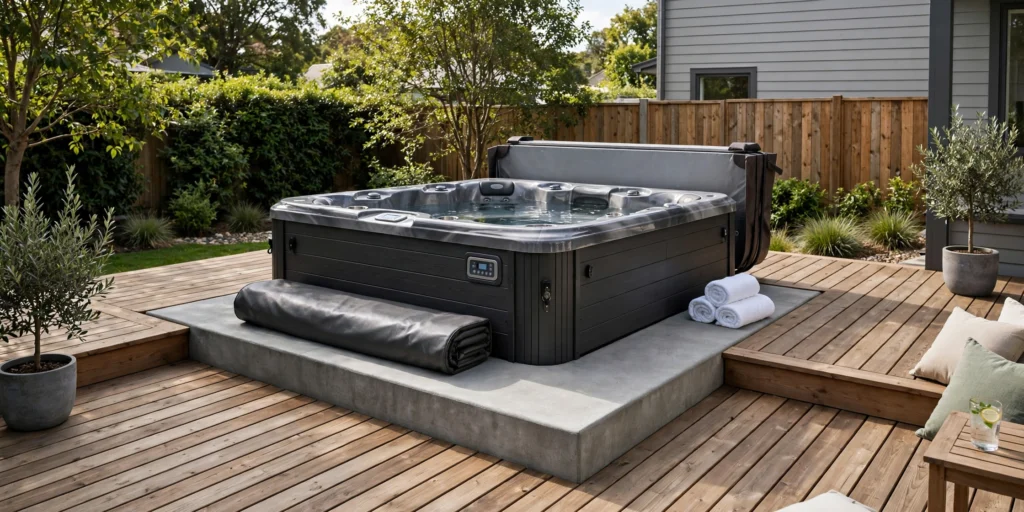
Four inches of reinforced concrete is the minimum thickness for most residential hot tubs. If the tub is large, the soil is soft, or the site is uneven, go to six inches. The slab must be reinforced with rebar or welded wire mesh, it must sit on a compacted base, and the pad should extend at least six inches beyond the tub footprint on all sides. Concrete needs time to gain strength before you place the tub: allow at least seven days, ideally longer. Follow your tub manufacturer’s guidance, because some specify their own base requirements.
Why four inches is the minimum
A filled hot tub is a heavy load in a small area. A typical two or three person spa holds a few hundred gallons of water at about 8.34 pounds per US gallon, plus the tub shell, equipment and the people inside. The total easily reaches several thousand pounds on a footprint of roughly fifty to seventy square feet.
A four inch slab spreads that load over the ground below. Steel rebar or welded wire mesh embedded in the slab handles the tensile stresses that make unreinforced concrete crack. An unreinforced slab under a heavy, constantly loaded tub is a cracking risk, which is why every reputable guide specifies reinforcement. Our slab thickness guide explains how thickness and reinforcement work together on general slabs.
Four inches is a minimum, not a target to aim below. Some manufacturers specify their own pad requirements in the owner’s manual, and those take priority.
When to pour six inches instead
Six inches is the sensible choice in several situations. Large tubs: spas seating six or more people, or models with heavy features such as stone cladding, put substantially more load on the pad. Soft ground: clay, fill or uncompacted soil settles unevenly under heavy load, and a thicker slab bridges minor settlement better. Swim spas: longer and heavier, they are treated as small pools, with six inches as the starting point.
Thicker concrete also gives the reinforcement better cover and increases stiffness, which reduces the flex that causes surface cracking. The extra material cost is modest: moving from four to six inches adds fifty percent more concrete.
| Situation | Recommended thickness | Reinforcement |
|---|---|---|
| Standard residential tub, firm undisturbed ground | 4 inches | Welded wire mesh or rebar grid |
| Large tub (6+ seats) or heavy features | 6 inches | Rebar grid, typically 12 inch centres |
| Soft, clay or recently disturbed soil | 6 inches | Rebar grid on a well compacted sub-base |
| Swim spa | 6 inches minimum | Rebar grid; consider professional design |
Reinforcement is not optional
Whether you pour four inches or six, the slab must contain steel. For most hot tub pads, welded wire mesh placed at mid-depth works well on four inch slabs. For six inch slabs and larger tubs, a rebar grid is stronger, commonly with bars at twelve inch centres in both directions.
Hold the steel at mid-depth on chairs or dobies so it does not sink to the bottom of the pour. Steel lying on the ground does almost nothing and can corrode. Overlap mesh sheets by at least six inches.
Preparing the base
The concrete is only as good as what it sits on. Remove topsoil, grass and organic material down to firm ground. Add a sub-base of compacted crushed stone or gravel, typically four to six inches thick, compacted in layers with a plate compactor. The sub-base spreads the load, improves drainage and gives the concrete a stable platform.
Compaction is the step most DIY jobs skip, and it prevents settlement cracking later. Walk on the compacted base: it should feel firm underfoot. If your heel sinks in, compact more.
Pad size, level and drainage
The pad should extend at least six inches beyond the tub footprint on all sides. This gives a margin for the tub’s actual delivered dimensions and a stable working edge around the spa. Mark the tub’s actual footprint before you form up.
The area under the tub must be level. A tilted pad gives an uneven waterline and uneven loading that is bad for the shell. Check across the forms with a long spirit level or a laser level.
Drainage matters around the pad, not under it. Give surrounding paving a slight fall of about one quarter inch per foot away from the pad and nearby structures. Keep the pad itself level; do not build the fall into the tub surface.
Let the concrete cure before placing the tub
This is the step people rush. Fresh concrete keeps gaining strength for weeks, so wait at least seven days before placing a hot tub on a new pad, and longer in cold weather. Many guides advise waiting until the concrete has gained good strength, with longer preferred for heavy loads.
Also follow the tub manufacturer’s guidance: some manuals specify a minimum curing period, and the warranty may depend on it. Filling a tub on green concrete risks surface damage and settlement that shows up months later.
How much concrete you need: worked examples
Two common pad sizes cover most residential hot tubs. Volume in cubic feet equals length times width times thickness in feet; divide by 27 for cubic yards. An 80 lb bag yields about 0.60 cubic feet, so divide cubic feet by 0.60 and round up. These examples add no waste allowance; add five to ten percent or round up generously.
8 ft by 8 ft pad at 4 inches thick: 8 x 8 x (4/12) = 21.33 cubic feet (0.79 cubic yards). Bags: 21.33 / 0.60 = 35.6, so 36 bags of 80 lb mix.
8 ft by 8 ft pad at 6 inches thick: 8 x 8 x (6/12) = 32.00 cubic feet (1.19 cubic yards). Bags: 32.00 / 0.60 = 53.3, so 54 bags of 80 lb mix.
10 ft by 10 ft pad at 4 inches thick: 10 x 10 x (4/12) = 33.33 cubic feet (1.23 cubic yards). Bags: 33.33 / 0.60 = 55.6, so 56 bags of 80 lb mix.
10 ft by 10 ft pad at 6 inches thick: 10 x 10 x (6/12) = 50.00 cubic feet (1.85 cubic yards). Bags: 50.00 / 0.60 = 83.3, so 84 bags of 80 lb mix.
| Pad size | Thickness | Volume (yd³) | 80 lb bags |
|---|---|---|---|
| 8 ft x 8 ft | 4 in | 0.79 | 36 |
| 8 ft x 8 ft | 6 in | 1.19 | 54 |
| 10 ft x 10 ft | 4 in | 1.23 | 56 |
| 10 ft x 10 ft | 6 in | 1.85 | 84 |
For any other pad size, run the numbers through the slab concrete calculator on this site. If you are pouring for a standard 10×10 slab, that guide gives a fuller breakdown of volume, bags and ready-mix options.
FAQs
Can I put a hot tub on an existing patio slab?
Often, yes, if the slab is at least four inches thick, reinforced, level, in good condition and on stable ground. Check for cracks, settlement or hollow spots. If the patio is unreinforced, thin or badly cracked, pour a dedicated pad.
Do I need rebar or is wire mesh enough?
For a standard four inch pad under a normal residential tub, welded wire mesh is widely accepted. For six inch slabs, larger tubs, soft soil or swim spas, a rebar grid gives more strength and is the better choice. Either way, the steel must be held at mid-depth, not left lying on the ground.
How long should I wait before filling the hot tub?
Wait at least seven days after pouring before placing the tub, and longer in cold weather. This gives the concrete time to gain good strength before taking the full weight of water, equipment and bathers. Check the tub manufacturer’s manual, which may specify its own minimum curing period.
Can I place a hot tub on gravel or pavers instead?
Some manufacturers approve compacted gravel pads or reinforced paver systems, but requirements vary by model. Check your tub’s manual first. Concrete remains the most common option and is what most warranties assume.
Should the pad slope for drainage?
No. The tub surface should be level so the waterline is even and the load is uniform. Build the fall, about one quarter inch per foot, into the surrounding paving instead.
How many bags of concrete do I need for an 8×8 hot tub pad?
At four inches thick, an 8×8 foot pad needs about 0.79 cubic yards, which is 36 bags of 80 lb mix. At six inches it needs about 1.19 cubic yards, or 54 bags. Add five to ten percent for waste.
Conclusion
Four inches of reinforced concrete on a compacted base is the minimum for most residential hot tubs; six inches is the right call for larger tubs, soft soil and swim spas. Extend the pad at least six inches beyond the tub, keep the surface level, drain the surrounding area, and give the concrete at least seven days before the tub goes on. Do those things and the pad will outlast the tub.
About the author
Kaleemullah Formulas use standard geometry and published bag yields; sources are linked in each article.