
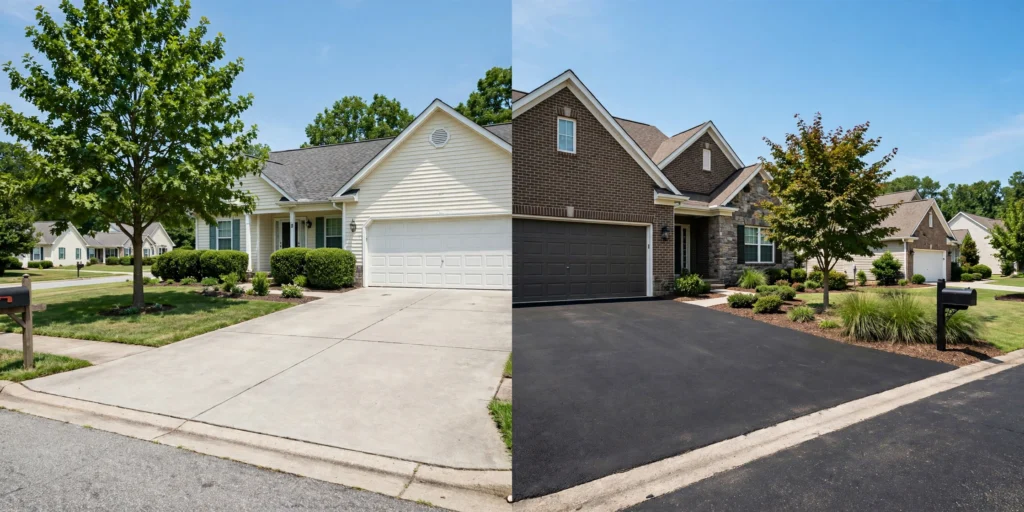
Concrete and asphalt are the two most common driveway materials, and the honest answer to which costs less is: asphalt usually costs less to install, but concrete often costs less over the life of the driveway. US cost guides (such as HomeGuide and DIYCalc) put installed asphalt at roughly $7 to $15 per square foot and installed concrete at roughly $8 to $18 per square foot. Those are US figures. In the UK, driveways are priced per square metre and prices vary a lot by region, so always get local quotes before budgeting. Asphalt typically lasts 15 to 25 years and needs resealing every few years. Concrete typically lasts 25 to 50 years with far less routine maintenance. The rest of this guide breaks down installation cost, lifetime cost, maintenance, climate suitability and appearance, so you can pick the right material for your budget and your climate. Unlike some comparison pages that quote a single price as if it applied everywhere, every figure here is a range, because real quotes move up or down with the job.
How installed costs compare
Installation is the number you will see on the quote, and here asphalt almost always wins. Published US guides put asphalt at roughly $7 to $15 per square foot installed, while concrete runs roughly $8 to $18 per square foot installed. Concrete costs more for two reasons: the material itself is more expensive, and the work is more labour intensive. A concrete driveway needs formwork, careful levelling, pouring, finishing and curing. Asphalt is laid hot with a paving machine and can be driven on within a day or two, which keeps labour costs down.
What moves a quote toward the top or bottom of those ranges:
- Ground preparation. Excavation, sub-base and drainage can cost as much as the surface itself on a difficult site.
- Thickness. A thicker layer costs more but lasts longer.
- Site access. Tight access for lorries and machinery pushes labour costs up.
- Finishes. Stamped or coloured concrete narrows the price gap with asphalt.
- Location. Rates differ sharply by region, so US per-square-foot figures do not translate directly to UK per-square-metre quotes.
But installed price is only part of the story. The table below compares the headline figures from published cost guides, with the arithmetic checked in every row.
| Factor | Asphalt | Concrete |
|---|---|---|
| Installed cost (US guides, per sq ft) | Roughly $7 to $15 | Roughly $8 to $18 |
| Typical lifespan (US guides) | 15 to 25 years | 25 to 50 years |
| Routine maintenance | Sealcoating every 3 to 5 years | Occasional sealing; far less routine work |
| Usable after installation | Usually 1 to 3 days | Usually 7 days for vehicles (cured longer for full strength) |
| Appearance options | Plain black surface | Stamping, colour, exposed aggregate finishes |
What a 600 square foot driveway costs in practice
Here is what a typical two-car driveway of about 600 square feet (roughly 56 square metres) costs using the US guide figures. These are indicative US figures, not quotes; UK prices differ by region. Our concrete calculator can help you work out the concrete volume for a driveway slab of any size.
| Material | Low estimate | Mid estimate | High estimate |
|---|---|---|---|
| Asphalt (600 sq ft) | $4,200 | $6,600 | $9,000 |
| Concrete (600 sq ft) | $4,800 | $7,800 | $10,800 |
| Difference (concrete minus asphalt) | $600 | $1,200 | $1,800 |
The gap at installation is real but modest. Over time it reverses: asphalt needs resurfacing or replacement after 15 to 25 years, while the concrete driveway next door may still be in service.
Lifetime cost: where concrete catches up
Total cost of ownership is what matters for a driveway you plan to keep for decades. Asphalt’s maintenance cycle looks like this:
- Sealcoating every 3 to 5 years. The main recurring cost. Without it, sun and water break the surface down much faster.
- Crack repairs. Cracks need filling before they spread, especially at edges and where water pools.
- Resurfacing or replacement. After 15 to 25 years, most asphalt driveways need a new surface layer or a full replacement.
Concrete’s maintenance list is shorter:
- Occasional sealing. An optional reseal every few years protects against stains, but skipping it does not destroy the surface the way skipping sealcoating damages asphalt.
- Crack sealing. Concrete cracks less often, and joints (saw cuts) control where cracks form.
- Spot repairs. Individual panels can sometimes be replaced without redoing the whole driveway.
Because asphalt needs resurfacing sooner, the total cost over 30 to 40 years can end up similar for both materials, and sometimes concrete works out cheaper. If you plan to move within five years, asphalt’s lower installation cost is attractive. If this is your long-term home, concrete’s longer life usually wins on value.
Climate: pick the material that suits your weather
Climate matters more than the price difference: the two materials behave very differently with temperature.
| Climate | Asphalt | Concrete |
|---|---|---|
| Hot climates (long hot summers) | Can soften and rut under parked cars; surface can get sticky | Stays rigid in heat; lighter colour reflects more sunlight |
| Cold climates (hard freezes, freeze-thaw cycles) | Flexes with ground movement; resists cracking from heaving | Can crack from freeze-thaw unless properly mixed and installed; needs air entrained concrete in frost zones |
| Mild temperate climates | Performs well with regular sealing | Performs well; longest realistic lifespan |
The simple version: hot climate, lean concrete. Cold climate with deep frost, asphalt’s flexibility is an advantage, although well-built air entrained concrete with good drainage also survives freezing well. In the UK’s mild temperate climate, either material performs, so cost and appearance decide it.
Appearance and property value
Concrete offers far more choice. Asphalt comes in one colour: black. Concrete can be:
- Stamped to mimic stone, brick or slate patterns
- Coloured with integral pigments or stains
- Finished with exposed aggregate for a textured, decorative surface
- Brushed for a clean, modern plain finish
Decorative options add cost, sometimes a lot, so they narrow or erase concrete’s installation price gap. A tidy driveway of either material beats a cracked one of the other for kerb appeal.
Installation time and disruption
Asphalt wins on speed. A typical residential asphalt driveway is laid in one to two days and takes vehicle traffic within a day or two. Concrete takes longer: forming, pouring and finishing take two to three days, then the slab needs around seven days before vehicles should drive on it. If you need the driveway usable fast, asphalt is the practical choice. Before deciding, it also helps to understand concrete cost per cubic yard and how ready-mix pricing works.
Repair and recycling
Repairs differ in character. Asphalt cracks are patched or sealcoated and blend in reasonably well because the whole surface is uniform black. Concrete patches are usually visible as colour differences unless the slab is resurfaced or coated. Both materials are recyclable: reclaimed asphalt is widely reused in new paving, and crushed concrete is reused as aggregate and fill. For small patch jobs, weigh up concrete bags vs ready-mix when estimating the material cost.
Frequently asked questions
Is concrete or asphalt cheaper for a driveway?
Asphalt is usually cheaper to install: roughly $7 to $15 per square foot against roughly $8 to $18 for concrete in US guides. Over 25 years or more the total cost can be similar, because asphalt needs sealcoating every few years and resurfacing sooner. UK readers should get local quotes, since UK pricing is per square metre and varies by region.
How long does an asphalt driveway last?
Published guides typically cite 15 to 25 years for a residential asphalt driveway with regular sealcoating and repairs. Without sealcoating, the surface breaks down faster. A concrete driveway typically lasts 25 to 50 years with far less routine maintenance.
Which driveway is better for a cold climate?
Asphalt flexes with freeze-thaw ground movement, so it suits regions with hard winters. Air entrained concrete, properly jointed and well drained, also survives cold climates well.
Which driveway is better for a hot climate?
Concrete. Asphalt can soften, rut under parked cars and turn sticky in prolonged heat, while concrete stays rigid and its lighter colour reflects more sunlight.
Can you get a decorative asphalt driveway?
Very limited. Asphalt is essentially black, though specialist stamping or colouring exists at extra cost. Concrete offers stamping, colour, exposed aggregate and brushed finishes, all at a higher price.
How much maintenance does a concrete driveway need?
Much less than asphalt. Most concrete driveways need only occasional crack sealing and an optional reseal every few years for stain protection. Asphalt needs sealcoating every 3 to 5 years plus crack filling, and a resurface or replacement after roughly 15 to 25 years.
Conclusion
There is no universal winner, only the right choice for your situation. Choose asphalt for the lowest installation cost, the fastest job and a surface that tolerates freeze-thaw movement. Choose concrete for the longest service life with the least maintenance, for hot climates, or for decorative finishes and kerb appeal. Get at least three local quotes for both materials, ask about ground preparation and drainage, and weigh the 25-year cost, not just the quote in front of you.
About the author
Kaleemullah Formulas use standard geometry and published bag yields; sources are linked in each article.