
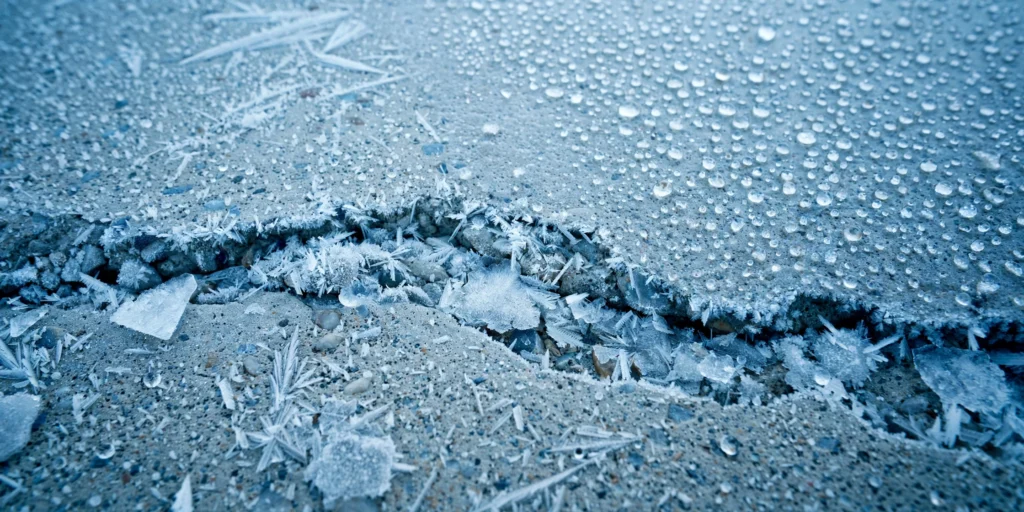
Air entrained concrete is ordinary concrete with millions of tiny, evenly spaced air bubbles mixed into it. Those bubbles are the whole point: when water trapped in the concrete freezes and expands, the bubbles give the ice somewhere to go, which protects the surface from cracking, scaling and flaking. It is the standard choice for any exterior concrete exposed to frost, including driveways, paths and patios. In short: it contains roughly 4 to 8 percent air by volume, is made by adding an air-entraining admixture, slightly reduces strength (mixes are adjusted to compensate), and any ready-mix supplier can provide it on request.
How air entrainment works
Concrete always contains some trapped air, but those are large, random voids that weaken the mix. Air entrainment is different. An air-entraining admixture (AEA), a chemical added at the batching plant, creates a system of microscopic, evenly distributed bubbles, typically between 10 and 1,000 micrometres across. The bubbles are so small you cannot see them with the naked eye.
The mechanism is simple. Hardened concrete is porous and holds a small amount of water. When that water freezes, it expands by about 9 percent. With nowhere to go, the expanding ice builds pressure inside the concrete, and over repeated freeze-thaw cycles that pressure cracks the surface, causing scaling (the top layer peeling away in flakes) and map cracking. The entrained bubbles act as tiny pressure-relief chambers: ice expands into the nearest bubble instead of splitting the concrete around it.
Fresh air entrained concrete is also more workable and cohesive at the same water content, and it bleeds and segregates less, which is why some specifications call for it even where frost is not the main concern.
When you need it (and when you do not)
The rule is straightforward: use air entrained concrete for exterior concrete that will be exposed to freezing, and skip it for interior work. The table below summarises the guidance found in ready-mix company explainers and UK practice.
| Application | Air entrainment needed? | Why |
|---|---|---|
| Driveways, paths, patios (exterior) | Yes | Exposed to rain and frost; scaling risk is high |
| Exposed structural concrete (bridges, retaining walls) | Yes | Freeze-thaw plus de-icing salts; most severe exposure |
| Garage floors (unheated) | Usually yes | Can see freezing temperatures and tracked-in water |
| Interior floor slabs (heated buildings) | Not normally | No freezing exposure; strength matters more |
| Foundations below frost line | Not normally | Protected from freeze-thaw cycles |
De-icing salts deserve a special mention. Salt lowers the freezing point of water, which increases the number of freeze-thaw cycles a surface experiences, and salt water is more damaging to concrete than plain water. Driveways that will see road salt or de-icer should always be air entrained.
On standards: in the UK, BS 8500 specifies minimum air contents for designated paving mixes (PAV1 and PAV2), with the required percentage varying by maximum aggregate size, so the requirement is built into the standard mix designations. In the US, the American Concrete Institute publishes similar freeze-thaw exposure guidance, and US ready-mix suppliers dose air-entraining admixtures to the specified percentage in the same way. The principle is identical on both sides of the Atlantic; only the specification documents differ.
How much air: typical air content levels
Total air content is measured as a percentage of the concrete’s volume, usually checked on site with a pressure meter. Typical figures cited by suppliers and specifications are shown below. These are common ranges, not a substitute for your specification or supplier’s data sheet. More air is not always better: above the specified range, strength drops and the surface becomes harder to finish; below it, frost protection is lost.
| Application | Typical total air content |
|---|---|
| Exterior paving, driveways and paths | Roughly 4 to 6 percent |
| Concrete exposed to severe frost and de-icing salts | Roughly 5 to 8 percent |
| General exterior concrete (moderate exposure) | Roughly 4 to 5 percent |
| Interior slabs (no frost exposure) | 1 to 3 percent (incidental trapped air only) |
Strength effects: the rule of thumb
Air bubbles take up space that would otherwise be solid concrete, so they reduce compressive strength. The widely cited rule of thumb is that each 1 percent of entrained air reduces compressive strength by around 5 percent. Treat that as a rough guide, not a precise formula: the real figure depends on the mix, the aggregate and how the air is distributed.
In practice this trade-off is managed, not suffered. Mix designers compensate by reducing the water to cement ratio or increasing the cement content so the specified strength is still met. A C32/40 air entrained mix still reaches C32/40. The trade-off only bites when air is added to a mix that was not designed for it.
| Benefit | Trade-off |
|---|---|
| Dramatically better freeze-thaw durability | Lower strength per unit of cement (compensated in mix design) |
| Resists scaling from de-icing salts | Slightly higher admixture cost |
| Better workability and finishability | Air content must be tested and controlled on site |
| Reduced bleeding and segregation | Overdosing causes excessive strength loss and finishing problems |
On cost, the admixture itself adds a small amount to the price of a cubic metre of ready-mix, and any extra cement used to hold the strength grade adds a little more. For a domestic driveway or patio the difference is minor compared with the cost of replacing scaled, frost-damaged concrete a few winters later. To estimate how much concrete your project needs, use our concrete calculator before you order.
Ordering and placing air entrained concrete
Ordering is simple: ask your ready-mix supplier for an air entrained mix and state the exposure and the specified air content (for example, a PAV designation under BS 8500 for paving in the UK). The admixture is dosed at the batching plant, not on site, so it must be on the ticket.
A few practical points for placing it:
- Do not overwork the surface. Excessive trowelling can drive the air out of the top layer, which is exactly the layer that needs protection.
- Cure it properly. Frost protection comes from the air system, but strength and surface durability still depend on good curing. See our guide on how to cure concrete for the full method.
- Do not add water on site. Extra water lowers strength and can disturb the air system. If the slump is wrong, call the plant.
- Test if specified. On larger jobs the air content is checked with a pressure meter before discharge. For small domestic pours, ordering the right designated mix from a reputable supplier is usually enough.
Air entrainment is one ingredient in frost-resistant concrete, not the whole recipe. Good drainage, the right mix designation and proper curing matter just as much. Understanding concrete mix ratios helps you see how water, cement and admixtures each play their part.
Frequently asked questions
What is air entrained concrete used for?
It is used for any concrete exposed to freezing weather: driveways, footpaths, patios, garage floors in unheated buildings, and exposed structures such as bridges and retaining walls. The entrained air bubbles give freezing water room to expand, preventing freeze-thaw cracking and surface scaling.
How much air is in air entrained concrete?
Typically around 4 to 8 percent of the concrete’s volume, depending on the exposure and specification. Exterior paving commonly uses roughly 4 to 6 percent, while concrete facing severe frost and de-icing salts may use up to about 8 percent. UK paving mixes (PAV1/PAV2 under BS 8500) have specified minimums that vary with aggregate size.
Does air entrainment weaken concrete?
Yes, but the effect is designed around. A common rule of thumb is that each 1 percent of entrained air reduces compressive strength by around 5 percent, though the real figure varies. Mix designers compensate with a lower water to cement ratio or more cement, so a specified grade such as C32/40 still reaches its grade.
Can I add an air-entraining admixture to site-mixed concrete?
Possible in principle, but accurate site dosing is difficult, and getting it wrong means no frost protection or serious strength loss. For anything exposed to frost, ordering air entrained ready-mix dosed at the plant is the reliable route.
Do I need air entrained concrete for an indoor slab?
Not normally. Interior slabs in heated buildings never freeze, so the air system gives no benefit and would only reduce strength for no reason. Interior mixes rely on their normal 1 to 3 percent of incidental trapped air.
Is air entrained concrete more expensive?
Slightly. The admixture and any extra cement add a small amount per cubic metre. Against the cost of repairing or replacing frost-damaged concrete, it is one of the cheapest insurance policies in construction. Get quotes from your supplier with and without the admixture to see the difference.
Conclusion
Air entrained concrete is a small, cheap addition that solves a big problem: water freezing inside concrete and breaking it apart. If your concrete will sit outside through winter, specify it, order it from the plant, place it without overworking the surface and cure it well. For interior slabs and foundations below the frost line, skip it and keep the strength.
About the author
Kaleemullah Formulas use standard geometry and published bag yields; sources are linked in each article.