
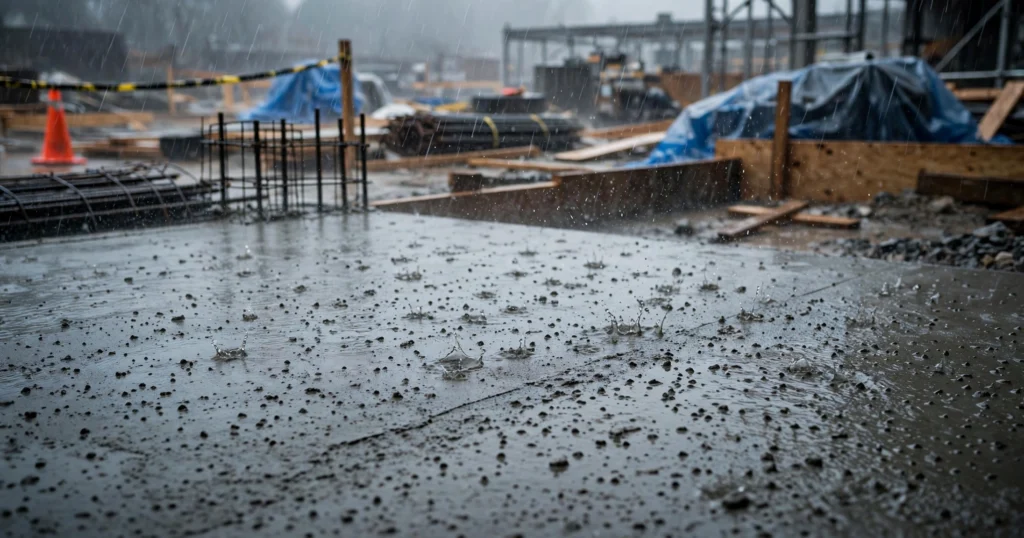
Aim for 24 hours of dry weather after pouring concrete, and up to 48 hours if you can manage it. At the very minimum, you need about 6 to 8 hours of dry weather, and even then only light rain is tolerable. Here is exactly what rain does to fresh concrete at each stage, how to protect your pour, and what to do if you get caught out.
The Direct Answer: The 24-Hour Rule
Concrete needs roughly 24 to 48 hours before rain to be on the safe side. This is the widely advised window, and it is the figure most ready-mix suppliers and guides settle on. The first 24 hours are the most critical, because that is when the surface is at its weakest and most easily damaged.
The absolute minimum is around 6 to 8 hours of dry weather after the pour, and even then the rain should be light, not a downpour. Heavy rain remains a threat until the concrete has properly hardened. If your slab will carry structural loads, such as a foundation or a driveway, do not gamble on the minimum. Wait for the full 24 hours, or reschedule the pour.
What Rain Does to Fresh Concrete, Stage by Stage
The damage rain causes depends entirely on when it arrives. This table breaks it down:
| Time after pouring | What is happening | Rain risk |
|---|---|---|
| 0 to 2 hours | Bleeding stage: excess water rises to the surface | Severe. Rain mixes back into the surface water, raising the water-cement ratio at the surface and weakening it |
| 2 to 4 hours | Finishing window; concrete starts hardening after about 2 to 4 hours | High. Rain ruins floating and trowelling and leaves a soft, dusty surface |
| 4 to 8 hours | Initial set, typically reached in this window depending on temperature and admixtures | Moderate. Light rain is far less damaging now, but heavy rain is still a threat |
| 8 to 24 hours | Hardening continues but the surface is still vulnerable | Low to moderate. Keep covered if rain threatens |
| 24 hours and beyond | Surface is set; concrete keeps gaining strength for weeks | Low. Light rain is fine; protect from heavy storms until fully cured |
The science is simple. In the first couple of hours, extra water at the surface dilutes the cement paste exactly where the concrete needs to be strongest. Too much water at the surface means a weak, powdery top layer that dusts underfoot and scales in winter. That damage cannot be trowelled away afterwards.
How to Protect a Fresh Pour From Rain
Do not wait for the first drops to start thinking about cover. Follow these steps:
- Check the forecast before you book or mix. You want no rain expected for at least 24 hours. In the UK, check again on the morning of the pour, because forecasts change.
- Have coverings on site before you start. Waterproof tarps or plastic sheeting should be stacked at the side of the pour, ready to go, with bricks or timber to weigh them down.
- Cover before the rain starts. Drape the sheeting over the concrete as soon as rain threatens. Do not let it touch and drag across a freshly finished surface if you can avoid it; tent it on timber battens where practical.
- Secure the edges. Water running in under the edges of the sheeting can pool on the surface, so weigh or peg the edges down so water cannot seep underneath.
- Squeegee off standing water. If water does get on the surface, push it off gently with a squeegee. Never work rainwater into the mix or trowel it into the surface.
For longer cures, plastic sheeting doubles as a curing cover, which helps you tick off proper curing at the same time. If you want the full picture of how concrete gains strength over time, read our guide to concrete drying and curing times.
Can You Pour Concrete in Light Rain?
It is not ideal, but a light drizzle during the pour is manageable if you act fast. Get the sheeting over the slab as soon as the concrete is placed and roughly levelled, and keep it covered through finishing if the rain keeps up. The danger is that light rain turns heavy while you are mid-pour, so have a plan and the materials ready before the first barrow goes down.
Heavy rain is a different matter. If a downpour starts while you are pouring, stop placing new concrete and protect what is down. Pouring into standing water or letting rain pound a fresh surface will compromise the slab, and no amount of finishing will fix it later. If the forecast shows heavy rain within your 24-hour window, the professional move is to reschedule.
One related question: what if it rained yesterday? You can pour the day after rain as long as there is no standing water where the slab will sit. Squeegee or pump puddles away first. Moist ground is fine; standing water is not, because it throws off the mix at the base of the slab.
What to Do If It Rains Unexpectedly
Even careful planners get caught out. If rain arrives with no warning:
- Do not panic-finish. Trowelling rainwater into the surface only drives the extra water deeper and makes the damage worse.
- Cover immediately. Get the tarps or sheeting on, secure the edges, and wait it out.
- Remove standing water. Once the rain eases, squeegee any pooled water off gently.
- Note the timing. Write down when the pour finished and when the rain hit. This tells you which stage the concrete was at, and therefore how worried to be.
- Assess the surface. Look for fine random cracks (craze cracking) or a sandy, weak-feeling surface once it dries. These are the classic signs of rain damage.
Fixing Rain-Damaged Concrete
Not all rain damage is fatal. Match the repair to the severity:
| Damage | What it looks like | How to fix it |
|---|---|---|
| Light surface damage | Fine random cracks, slightly dusty finish | Grind the surface smooth or apply a thin overlay once cured |
| Sandy, weak top layer | Surface crumbles or powders underfoot | Remove the damaged layer and apply a bonded overlay or re-pour that section |
| Severe washout | Exposed aggregate, deep pitting, visibly washed-out areas | Remove and re-pour; the slab cannot be salvaged |
Two timing points matter here. First, cut control joints when the concrete is hard enough to walk on without leaving footprints, typically 4 to 12 hours after pouring, even in damp weather. Second, do not apply sealer to fresh concrete as rain protection. Most concrete needs about 28 days before sealing; use sheeting for rain protection in the meantime.
If the slab is structural and you are unsure about its integrity, get a professional assessment rather than guessing. And for future pours, review the DIY concrete mistakes to avoid so the same thing does not happen twice.
Frequently Asked Questions
Can it rain 6 hours after pouring concrete?
Six to eight hours is the minimum, and only light rain is acceptable at that point. Heavy rain can still damage the surface. For real peace of mind, protect the slab for the full 24 hours.
Can I pour concrete if rain is forecast in 12 hours?
Twelve hours falls short of the ideal 24-hour window. You can go ahead only if you will have the pour finished, covered, and protected well before the rain arrives. If you cannot guarantee that, reschedule.
What does rain-damaged concrete look like?
Look for fine random cracks across the surface (craze cracking), a sandy or powdery texture that crumbles underfoot, or a generally weak and dusty finish. These signs usually appear once the surface has dried.
Can I use a concrete sealer to protect fresh concrete from rain?
No. Sealers are for hardened concrete, and most concrete needs about 28 days before it can be sealed. Covering with plastic sheeting or tarps is the correct protection for fresh concrete.
When should I cut control joints if the weather is damp?
Cut them when the concrete is hard enough to walk on without leaving footprints, typically 4 to 12 hours after pouring. Damp weather does not change this; go by the footprint test, not the clock.
Does cold weather change the rain-safe timing?
Yes. Cold slows setting, so every stage in the table above stretches out. In cold, damp UK conditions, treat the timings as minimums and extend your protection period. As a rule of thumb, the colder it is, the longer you should keep the cover on.
Conclusion
Rain and fresh concrete are a bad combination, but the rules are simple: aim for 24 hours of dry weather, accept no less than 6 to 8 hours with light rain only, and always have tarps on site before you pour. Protect the surface, never trowel rainwater in, and assess honestly if you get caught out. A little planning beats an expensive re-pour every time.
Last verified: October 2026.
About the author
Kaleemullah Formulas use standard geometry and published bag yields; sources are linked in each article.