
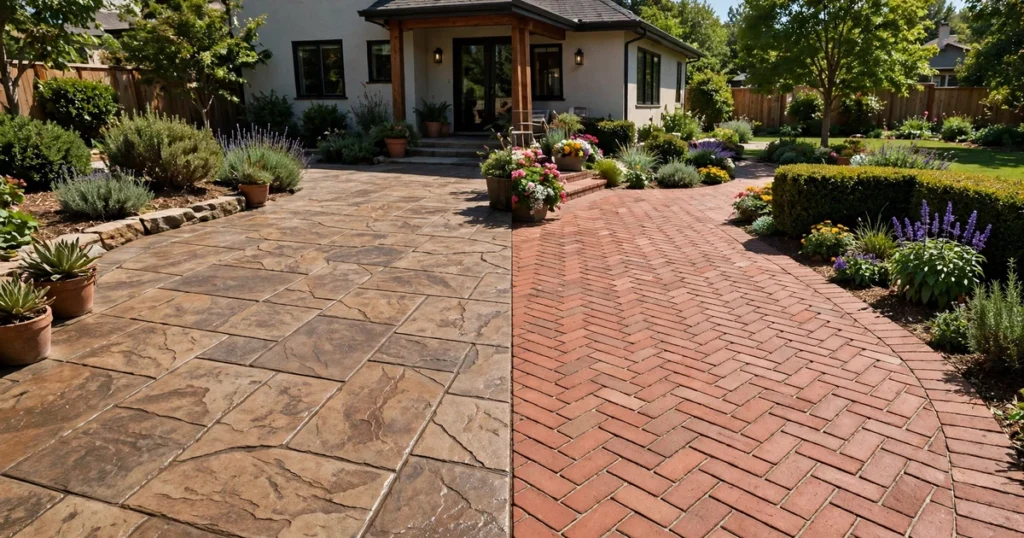
Stamped concrete and pavers both turn an ordinary patio, pool deck or driveway into a decorative surface. Stamped concrete usually costs less to install and looks seamless, while pavers cope better with freeze-thaw weather and are far easier to repair. This guide compares cost, lifespan, maintenance, safety and repairs side by side, using source-backed figures and correcting errors that keep appearing in other guides.
The short answer: stamped concrete vs pavers
Stamped concrete is a poured slab patterned, textured and coloured before it sets, with rubber stamps pressing designs like slate or brick into the workable surface. Pavers are factory-made concrete units laid one by one on a compacted base with sand joints.
Choose stamped concrete for a tighter budget and mild climate with a seamless high-end look. Choose pavers where ground freezes, where easy repairs matter, or where you want colour without a sealing cycle.
Installed cost compared
Published cost figures contradict each other, a major gap in the guides currently ranking. Concrete Network puts stamped concrete at $8 to $18 per square foot and pavers at $7 to $20. A Las Vegas contractor quotes stamped at $12 to $25 plus and pavers at $15 to $30. An Ohio contractor goes higher again: stamped $20 to $30 plus, pavers $25 to $40 plus.
The spread is real: region, pattern complexity, single versus multi-colour finishes, borders and site access all move the price. The honest presentation is a range: stamped concrete typically runs $8 to $25 per square foot installed, and pavers $7 to $30 plus.
One comparison page out there lists costs of $1,000 to $5,000 per square foot, which would price a modest 400 sq ft patio at up to two million dollars. That is an obvious unit typo, not real pricing. Use the corrected ranges above for planning.
| Line item (400 sq ft patio) | Stamped concrete | Concrete pavers |
|---|---|---|
| Low end | $3,200 (simple pattern, easy access) | $2,800 (basic pavers, simple layout) |
| Mid range | $6,000 (two colours, standard border) | $8,000 (quality pavers, herringbone or ashlar) |
| High end | $10,000 (multi-colour, detailed border, metro rates) | $12,000 plus (premium pavers, complex pattern) |
| What drives the price up | Multiple colours, hand detailing, release agents, sealing | Paver quality, pattern complexity, edging, thicker units |
For planning the concrete portion of your budget, try our concrete cost calculator and check current concrete prices per cubic yard before you request quotes.
Lifespan and durability
Some marketing pages claim 50-plus years for both materials, which is puffery for a decorative outdoor surface that relies on a sealer. Realistic lifespans are shorter but still strong, as the table shows.
| Factor | Stamped concrete | Concrete pavers |
|---|---|---|
| Realistic lifespan | 25 to 30 years with proper care | 20 to 30 years with proper care |
| Strength | Typical residential pour: 3,000 to 4,000 psi | Typical manufactured paver: 8,000 to 10,000 psi |
| Key maintenance | Reseal every 2 to 3 years | Re-sand joints as needed; sealing optional |
| Main enemy | Cracking from ground movement; sealer wear | Joint sand washout; weed growth in joints |
The strength figures above are typical industry values reported by contractors and forum professionals, not guarantees for every product or pour.
Maintenance: the resealing cycle
Stamped concrete needs resealing every 2 to 3 years to protect the colour and surface. Skip it and the colour fades, water soaks in, and freeze-thaw damage accelerates.
One nuance most guides miss: integral colour (pigment mixed through the whole slab) holds its tone far better than surface-applied colour (hardener or stain dusted on top), which wears faster under traffic and weather. Ask your contractor which type it is before you sign.
Pavers need far less scheduled maintenance. Joints may need re-sanding every few years as sand washes out, and weeds can sprout if polymeric sand is not used. Sealing pavers is optional and mainly locks in colour.
Repairs: the biggest real-world difference
This is the section competing guides underplay, and it matters most when something goes wrong. A badly cracked stamped slab means cutting out and re-pouring a whole panel between control joints. Matching the original colour and stamp pattern is difficult, so the patched panel often looks visibly different.
With pavers, a cracked or stained unit simply lifts out and a new one drops in. Settlement is handled by lifting the affected pavers, re-levelling the base and relaying them. The repair is local, quick and nearly invisible. For guidance on fixing damaged concrete surfaces, see our concrete spalling repair guide.
- Stamped concrete: whole-panel cut-out and re-pour; colour and pattern matching is hard; higher repair cost.
- Pavers: individual units replace in minutes; settlement fixed by re-levelling; low repair cost.
- Stain or oil damage: a stained stamped panel is stained for good; a stained paver swaps out.
Safety: slip resistance and heat
Sealed stamped concrete can be slippery when wet, because the glossy sealer forms a smooth film over the texture. Traction additives help, but they wear off and must be refreshed at every reseal.
Pavers are generally less slippery because the joints and textured faces give shoes grip. On heat, darker finishes of either type run hot underfoot in full sun; lighter colours stay noticeably cooler.
Freeze-thaw weather: how each surface copes
In cold climates, ground heave is the decisive factor. Paver joints act as shock absorbers: the units flex and shift independently as the base moves. A stamped slab is one rigid piece, so it needs correctly spaced control joints and can still crack when the ground heaves.
| Climate | Better choice | Why |
|---|---|---|
| Freeze-thaw region (cold winters, ground heave) | Pavers | Joints absorb movement; individual units replaceable |
| Mild climate (rarely freezes) | Either; stamped concrete viable | No heave stress; choose on cost and look |
| Hot, sunny climate | Either, with lighter colours | Both run hot in dark tones; sealer on stamped needs more frequent attention in UV |
| Wet climate, pool decks | Pavers | Better wet grip; no mandatory glossy sealer |
If you are in a freeze-thaw zone and still prefer stamped concrete, insist on air-entrained concrete and correctly spaced control joints, and budget for the eventual crack repair that climate makes likely.
Which should you choose?
Pick stamped concrete if budget is the main constraint, your climate is mild, and you want the most seamless look per dollar. Accept the resealing cycle and the repair downside.
Pick pavers if you live where the ground freezes, if easy repairs matter, if the surface will be wet often, or if you want almost no scheduled maintenance.
Frequently asked questions
Which is cheaper, stamped concrete or pavers?
Stamped concrete is usually cheaper to install, typically $8 to $25 per square foot against $7 to $30 plus for pavers, with wide overlap. Long-term costs narrow the gap because stamped concrete needs resealing every 2 to 3 years.
How long does stamped concrete last?
A realistic lifespan is 25 to 30 years with resealing every 2 to 3 years and a proper base with control joints. Claims of 50-plus years are marketing puff.
Do pavers crack?
Individual pavers rarely crack because manufactured units are dense and high strength, but the surface can settle or shift if the base was poorly compacted. The difference is that settlement and cracked units are fixed locally by lifting and relaying, rather than by cutting out a whole panel.
Is stamped concrete slippery?
Yes, sealed stamped concrete can be slippery when wet, especially with a glossy sealer. Traction additives reduce the risk but wear off and must be refreshed at each reseal.
Can cracked stamped concrete be repaired?
Yes, but the repair is a cut-out and re-pour of the whole panel between joints, and matching the original colour and stamp pattern is difficult, so the patched area often looks different. This repair asymmetry is the strongest practical argument for pavers where cracking is likely.
Which is better in cold climates with freeze-thaw cycles?
Pavers are the safer choice. Their joints let units move with ground heave instead of cracking, and damage is repaired one unit at a time. Stamped concrete can work in cold regions with air-entrained concrete and good control joints, but carries a higher cracking risk.
Sources
- Concrete Network: Stamped Concrete vs. Pavers – cost bands, lifespan, reseal maintenance, repair complexity.
- Las Vegas Concrete Artisans: Pavers vs Stamping – comparison table, regional cost ranges, reseal cycle.
- Inspired Design Contracting: Stamped Concrete vs Pavers – lifespan figures and installed cost ranges.
- Green Homes Consultant: Stamped Concrete vs Pavers – freeze-thaw mechanism, slip resistance, heat absorption.
- DoItYourself forum: Stamped Concrete vs Brick Pavers – user-reported strength comparisons and repair experience.
Conclusion
Stamped concrete gives you a seamless decorative surface for less money up front, at the price of a resealing cycle every 2 to 3 years and difficult repairs. Pavers cost more to install but flex with freeze-thaw ground, grip better when wet and repair one unit at a time. Match the choice to your climate and your tolerance for maintenance, not just the quote on the day.
Last verified: October 2026.
About the author
Kaleemullah Formulas use standard geometry and published bag yields; sources are linked in each article.