
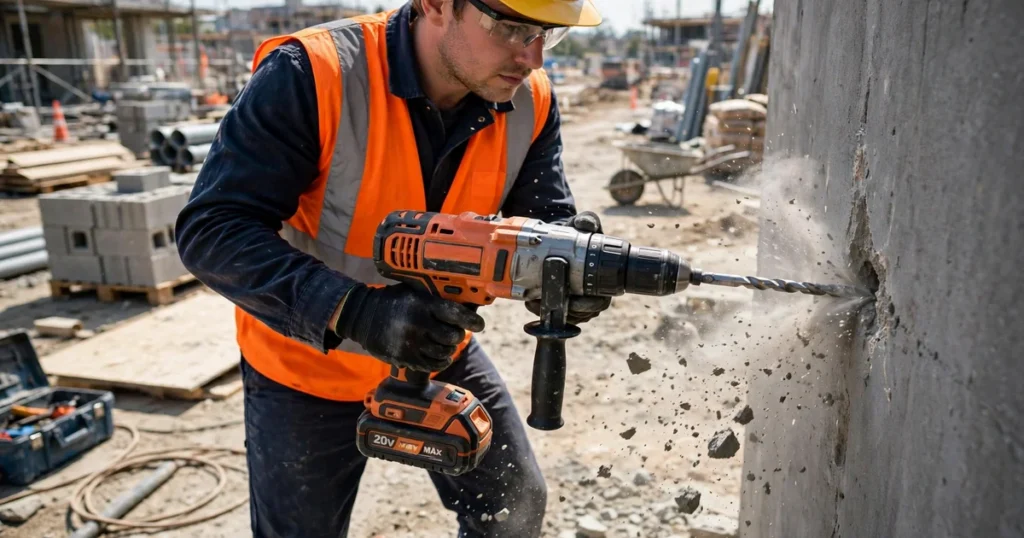
To drill into concrete, use a hammer drill fitted with a carbide-tipped masonry bit and drill a hole sized to your anchor. The numbers the guides skip are these: a 3/16 inch Tapcon concrete screw needs a 5/32 inch bit, a 1/4 inch Tapcon needs a 3/16 inch bit, and the hole must be at least 1/4 inch deeper than the screw’s embedment. Drive the screw with a rotation-only drill or impact driver, stop as soon as it seats, and the fix will hold. The sections below give the depth math, a worked example, and the anchor decision table.
What you actually need to drill concrete
Concrete destroys ordinary twist bits. You need a drill with hammer action, a carbide-tipped masonry bit, a dust mask and goggles. Silica dust from drilling is a genuine health hazard.
Hammer drill vs SDS-Plus rotary hammer
These are not the same tool. Picking the right one saves real time.
| Feature | Hammer drill (standard chuck) | SDS-Plus rotary hammer |
|---|---|---|
| Mechanism | Two ridged discs hammer the chuck forward | Pneumatic piston drives the bit directly |
| Best for | Holes up to about 13 mm in block, brick and concrete | Holes over about 13 mm, deep or repetitive drilling |
| Bits | Straight-shank masonry bits | SDS-Plus shank bits, no chuck slip |
| Buy or hire? | A combi drill with hammer mode covers most DIY jobs | Hire for a day when you have dozens of holes to drill |
A combi drill with hammer mode handles a handful of fixings. For many holes, holes deeper than about 75 mm, or very hard concrete, hire an SDS-Plus rotary hammer. It drills far faster and the bit cannot slip.
Choose the right anchor first
The anchor decides the load you can carry, so pick it before drilling. Each type needs a different hole size.
| Anchor type | Duty | Suitable in | Removable? | Typical use |
|---|---|---|---|---|
| Concrete screw (Tapcon style) | Light | Concrete, brick, block | Yes | Timber plates, shelves, brackets |
| Sleeve anchor | Medium | Concrete, brick, hollow block | Partially | Handrails, gate hinges |
| Wedge anchor | Heavy | Solid concrete only | No, permanent | Structural steel, heavy racking |
| Hammer-drive / split-drive | Light | Concrete, brick, block | No | Electrical boxes, tamper-resistant fixings |
Everyday jobs like shelves, TV brackets and timber plates are light duty, so concrete screws are the right call. Sleeve anchors cover medium loads. Wedge anchors are for heavy loads in solid concrete only. If you are rushing fixings, read our guide to DIY concrete mistakes first.
The numbers that matter: bit sizes, embedment and torque
Tapcon concrete screws
Tapcon screws cut their own threads, so the bit must be smaller than the screw. Per the Tapcon user manual:
| Screw diameter | Required bit | Min embedment | Max embedment | Hole depth |
|---|---|---|---|---|
| 3/16 inch | 5/32 inch carbide bit | 1 inch | 1-3/4 inches | Embedment plus at least 1/4 inch |
| 1/4 inch | 3/16 inch carbide bit | 1 inch | 1-3/4 inches | Embedment plus at least 1/4 inch |
Drive Tapcon screws with a rotation-only drill or an impact driver on low torque. Never use hammer mode to drive them. Over-tightening is the number one failure mode: torque past seating strips the threads and snaps the screw. Snug it down, then finish by hand so you can feel it seat.
Wedge anchors
The hole must be the same diameter as the anchor, drilled with a carbide-tipped ANSI bit, and at least 1/2 inch deeper than the embedment. Solid concrete only. Never brick or block. The section on why is below.
Sample torque and embedment figures from Simpson Power-Stud SD2 technical data:
| Anchor diameter | Minimum embedment | Installation torque |
|---|---|---|
| 3/8 inch | 2-3/8 inches | 20 ft-lb |
| 1/2 inch | 2-1/2 inches | 40 ft-lb |
Always check the specific manufacturer’s table for your anchor. Embedment and torque vary between brands, and the evaluation report tables are what engineers actually use.
Sleeve anchors suit concrete, brick and hollow block, the versatile option when the base material is uncertain.
Do the depth math before you drill
Every hole has three components. Add them up and mark the total on your bit with tape or a depth stop:
Hole depth = anchor embedment + fixture thickness + dust clearance
- Anchor embedment: how much of the anchor sits in the concrete, from the manufacturer table.
- Fixture thickness: the thickness of the timber, bracket or plate you are fixing through.
- Dust clearance: at least 1/4 inch for Tapcon screws per ICC-ES ESR-2202, and 1/2 inch as a rule of thumb for wedge and sleeve anchors. Dust at the bottom of a shallow hole bottoms the screw out before it seats.
Worked example. Fixing a 1.5 inch timber plate with a Tapcon at 2 inches of embedment: hole depth = 2 + 1.5 + 0.5 = 4 inches. Wrap tape at 4 inches from the bit tip and drill to the tape.
Respect placement too. The rule of thumb is minimum edge distance of about 5 anchor diameters and minimum spacing of about 10 anchor diameters. For exact values, use the manufacturer’s evaluation report tables.
Step by step: drilling the hole
- Check what is behind the spot. Scan for pipes, cables and rebar. If the bit hits steel, stop and relocate. Never drill through rebar with a masonry bit.
- Mark the spot with a centre punch so the bit does not wander.
- Start slow with light pressure to seat the bit, then switch to full hammer action once started.
- Keep the drill perpendicular to the surface. Angled holes load anchors unevenly.
- Withdraw periodically to clear the flutes. Heavy pressure overheats the bit.
- Clean the hole. Brush out the fines and blow or vacuum the dust. Per ICC-ES ESR-2202 the hole must be clean before a Tapcon goes in.
- Drive the anchor to the manufacturer’s spec: concrete screws with rotation only, wedge and sleeve anchors tightened to the listed torque.
Wedge anchors must never go in brick or block
Wedge anchors set by expanding a clip against the hole wall with enormous force. Solid concrete resists it. Brick and hollow block do not. The expansion cracks the unit and the anchor loses its grip, sometimes pulling out under load.
The CONFAST manual states it plainly: concrete only, never block or brick. In brick or hollow block, use concrete screws or sleeve anchors from the table above. If you are unsure what the wall is made of, treat it as not solid concrete until proven otherwise.
Mistakes that ruin a good fixing
- Over-tightening Tapcon screws. The threads strip or the head snaps. Snug, then finish by hand.
- Skipping the dust clearance. The screw bottoms out on dust before it seats. Drill deeper than the embedment, every time.
- Drilling through rebar. You blunt the bit and weaken the slab. Stop and move the hole.
- The folk method. Pinning timber with a concrete nail plus two angled 16d nails has no rated load. Use a proper anchor.
- No dust protection. Concrete dust contains silica. A dust mask is not optional.
If the project involves a new slab, our concrete slab thickness guide helps you get the base right, and the how to cure concrete guide covers the wait before drilling into fresh concrete.
Frequently asked questions
Can I drill into concrete with a regular drill?
A combi drill with hammer mode handles small holes up to about 13 mm. For bigger, deep or many holes, a rotary hammer is worth hiring.
What size bit do I need for a Tapcon screw?
A 3/16 inch Tapcon needs a 5/32 inch bit; a 1/4 inch Tapcon needs a 3/16 inch bit. The bit is always smaller than the screw so the threads cut in.
How deep should a concrete anchor go?
Follow the manufacturer’s minimum embedment, then add fixture thickness and dust clearance. Tapcon needs at least 1/4 inch of clearance past the embedment.
Can I use wedge anchors in brick?
No. Wedge anchors are for solid concrete only. The expansion force cracks brick and hollow block. Use concrete screws or sleeve anchors instead.
Why did my Tapcon screw snap?
Over-tightening. Drive with rotation only, stop when it seats, and finish by hand so you feel the seating point.
What do I do if I hit rebar?
Stop. Do not force a masonry bit through steel. Move the hole a few inches away and use a rebar detector before drilling near slab edges.
Conclusion
Drilling into concrete is a numbers game. Match the anchor to the load, drill to the manufacturer’s bit size, add embedment plus fixture thickness plus dust clearance for the depth, clean the hole, and drive to spec without over-tightening. Keep wedge anchors out of brick and block and wear a dust mask. Do that and the fixing will last.
Sources
- Tapcon user manual (manuals.plus) – bit sizes, embedment 1 to 1-3/4 inches, hole 1/4 inch past embedment
- ICC-ES ESR-2202 evaluation report – hole depth and cleaning rules
- CONFAST wedge anchor manual (manuals.plus) – hole equals anchor diameter, concrete only
- Simpson Power-Stud SD2 technical data (Tanner Bolt) – embedment and torque figures
- EngineerFix: how to screw into concrete – hole depth rules, placement rule of thumb
Last verified: October 2026.
About the author
Kaleemullah Formulas use standard geometry and published bag yields; sources are linked in each article.