
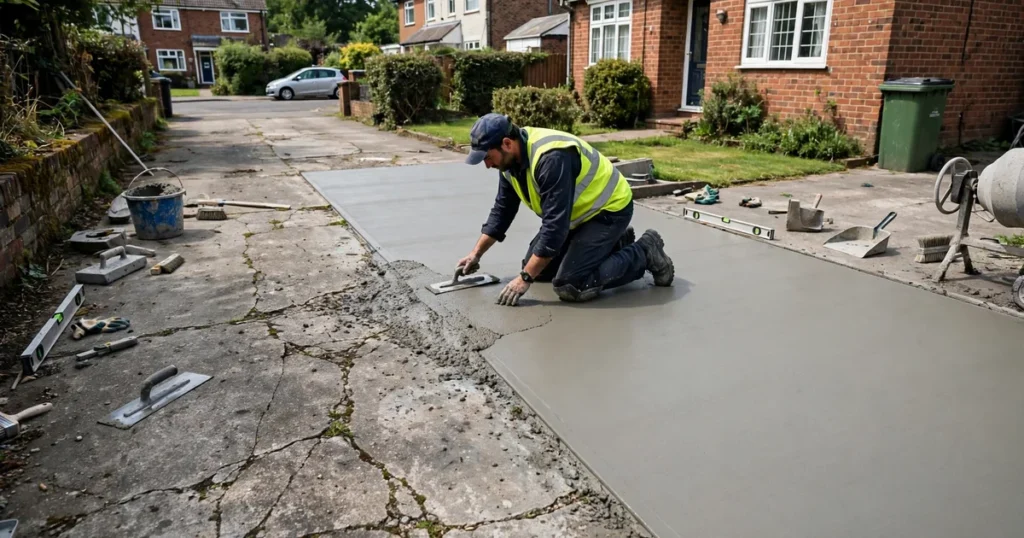
A worn slab leaves two choices, and the wrong one wastes money twice. An overlay adds a thin new surface over the old slab. Replacement breaks it out and pours a new one. Choose an overlay when the slab is sound and the damage is only on the surface. Choose replacement when it is moving, sinking, badly cracked or crumbling, because no overlay can fix a failing base.
The short answer
An overlay suits a level, stable slab with hairline cracks, light spalling, stains or a worn finish. A bonded polymer modified overlay, usually 10 mm to 50 mm thick, restores the wearing surface at a fraction of replacement cost. Replacement suits a slab with cracks wider than about 3 mm that keep growing, steps over about 5 mm, sinking or rocking. Then the old slab must come out, the base must be fixed, and a new slab poured. Overlay a moving slab and the new surface cracks in the same place, often within one winter.
Decision checklist: read the slab first
Walk the slab before pricing either option. Mark cracks with chalk and measure them. Stand on each panel edge: if it rocks, the base has gone. Check for pooling water, open joints and laitance, a dusty layer that stops an overlay bonding. Tap with a hammer: sound concrete rings sharp, hollow spots suggest delamination.
Use the table as a first pass. One red flag alone does not always mean replacement, but two or more usually do. If unsure, ask a local contractor to look first.
| What to check | Overlay is likely fine | Replace instead |
|---|---|---|
| Crack width | Hairline, under 3 mm, stable | Over 3 mm, growing, or stepped |
| Level between panels | Even, or under 5 mm step | Step over 5 mm, or panels rock |
| Movement | None when you stand on it | Rocking, sinking or heaving |
| Surface damage | Light spalling, stains, wear | Deep spalling, crumbling, exposed steel |
| Base and drainage | Dry, firm, water runs away | Water pools, base washed out |
| Strength | Sound concrete below the surface | Soft, dusty or hollow concrete |
How an overlay works
An overlay is a bonded repair, not a new slab. Preparation is most of the job: clean the slab, remove oil and paint, fill cracks, and grind or shot blast the surface so the new layer can grip. Laitance, loose material and old sealer must come off. A bonding agent is applied, then the overlay is spread, usually 10 mm to 25 mm, up to 50 mm where levelling is needed, and finished with a trowel or broom. Most overlays take foot traffic in a day, but follow the product data sheet. A fresh overlay needs frost protection for at least 24 hours. It cannot add strength or bridge a moving crack, and it raises the finished level, so check thresholds, drains and steps first.
How replacement works
Replacement starts with breaking out the old slab, a hired breaker for a small patio, a mini digger with a breaker for a driveway. The broken concrete goes into a skip or a grab lorry. Concrete weighs about 2.4 tonnes per cubic metre, so disposal is a real part of the cost, though crushed concrete can often be recycled as hardcore. Once the old slab is out, the base decides whether the new slab lasts. Remove soft material, lay and compact MOT Type 1 hardcore in layers, and check levels. A vapour barrier and mesh or rebar go in where needed; our slab thickness guide explains thickness and reinforcement by job. Then pour, level, finish and cure the new concrete. A new driveway should not carry vehicles for at least 7 days, and 28 days is the standard period before full loading.
Cost in the UK
Costs vary by region and finish, so treat every figure as a planning range from the named sources, and get local quotes first. Checkatrade puts a small driveway resurface at about 630 pounds in total for a 2.5 m by 2.25 m area, materials about 330 pounds and labour about 300 pounds. Materials only run about 280 to 380 pounds for that size, rising to about 1,500 pounds for a 5 m by 5 m driveway. Replacement costs far more, since it adds breaking out, disposal, a new base and a new pour. US guides show the same gap in proportion, about 3 to 9 dollars per square foot for resurfacing and 10 to 15 dollars or more for replacement, though those money figures do not transfer to the UK. A cheap overlay on a failing slab is the most expensive option, because you pay twice.
Worked examples
Use the site overlay and removal calculators to check your own slab. For a 5 m by 5 m driveway, 25 square metres at 20 mm thick is 0.5 cubic metres of overlay, before waste. The same area at 100 mm thick needs 2.5 cubic metres of new concrete, plus disposal of the old slab, about 6 tonnes at 2.4 tonnes per cubic metre. That weight explains why disposal and labour dominate replacement cost.
| Example | Overlay route | Replacement route |
|---|---|---|
| Driveway 5 m by 5 m, sound slab, worn surface | 25 m2 overlay at about 20 mm, materials about 1,500 pounds per Checkatrade, plus labour | Break out 25 m2, dispose of about 15 tonnes, new base and pour, several thousand pounds |
| Patio 4 m by 3 m, sound slab, light spalling | 12 m2 overlay, one or two days of work, foot traffic the next day | Break out 12 m2, skip hire and new pour, a week or more before full use |
| Driveway 5 m by 5 m, sinking panels, 8 mm steps | Not recommended, the overlay will crack at the steps | Break out, fix the base and drainage, then pour a new slab |
The UK frost note
Frost separates a good overlay from a bad one in the UK. Water gets into cracks, freezes, expands and lifts the surface. An overlay on a sound, dry slab with sealed joints can last many years, but one on a slab that holds water will blister and peel after a few freeze and thaw cycles. Air entrained concrete resists frost better, so ask your supplier, and choose an overlay rated for external use in frost. Do not lay an overlay when frost is forecast overnight. For more on sealing, read our guide to sealing a concrete driveway on this site.
Mistakes to avoid
- Skipping preparation. Dirt, oil, laitance and old sealer stop the bond.
- Overlaying a moving crack. It will reflect through the new surface.
- Feather edging the overlay. Thin edges chip and lift, so cut a square edge.
- Adding water to make the overlay easier to spread. Extra water weakens the mix.
- Ignoring the level change. Check thresholds, drains and steps first.
- Driving on it too soon. Follow the product curing time, longer in cold weather.
- Forgetting drainage. If water still pools, fix the fall and drainage first.
If the slab needs repair first, read our concrete crack repair guide and our spalling repair guide.
Frequently asked questions
Is a concrete overlay worth it?
Yes, when the slab is sound and the damage is only on the surface. It is not worth it when the slab is moving, sinking or badly cracked, because the overlay will fail with the base.
How long does a concrete overlay last?
A well prepared overlay on a sound slab often lasts 8 to 15 years with good care, according to US guides. Poor preparation, water and frost shorten that life sharply.
How thick is a concrete overlay?
Most bonded overlays are 10 mm to 50 mm thick, skim resurfacers only a few millimetres. Thicker overlays can level small dips, but cannot fix a slab that has sunk badly.
Can I overlay a cracked driveway?
Hairline cracks that are stable can be filled and overlaid. Wide, growing or stepped cracks cannot, as the movement will show through, so replace the slab or repair the cause first.
Can I do an overlay myself?
A small patio is a realistic DIY job with a hired grinder and the product instructions. A driveway is harder, because the area is large and the overlay sets fast.
Does an overlay add strength to my slab?
No. An overlay renews the wearing surface only. It does not strengthen a weak slab or fix a failed base.
Conclusion
Read the slab, then choose. Overlay a sound slab and you get a fresh finish for a fraction of replacement cost. Replace a moving, sinking or crumbling slab and you fix the cause instead of hiding it. Measure the cracks, check movement and drainage, and let those checks decide. The cheapest job is the one you only do once.
Sources
- Checkatrade: Cost of Concrete Resurfacing in 2026
- British Concrete Polishing: Comparing Concrete Overlay vs a Complete Replacement
- DIY Craft: Resurface Concrete the Right Way
- Belcovo: Concrete Overlay FAQ
- Garage Kings: Concrete Resurfacing Guide
Last verified: November 2026.
About the author
Kaleemullah Formulas use standard geometry and published bag yields; sources are linked in each article.