
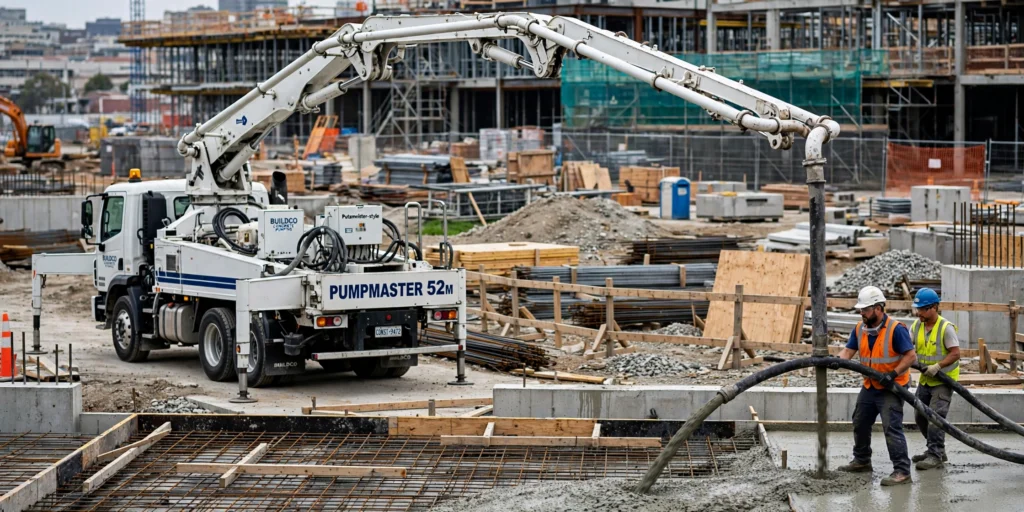
Hiring a concrete pump typically costs $150 to $220 per hour for a line pump or $210 to $320 per hour for a truck-mounted boom pump in the US, and £250 to £450 per day for a line pump or £600 to £1,600 per day for a boom pump in the UK. The headline rate is only half the story. Nearly every hire carries a minimum charge, so a pour that takes one hour can still cost you three or four hours of pump time. This guide breaks down US and UK pricing, the extras that inflate the final invoice, and when a pump is genuinely cheaper than wheelbarrows.
How Much Does Concrete Pump Hire Cost?
Pump companies price their equipment in different ways, but most quotes reduce to the same three parts: a base rate, a minimum charge, and a handful of extras. In the US, many firms also add a charge per cubic yard pumped.
US concrete pump prices
| Pump type | Hourly rate | Minimum charge | Yardage charge | Day equivalent |
|---|---|---|---|---|
| Line pump | $150-220/hr | 3-4 hours | $3-5.50 per cubic yard | $800-1,400/day |
| Boom pump (truck-mounted) | $210-320/hr | 4 hours | $3-5.50 per cubic yard | $1,300-2,600/day |
The yardage charge is usually a small part of the bill. Pumping 4 cubic yards at $5 per yard adds only $20, while the minimum charge on the same job can run $450 to $660. Minimums, not hourly rates, decide what a small pour costs. Before you order concrete, use a concrete cost calculator to pin down your volume.
UK concrete pump prices
| Pump type | Typical day rate | Best for |
|---|---|---|
| Line pump | £250-450/day | Slabs, driveways and foundations where the truck can park close |
| Medium boom (30-40m reach) | £600-1,000/day | Upper floors and multi-storey work |
| Large boom (40-60m reach) | £1,200-1,600/day | Long reach and large-volume pours |
UK hire is normally sold as a half day (4 hours) or a full day (8 hours), with a 2 to 4 hour minimum applying even if your pour finishes sooner. If the operator is not included, budget an extra £150 to £250 per day. UK pump operators must hold a CPCS card (Category A42), so confirm this when you book.
Line Pump vs Boom Pump: Which Do You Need?
The cheapest pump is the one that suits your site. Pick the wrong type and you either pay for reach you never use or discover on pour day that the pump cannot reach your forms.
| Factor | Line pump | Boom pump |
|---|---|---|
| How it works | Trailer or truck pump feeding hoses laid across the site | Truck-mounted hydraulic arm that places concrete directly |
| Best for | Slabs, driveways and foundations where the truck can get close | Elevated pours, long reach and large volumes |
| Access needs | Truck parks nearby; hoses do the reaching | Truck needs firm, level ground for the outriggers |
For a ground-level slab or driveway where the mixer truck can park within hose reach, a line pump is the economical choice. For anything elevated or where the truck must stay far from the work area, a boom pump earns its higher price. Where access is genuinely tight, such as a rear garden down a narrow lane, ask about a mini or compact pump.
What Affects the Final Price?
The base rate gets the pump on site. These five factors decide the number on the invoice.
- Minimum charges. The biggest driver for small pours. A US line pump with a 3-hour minimum at $150 per hour costs $450 before a yard is pumped, even if the pour takes 45 minutes.
- Standby and waiting time. If the pump sits idle because the site is not ready or the next truck is late, you pay: $120-200 per hour in the US, or £80-150 per hour in the UK after a 30-minute grace period.
- Travel and mobilisation. A separate line item in many quotes: roughly $125-275 mobilisation in the US, and £50-150 in the UK when the site is beyond about 25 miles.
- Weekend and after-hours work. Often 1.5 times the standard rate in the US and around 50 percent extra in the UK. Confirm the multiplier in writing.
- Yardage fees (US). At $3 to $5.50 per cubic yard, this adds up on large pours (about $60-110 on 20 cubic yards) but rarely decides the job. Compare it with the cost of concrete per cubic yard to see the full per-yard picture.
A worked example: why small pours feel expensive
Say you need 3 cubic metres (about 4 cubic yards) for a small slab. A US line pump at $180 per hour with a 3-hour minimum bills $540 for time, plus roughly $20 in yardage fees and perhaps $150 mobilisation: around $710 for 3 cubic metres, or about $237 per cubic metre. The same pump on a 12-cubic-metre pour at a $1,000 day equivalent costs about $83 per cubic metre. The pump did not get cheaper; the minimum simply spread across more concrete.
UK vs US Pricing at a Glance
| Cost element | US (planning range) | UK (planning range) |
|---|---|---|
| Line pump | $150-220/hr, 3-4 hr minimum | £250-450/day |
| Boom pump | $210-320/hr, 4 hr minimum | £600-1,600/day by reach |
| Volume charge | $3-5.50 per cubic yard pumped | Not standard; hire is time-based |
| Getting to site | $125-275 mobilisation | £50-150 beyond 25 miles |
| Waiting time | $120-200/hr standby | £80-150/hr after 30 minutes |
| Weekend premium | Often 1.5x | Around +50% |
| Operator | Usually included in the hourly rate | £150-250/day if not included; CPCS card required |
When Is a Pump Worth It vs Wheelbarrows?
A pump is a fixed cost with a minimum. Wheelbarrows are slow but have no minimum. That contrast sets the breakeven point.
- Over about 10 m³: pumping usually wins once labour is counted, because the pump’s day rate spreads across a large volume.
- Under about 5 m³: wheelbarrows or direct chute discharge are usually cheaper. The pump’s minimum applies in full whether you pour 2 cubic metres or 6.
- Between 5 and 10 m³: the judgement zone. Good access and a cheap half-day line pump hire tip it toward pumping; difficult access and an expensive boom tip it back toward barrows.
Access can override the maths entirely. If the mixer truck cannot reach the pour and the barrowing distance is long, a pump may be the only practical option. If the truck can discharge straight into the forms, skip the pump and save the money. Knowing how much concrete a 10×10 slab needs helps: that volume (roughly 1.5 cubic metres at 100mm thick) sits firmly in wheelbarrow territory.
Booking Checklist
- Confirm the pump type and, for booms, the reach you actually need.
- Get the minimum charge in writing, and ask whether travel time counts toward it.
- Ask how standby is charged and what triggers it.
- Confirm travel or mobilisation fees for your exact postcode or ZIP.
- Check the weekend and after-hours multiplier if your pour might slip.
- In the UK, confirm the operator holds a CPCS card (Category A42) and whether their day rate is included.
- Agree who supplies the washout area before pour day.
How much does it cost to hire a concrete pump for a day?
In the US, budget roughly $800-1,400 per day for a line pump and $1,300-2,600 for a boom pump, before travel, standby and yardage extras. In the UK, expect £250-450 per day for a line pump, £600-1,000 for a medium boom and £1,200-1,600 for a large boom.
Is a line pump or a boom pump cheaper?
A line pump is cheaper in both markets. Choose it when the truck can park close to a ground-level pour; pay for the boom when you need height or reach.
What is the minimum hire for a concrete pump?
US line pumps typically carry a 3 to 4 hour minimum and boom pumps a 4 hour minimum. UK hire is usually a half day or full day, with a 2 to 4 hour minimum applying even if the pour finishes sooner. Always confirm whether travel time counts toward the minimum.
Do concrete pump prices include the operator?
In the US the hourly rate usually includes the operator. In the UK the operator is sometimes quoted separately at £150-250 per day, so check the quote carefully. UK operators must hold a CPCS card (Category A42).
Is it cheaper to pump concrete or use wheelbarrows?
Over about 10 cubic metres, pumping usually wins once labour is counted. Under about 5 cubic metres, wheelbarrows or direct discharge are usually cheaper because the pump’s minimum charge applies regardless of volume.
What extras should I watch for on a pump quote?
Mobilisation or travel fees, standby and waiting time, weekend or after-hours premiums, yardage charges in the US, and separate operator charges in the UK. Ask for each one to be named in the quote before you book.
Once you understand that the minimum charge drives the price, hiring a concrete pump is straightforward. Match the pump type to your site, confirm the minimums and extras in writing, and compare the quote against the wheelbarrow option.
Last verified: October 2026.
About the author
Kaleemullah Formulas use standard geometry and published bag yields; sources are linked in each article.