
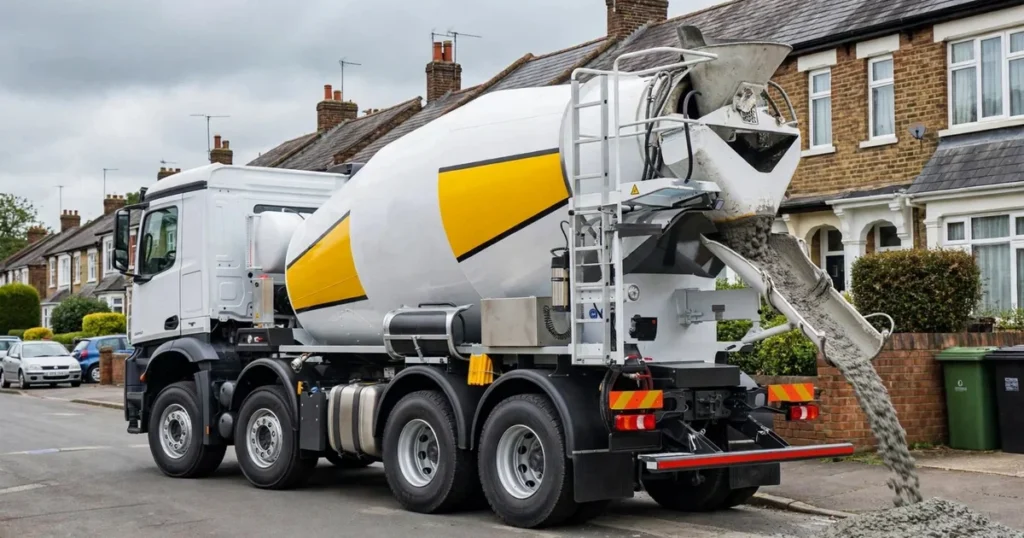
A concrete short load fee is a surcharge your supplier adds when you order less concrete than their minimum load, and in the UK it typically costs between £60 and £200. For a small order of 2 cubic metres, expect the fee to add roughly £100 to £200 to the bill. The fee exists because a ready-mix truck is built to carry 6 to 8 cubic metres, and sending it out part empty costs almost as much as sending it full.
What is a short load fee?
A short load fee, also called a part load surcharge, is what a ready-mix supplier charges when your order falls below their minimum load. Most UK suppliers set a minimum order of 3 to 6 cubic metres, and Material Calculator puts the most common minimum at 6 cubic metres. Order below that figure and the supplier will usually still deliver, but will add a surcharge.
The fee is not a penalty for small customers. It covers the real cost of the trip: the driver, the fuel and the truck time are nearly the same whether the drum holds 2 cubic metres or 6. ProConcrete247 puts it plainly: ready-mix trucks are built for 6 to 8 cubic metre loads, and when you order less, typically under 3 cubic metres, the truck runs partially empty and the supplier recovers the cost through a surcharge of £100 to £200 per delivery.
Every supplier sets its own minimum and its own fee, so ask about the minimum load and the short load fee before you ask the price per cubic metre.
How much is the fee? The two charging models
Suppliers charge the fee in one of two ways: a flat fee per delivery, or a charge per cubic metre short of the minimum.
| Charging model | Typical fee | Source | Example on a 2 m3 order |
|---|---|---|---|
| Flat surcharge | £100 to £200 | Material Calculator, ProConcrete247 | £100 to £200 added |
| Per m3 short | £15 to £30 per m3 short | Websites for Tradespeople | £60 to £120 added on a 6 m3 minimum |
On a 2 cubic metre order against a 6 cubic metre minimum, you are 4 cubic metres short. At £15 to £30 per cubic metre short, the fee is £60 to £120. All routes land in the same place, which is why the honest planning range is £60 to £200, and the most commonly quoted figure is £100 to £200.
BuildEstimatory gives the clearest illustration. A 2 cubic metre order might cost £130 per cubic metre including fees, while a 6 cubic metre order costs £95 per cubic metre with no penalty.
UK minimum loads: what suppliers actually require
Minimum loads vary by supplier. Material Calculator puts the most common minimum at 6 cubic metres, while smaller local plants often accept 3 cubic metres. A volumetric mixer has no practical minimum.
Volumetric vs drum ready-mix
There are two ways concrete arrives on site. A drum mixer carries ready-mixed concrete from the batching plant, and the load is fixed once it leaves. A volumetric mixer carries cement, sand, aggregate and water in separate compartments and mixes the concrete on site, to the exact volume you need.
| Factor | Drum ready-mix | Volumetric mixer |
|---|---|---|
| Minimum order | 3 to 6 m3 | No practical minimum |
| Short load fee | £60 to £200 | None |
| Price per m3 | £90 to £110 standard grade | 15 to 25 percent more per m3 |
| Extra concrete | You pay for the full load ordered | You pay only for what is mixed |
| Best for | Orders above 4 m3 | Orders below 3 m3 |
Volumetric costs 15 to 25 percent more per cubic metre, but that premium is usually smaller than the short load fee. ProConcrete247 states the rule directly: if your project needs less than 3 cubic metres, volumetric is almost always the better option.
Worked example: a 2 cubic metre order, three ways
Take a small job that needs exactly 2 cubic metres of standard grade concrete, priced at £100 per cubic metre.
- Drum ready-mix: 2 cubic metres at £100 = £200, plus a flat fee of £100 to £200, giving £300 to £400 in total.
- Volumetric mixer: 2 cubic metres at £115 to £125 per cubic metre, giving £230 to £250 in total, with no fee and no waste.
- Bagged concrete: a 25 kg bag yields about 0.012 cubic metres, so 2 cubic metres needs about 165 bags. At £5 to £7 per bag that is £825 to £1,155.
On this example volumetric wins by £70 to £150 over drum, and by a large margin over bags. The crossover point sits around 3 to 4 cubic metres. Above that, drum ready-mix with no fee is cheapest. Below it, volumetric usually wins. For the volume maths, use the calculators on this site and our guide to concrete cost per cubic yard. For delivery charges, see our guide to ready-mix delivery costs.
When a short load is still cheaper
Paying the fee is not always a mistake. There are four cases where a short load on a drum mixer is still the cheapest sensible option.
- You are close to the minimum. If you need 5 cubic metres against a 6 cubic metre minimum, the fee may be small, and ordering the extra cubic metre for a small side job can be cheaper.
- The site needs a specific mix. Some specialist mixes, such as high strength or waterproof concrete, are easier to order from a drum supplier.
- Timing matters. A drum mixer arrives with the concrete ready to pour. A volumetric mixer mixes on site, which takes longer.
- You can use the spare concrete. Ordering up to the minimum and using the extra concrete for a path or a pad can be cheaper than paying the fee for nothing.
Work the numbers before you decide. A fee of £100 on a £200 order is a 50 percent surcharge, and on a £500 order it is 20 percent.
How to avoid the fee
- Order volumetric. For any job under 3 cubic metres, get a volumetric quote first. There is no minimum and no fee.
- Combine jobs. Pour the path, the shed base and the step footings on the same day, from the same load.
- Order up to the minimum. If you need 4 cubic metres against a 6 cubic metre minimum, find a use for the extra 2 cubic metres rather than paying the fee.
- Share a load. If a neighbour is pouring on the same day, ask the supplier whether one truck can serve both jobs.
- Use bags for very small pours. Below about 0.5 cubic metres, bagged concrete from a builders merchant is usually cheapest.
- Ask and negotiate. Local suppliers may reduce the charge for a returning customer, so always ask what the fee is before you book.
- Check the minimum before you price the job. A supplier with a 3 cubic metre minimum can be far cheaper than one with a 6 cubic metre minimum.
Frequently asked questions
What is a concrete short load fee?
A surcharge added when your ready-mix order falls below the supplier minimum load, usually 3 to 6 cubic metres. It covers the cost of sending a truck out part empty.
How much is a short load fee in the UK?
Typically £100 to £200 as a flat fee, or £15 to £50 per cubic metre short of the minimum. Local quotes govern.
What is the minimum order for ready-mix concrete?
Usually 3 to 6 cubic metres, with 6 cubic metres the most common minimum at large plants. Small local plants often accept 3 cubic metres.
Is volumetric concrete cheaper for small loads?
Yes, usually, for orders below 3 cubic metres. Volumetric costs 15 to 25 percent more per cubic metre, but there is no minimum and no short load fee.
Can I avoid the fee by ordering more concrete?
Yes, if you can use the extra concrete. Ordering up to the minimum and using the spare for a path or a pad is often cheaper than paying the fee.
Do bagged concrete orders have a short load fee?
No. Bagged concrete has no delivery fee and no minimum order. It only makes sense for very small pours, below about 0.5 cubic metres.
Conclusion
A short load fee typically adds £60 to £200 to a small ready-mix order, and on a 2 cubic metre job it can nearly double the cost of the concrete. Before you pay it, get a volumetric quote, check the minimum load with a second supplier, and see whether another small job can share the load. For orders below 3 cubic metres, volumetric usually wins. For orders above 4 cubic metres, drum ready-mix is usually cheapest.
Sources
- Material Calculator, Free Concrete Calculator UK, https://materialcalculator.co.uk/concrete-calculator
- ProConcrete247, Concrete Price Per m3 2025: Full UK Cost Guide, https://www.proconcrete247.co.uk/blog/concrete-pouring-cost-2025
- Websites for Tradespeople, Concrete Measuring Calculator, https://www.websitesfortradespeople.co.uk/tools/concrete-calculator
- UKCalculator, Concrete Calculator UK 2026, https://ukcalculator.com/concrete-calculator.html
- BuildEstimatory, How Much Does Concrete Cost? 2026 Price Guide, https://uk.buildestimatory.com/guides/concrete-cost-guide/
- 2Brothers, Small Quantity Concrete Delivery: Costs and Minimums, https://www.2brothers.uk/news/ready-mix-concrete-for-small-jobs/
Last verified: November 2026.
About the author
Kaleemullah Formulas use standard geometry and published bag yields; sources are linked in each article.