
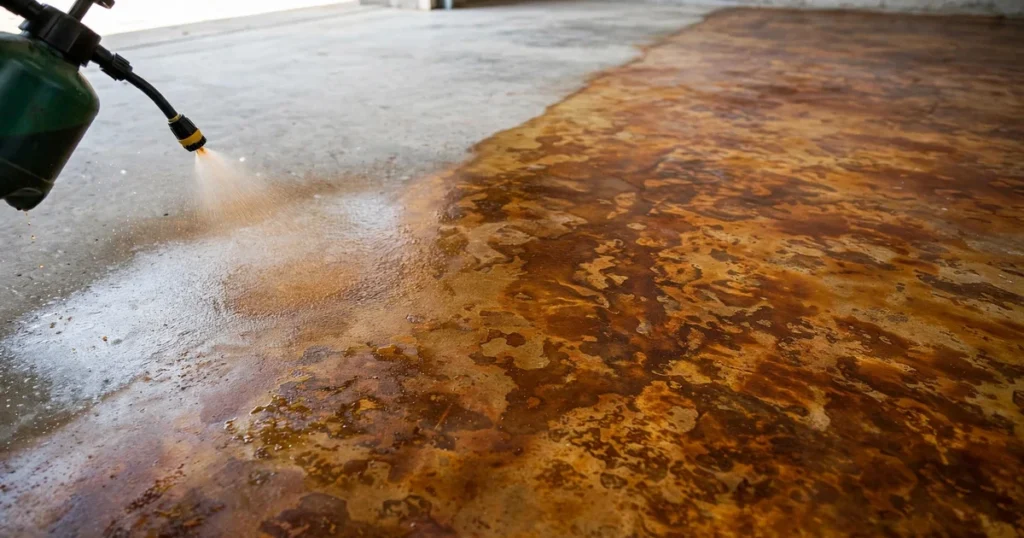
Staining concrete turns a plain grey slab into a richly coloured floor, but there are two very different ways to do it. Acid stains react chemically with the minerals in concrete, producing variegated, mottled colour that looks like natural stone. Water-based stains sit on the surface instead, giving more consistent colour, a wider colour range and easier application. Whichever you choose, three rules hold: stain is permanent, so test a patch first; acid stain must be neutralised before sealing; and every stained floor needs a sealer to lock the colour in.
Acid vs Water-Based Stain: How to Choose
Start here, because the two products behave differently from the first coat:
| Acid stain | Water-based stain | |
|---|---|---|
| How it colours | Reacts with minerals in the concrete | Pigment sits on the surface |
| Finished look | Variegated, mottled, stone-like | Consistent, even colour |
| Colour range | Limited, mostly earth tones | Wide, including brights |
| Application | More demanding: timing and neutralisation matter | Easier, more forgiving |
| Coverage example | Graniterock: 75 to 100 sq ft per gallon over two applications | Tru-Tint WB: ~250 sq ft per coat per gallon, two coats typical |
No manufacturer claims one type objectively outlasts the other by a fixed number of years, so do not let a blog tell you acid stain “lasts twice as long”. Choose acid for natural, mottled character and water-based for colour control and simplicity.
How Much Stain to Buy: Coverage and a Worked Example
DIY guides almost never give coverage numbers. These come from manufacturer spec sheets:
| Product | Coverage | Coats |
|---|---|---|
| Tru-Tint WB (water-based) | ~250 sq ft per coat per gallon | 2 typical |
| Graniterock chemical stain | 75 to 100 sq ft per gallon | Across two applications |
| Increte water-based stain | 150 sq ft per gallon per coat | Per coat |
| RockSolid semi-transparent | 250 to 400 sq ft smooth bare; 175 to 250 sq ft rough | Per gallon |
Worked example: a 200 square foot patio with a water-based stain at ~250 square feet per coat needs 200 / 250 = 0.8 gallons per coat, so one gallon per coat, and with two coats typical you need two gallons total. Buy a little extra rather than a little short: running out mid-floor risks a visible tone shift between batches. To measure your slab first, use our concrete calculator for area and dimensions.
Before You Start: Prep Tests and Rules
Staining rewards good prep and punishes rushed prep. Three checks come before any stain goes down:
- New concrete must cure first. The Behr spec sheet requires a minimum of 30 days before staining new concrete. Our how to cure concrete guide explains what happens during that month, and our drying and curing times guide gives the full timelines.
- Run a moisture test. Tape an 18 by 18 inch plastic sheet to the slab and leave it 24 hours. Condensation underneath means trapped moisture, which interferes with stain and sealer.
- Test patch, always. Stain is permanent. Colours react with your slab’s specific chemistry, so a test patch in an inconspicuous corner is mandatory, not optional.
Also repair cracks and spalls before staining, since stain will highlight damage rather than hide it. See our concrete spalling repair guide for the repair side of prep. And clean thoroughly: grease, sealers and old coatings block acid stain from reacting evenly.
Acid Stain, Step by Step
- Clean and etch. Degrease, pressure wash and let the slab dry fully.
- Apply the stain. Spray or roll on at full strength, keeping a wet edge. Acid stain does its work by reacting with minerals, so coverage should follow the product spec.
- Let it react. This is where competitors contradict each other, stating a single time as fact. The honest range: Direct Colors (manufacturer) says most colours take 4 to 8 hours to develop; Graniterock specifies a minimum 4-hour contact time; other guides suggest up to 24 hours. The real variables are colour, temperature and your slab’s chemistry. Follow your product’s spec sheet, and stay inside its stated range.
- Neutralise. Required before sealing. See the next section, because the ratios are a mess across the industry.
- Rinse until clear. Rinse and wet-vacuum repeatedly until the rinse water runs completely clear, then do a rag test: wipe the dry floor with a clean white rag. Any colour transfer means residue remains, and leftover neutralised residue is the leading cause of sealer peeling within weeks, because the sealer bonds to the residue instead of the concrete.
- Seal. Only when the floor is fully dry.
The Neutralisation Conflict: Read This Before You Mix Anything
This is the section ranking guides get wrong. Every competitor states one neutralisation ratio as universal, and they contradict each other:
| Source | Stated ratio |
|---|---|
| Concrete Camouflage | 1/2 cup ammonia per gallon, or 1 part baking soda to 10 parts water |
| Direct Colors | 1 to 2 tablespoons baking soda per gallon |
| Graniterock spec | 1 lb baking soda per 5 gallons, until fizzing stops |
| EngineerFix / ResearchGate | 1 lb per 5 gallons |
Those are not minor differences: one tablespoon per gallon and one pound per five gallons are an order of magnitude apart. No single ratio is “correct” across products. Follow the technical data sheet of the exact stain you bought. Whatever ratio you use, neutralise, rinse thoroughly, wet-vacuum, and confirm with the rag test before sealing. Our DIY concrete mistakes guide lists rushed rinsing among the top ways staining jobs fail.
Water-Based Stain, Step by Step
- Clean the slab. Same prep as acid stain, without the chemical reaction.
- Apply thin, even coats. Two coats are typical. Keep a wet edge and avoid puddling.
- Respect the drying ranges. Drying varies by product, temperature and humidity, so treat these as ranges, not promises. Increte water-based stain dries in 1 to 2 hours at 73F and 50 percent relative humidity, with 24 hours before foot traffic; it needs a minimum working temperature of 55F. Chem-Crete Venetian stain dries in 2 to 3 hours at 77F with a minimum substrate temperature of 40F. RockSolid needs 4 to 6 hours before foot traffic. Always check your product’s sheet.
- Seal. Sealer is mandatory to lock in colour.
Sealing: Mandatory, With One Temperature Rule
Stain without sealer fades, stains and wears fast. Sealer locks in the colour and gives the floor its wear layer. Two rules:
- Seal only a fully dry, residue-free floor. Moisture or leftover neutraliser under the sealer causes peeling within weeks.
- Never seal outdoors above 90F. Direct Colors states this limit plainly; none of the ranking DIY guides mention it. Hot sealer application causes bubbling and poor adhesion.
Exterior floors need resealing roughly every 1 to 2 years to hold colour and protection. Budget for it from the start.
Frequently Asked Questions
Which is better, acid stain or water-based stain?
Neither is objectively better; they do different jobs. Acid stain gives variegated, stone-like colour through a chemical reaction with the concrete. Water-based stain gives consistent colour with a wider colour range and easier application. Choose by the look you want.
How long does acid stain need to react?
Ranges, not a single number: 4 to 8 hours for most colours (Direct Colors), with a minimum 4-hour contact time (Graniterock). Colour, temperature and slab chemistry all affect development. Follow your product’s spec sheet.
Do I have to neutralise acid stain?
Yes, always, before sealing. Unneutralised residue causes the sealer to peel. Ratios conflict between manufacturers (1 to 2 tablespoons per gallon versus 1 lb per 5 gallons), so use the ratio on your product’s technical data sheet, then rinse until the water runs clear.
Can I stain new concrete?
Not immediately. Behr requires new concrete to cure a minimum of 30 days before staining. Staining earlier risks poor colour development and sealer failure.
Why is my sealer peeling after staining?
Almost always leftover residue. Neutralised stain residue left on the floor bonds to the sealer instead of the concrete, and the sealer lets go within weeks. Rinse and wet-vacuum until water runs clear, then do a white-rag test before sealing.
Is concrete stain permanent?
Yes. Stain penetrates and reacts with the concrete, so colour cannot be undone. Always run a test patch in an inconspicuous spot and live with it before committing to the whole floor.
Conclusion
Staining concrete is a straightforward weekend project when you respect the chemistry. Pick acid stain for natural mottled character or water-based for colour control and simplicity. Give new slabs 30 days, test for moisture, run a test patch, and let the reaction take its full stated time. Then neutralise per the product’s own data sheet, rinse until the water runs clear, and seal on a dry day under 90F. Do those steps properly and the colour you lock in will last for years.
Sources
- Direct Colors: How to Apply Concrete Acid Stain
- Direct Colors: Neutralize Acid Stain FAQ
- Graniterock: chemical stain specification
- Expressions Ltd: Tru-Tint WB water-based stain
- Behr: concrete stain (30-day cure spec)
- ConSpec: Increte water-based stain TDS (PDF)
- Chem-Crete: Venetian stains
- EngineerFix: preparing concrete for staining
Last verified: October 2026.
About the author
Kaleemullah Formulas use standard geometry and published bag yields; sources are linked in each article.