
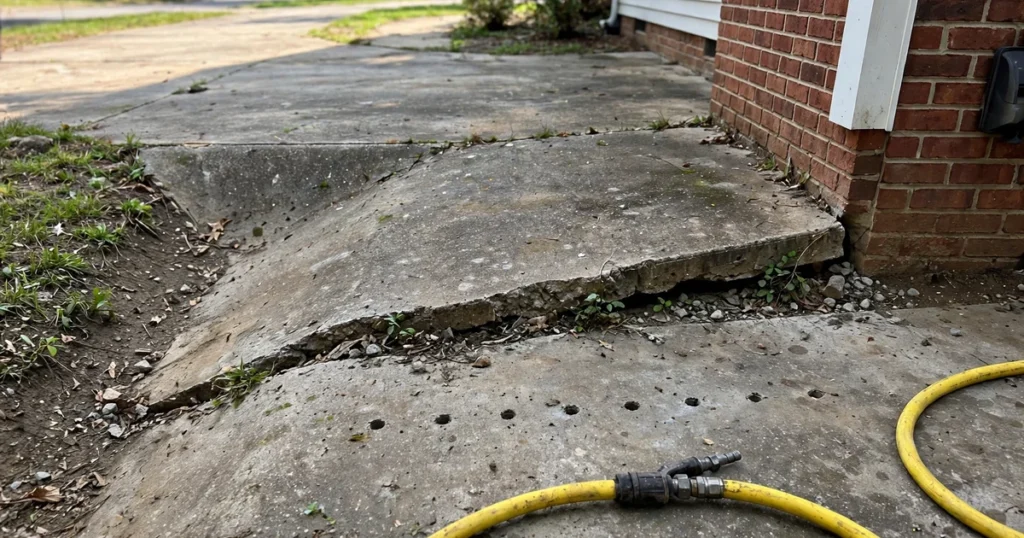
A sunken concrete slab is more than a trip hazard. It collects water, cracks further at the joints, and drags down the look of a driveway, patio or garage floor. Full replacement is rarely the only option. Most sound slabs can be lifted back to level by injecting material underneath, a process called slab jacking, and the two methods worth comparing are mudjacking and polyurethane foam injection. This guide explains how each method works, what each one costs, and when lifting is the wrong call.
The short answer: mudjacking vs polyurethane foam
Mudjacking pumps a heavy cement slurry under the slab through large holes. Polyurethane foam injection, often called polyjacking, pumps a lightweight expanding foam through small holes. Both fill the void beneath the slab and push it back up. Mudjacking usually costs less up front. Foam costs more but cures in minutes, adds almost no weight to weak soil, and leaves far smaller patch marks. For a slab over weak or wet soil, or a driveway you need back in use the same day, foam is usually the better buy.
Why concrete slabs sink
Slabs rarely sink because the concrete itself fails. They sink because the ground beneath them moves. Poorly compacted fill settles over time. Water from a broken downspout, a leaking pipe or bad grading washes soil out from under the slab, leaving a void. Tree roots dry out clay soil in summer, and the soil shrinks. In cold climates, freeze and thaw cycles heave and drop the ground.
This matters because lifting treats the symptom, not the cause. If water is still washing soil away under your driveway, a lifted slab can sink again whatever method you choose. Fix the drainage first, or at least at the same time. Check that downspouts discharge well away from the slab and that the ground slopes away from the concrete.
What mudjacking is and how it works
Mudjacking is the older method, used since the early twentieth century. A crew drills holes through the slab, typically 1 to 2.5 inches across, then pumps a slurry of water, Portland cement, sand or pulverised limestone under pressure beneath the concrete. The slurry fills the void first. As pumping continues, pressure builds and the slab rises. The crew watches the level closely and lifts slowly to avoid cracking the slab. When the slab is level, the holes are plugged and patched with cement mortar.
The main drawback is weight. Mudjacking slurry weighs roughly 100 to 140 pounds per cubic foot. On soil that already let a slab sink once, that extra load can encourage further settlement. The large holes are also more visible after patching, and the slurry needs 24 to 72 hours to cure before it can carry heavy loads such as vehicles.
What polyurethane foam injection is and how it works
Polyjacking injects a two-part polyurethane foam under the slab. The two liquid components mix at the injection gun, then expand rapidly into a rigid, closed-cell foam. The crew drills much smaller holes, usually about 5/8 inch across, roughly the size of a dime. The expanding foam fills voids and lifts the slab with precise control, and it reaches most of its strength within 15 to 30 minutes. You can usually walk or drive on the slab the same day.
Foam is extremely light, weighing roughly 2 to 8 pounds per cubic foot. That matters on weak soil, because the repair adds almost no new load. The closed-cell foam also resists water, so it does not wash out the way a cement slurry can. The trade-off is price: the foam material and the specialist rig cost more, so quotes run higher than mudjacking for the same job.
Mudjacking vs polyjacking side by side
| Factor | Mudjacking | Polyurethane foam |
|---|---|---|
| Material | Cement slurry: water, cement, sand or limestone | Two-part expanding polyurethane foam |
| Hole size | 1 to 2.5 inches | About 5/8 inch |
| Weight added | 100 to 140 lb per cubic foot | 2 to 8 lb per cubic foot |
| Cure before heavy use | 24 to 72 hours | 15 to 30 minutes |
| Water resistance | Can wash out over time | Closed-cell foam resists water |
| Patch visibility | Larger, more noticeable | Small, easy to conceal |
| Best for | Large areas, tight budget, stable soil | Weak soil, wet ground, fast return to use |
What lifting costs
Published figures disagree, so understand the spread before you accept a quote. Mudjacking is commonly quoted at $3 to $8 per square foot, while polyjacking is quoted at $5 to $25 per square foot. Typical residential jobs land roughly between $500 and $4,000 depending on slab size, how far it has sunk, and how much void needs filling.
Use these figures only as a planning range. Get at least two quotes, and ask what is included: patching, cleanup, and any warranty. These are US market figures from published contractor guides; UK prices vary by region, so local quotes are the only reliable numbers for a UK project.
| Job type | Mudjacking guide range | Polyjacking guide range |
|---|---|---|
| Single walkway panel | $300 to $600 | $500 to $800 |
| Small patio or porch | $700 to $1,200 | $1,000 to $1,800 |
| Full driveway | $1,500 to $3,000 plus | $2,500 to $5,000 plus |
When lifting is the wrong answer
Lifting only works if the slab itself is still sound. If the concrete is shattered, crumbling, or badly cracked through its full depth, pumping material underneath will not make it a good slab again. Replacement is the honest answer there. The same applies if the problem is a failing foundation: that needs a foundation specialist, not a lifting crew.
| Situation | Lift it | Replace it |
|---|---|---|
| Settled evenly, few or no cracks | Yes, ideal candidate | No |
| Cracked but pieces still stable | Often yes, plus crack repair after | If cracks are wide or growing |
| Shattered or crumbling | No | Yes |
| Foundation movement suspected | No, get a foundation assessment | As advised by the specialist |
For cracks that remain after a lift, see our concrete crack repair guide and our concrete spalling repair guide. If the slab is a driveway, check how thick a concrete driveway should be before deciding whether the original slab was built to a reasonable standard.
What to ask before you hire
- Which method do you recommend for my soil and slab, and why?
- What is included in the quote: patching, cleanup, and warranty?
- How long before I can drive on the slab?
- What happens if the slab cracks during the lift?
- What drainage or grading work do I need first so it does not sink again?
- Is the slab thick enough and sound enough to lift, or should it be replaced?
A good contractor answers the drainage question before talking about price. If a quote skips drainage entirely, get a second opinion. For common errors around slabs, see our DIY concrete mistakes guide.
Frequently asked questions
How long does slab lifting last?
It depends on the method and on whether the cause is fixed. Foam resists water and adds little weight, so it tends to last longer on weak or wet soil. Mudjacking can last many years on stable, dry soil but may need repeating if water keeps washing the slurry out. No contractor can guarantee a lifespan without knowing your soil and drainage.
Is mudjacking or foam better for a driveway?
Foam is usually better for a driveway you need back in use quickly, and for weak soil. Mudjacking is reasonable for a large driveway on stable soil where budget matters most and a day or two out of use is acceptable.
Will the holes show after the repair?
Mudjacking holes are larger and more visible, even after patching. Foam holes are small and usually blend in well, especially on a broom-finished surface.
Can a badly cracked slab be lifted?
Sometimes, if the pieces are still stable and the cracks are not growing. A shattered or crumbling slab cannot be saved by lifting and should be replaced instead.
Does lifting fix drainage problems?
No. Lifting restores the level, but if water still pools against the slab or washes soil from beneath it, the slab can settle again. Fix grading, downspouts and leaks first.
How much does slab lifting cost?
Published US guide ranges run roughly $3 to $8 per square foot for mudjacking and $5 to $25 per square foot for polyjacking, with typical residential jobs between $500 and $4,000. Local quotes vary, so get at least two before deciding.
Conclusion
For a sound slab that has settled, lifting beats replacement on cost, time and disruption. Mudjacking wins on upfront price; foam wins on speed, weight and water resistance. Whichever method you choose, the repair only lasts if the cause is fixed: sort the drainage, confirm the slab is sound enough to lift, and hire a contractor who explains the method, not just the price.
Sources
- Engineer Fix: Which Is Better, Mudjacking or Foam Injection?
- Angi: Mudjacking vs Polyjacking
- TK Concrete Lifting: Mudjacking vs Foam Lifting
- Unfinished Man: Mudjacking vs Polyjacking
- Golden Bay Foundation Builders: Why Polyjacking Is a Faster Alternative to Mudjacking
About the author
Kaleemullah Formulas use standard geometry and published bag yields; sources are linked in each article.