
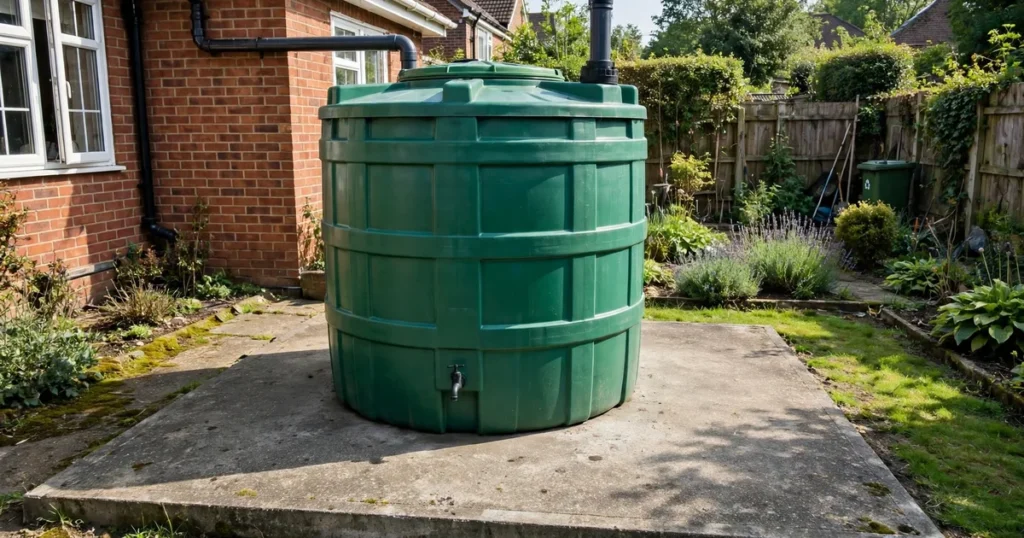
A water tank is heavier than it looks. Water weighs 1 kg per litre, so a full 1,000 litre tank weighs 1 tonne, and a 5,000 litre tank weighs 5 tonnes, before the tank itself. A base that is too small, too thin or out of level will crack, tilt or split the tank. Build a flat, level slab at least 100 mm thick, at least 100 mm longer and wider than the tank, reinforced with mesh, and cure it at least five days before adding the tank. This guide covers size, thickness, grade and cost for UK rainwater tanks.
The short answer
Measure the tank footprint, add 100 to 200 mm on each side, and pour a slab to that size. For most domestic tanks up to 5,000 litres, a 100 mm slab of C25 or C35 concrete with mesh, on compacted hardcore, is a sound starting point. Larger tanks, soft ground or a slope need a thicker slab and heavier mesh, and a tank over 10,000 litres needs a design, not a guess. Always check the maker instructions first. The base must be flat, smooth and level, with no high spots, since a tank bridging a hump will stress its floor.
How heavy is a full tank?
Work the weight out before choosing a thickness. One litre of water weighs 1 kg, so a 1,000 litre tank holds 1 tonne, a 2,500 litre tank 2.5 tonnes, a 5,000 litre tank 5 tonnes, and a 10,000 litre tank 10 tonnes. Add the tank itself: a plastic tank may add 50 to 150 kg, a steel tank more. The load is spread over the footprint, so a small tank can press harder per square metre than a large one. A slab that suits a wide, low tank may not suit a tall, narrow one of the same capacity.
Size the base
The base must support every edge of the tank, with a margin all round. AQUAPLATE guidance says the slab should be at least 100 mm longer and wider than the tank, and other makers recommend 100 to 150 mm wider. Use 100 mm as a minimum and 150 to 200 mm where you have room, since the extra margin eases levelling and drainage and leaves room for pipework. For a round tank the base is usually square, sized to the diameter plus the margin. Mark it with string and check the diagonals are equal.
| Tank size | Water weight | Typical base size |
|---|---|---|
| 1,000 litres, round, 1.2 m diameter | 1 tonne | 1.4 m by 1.4 m |
| 2,500 litres, round, 1.6 m diameter | 2.5 tonnes | 1.8 m by 1.8 m |
| 5,000 litres, round, 2.0 m diameter | 5 tonnes | 2.2 m by 2.2 m |
| 5,000 litres, rectangular, 2.4 m by 1.5 m | 5 tonnes | 2.6 m by 1.7 m |
| 10,000 litres, round, 2.5 m diameter | 10 tonnes | 2.7 m by 2.7 m, design check |
These sizes use a 100 mm margin each side. If the ground slopes, the base must still be level, so cut into the slope or build up the low side with compacted hardcore, never loose fill.
Thickness and grade by tank size
Maker minimums are a floor, not a target. AQUAPLATE guidance calls for at least 100 mm thick concrete with F62 mesh, flat and level, with a metal trowel finish. Megastor requirements call for at least 100 mm and C35 concrete with 300 kg of cement per cubic metre. Other guides recommend at least 25 MPa concrete, about C25, at 100 mm with mesh. On a slope, increase thickness and mesh grade. Start at 100 mm and C25 or C35 with mesh, then step up for weight, slope or poor ground.
| Tank size | Slab thickness | Grade and mesh |
|---|---|---|
| Up to 1,000 litres, firm flat ground | 100 mm | C25, A142 mesh |
| 1,000 to 2,500 litres, firm flat ground | 100 mm | C25 or C35, A142 mesh |
| 2,500 to 5,000 litres | 100 to 150 mm | C35, A193 mesh |
| 5,000 to 10,000 litres | 150 mm | C35, A193 mesh, design check |
| Any size on soft ground or a slope | 150 mm or more | C35, heavier mesh, engineer advice |
Do not use a thin blinding slab or pavers for a large tank. Pavers can suit a small tank on firm ground if laid flat on a sand and cement bed, but a concrete slab is safer over 1,000 litres. Our slab thickness guide explains thickness for other jobs.
Build the base step by step
Clear the area and strip topsoil and soft material down to firm ground. Lay 100 mm of compacted MOT Type 1 hardcore and check it is level; our guide to gravel under concrete explains the sub-base. Set formwork to size, square it and peg it firmly. Place mesh on chairs so it sits mid-slab, not on the ground. Pour, spread, tap the formwork to release air, and level with a straight edge. Finish with a float then a steel trowel for a smooth, flat top: any ridge under the tank becomes a stress point. Cover and keep damp for a few days. Do not put the tank on for at least five days, longer in cold weather.
Worked examples with the tank tool
Use the site tank base calculator to check your tank. Take a 2,500 litre round tank, 1.6 m in diameter. Add 100 mm each side and the base is 1.8 m by 1.8 m, 3.24 square metres. At 100 mm thick the volume is 0.32 cubic metres; add 10 percent waste and order about 0.36. For a 5,000 litre tank, 2.0 m in diameter, the base is 2.2 m by 2.2 m, 4.84 square metres. At 150 mm thick the volume is 0.73 cubic metres, so order about 0.8. Ready-mix has a minimum load, often about 1 cubic metre, so check it before ordering. For a similar shed base, see our concrete base for a shed guide.
Cost in the UK
A small tank base is cheap in materials and expensive if it fails. A 1.8 m by 1.8 m base at 100 mm thick needs about 0.35 cubic metres of concrete, plus hardcore, mesh and formwork. Ready-mix for that volume, with a minimum load charge, commonly runs into the low hundreds of pounds, while a bagged mix costs more per cubic metre but avoids the minimum charge. A 5,000 litre base at 150 mm needs about 0.8 cubic metres, so concrete costs roughly double. Labour is usually a day for a small base. Local quotes govern; get at least two and check what each includes.
Mistakes to avoid
- Pouring on soft ground or topsoil.
- Making the base smaller than the tank. Every edge must be supported.
- Leaving the top rough or out of level. A hump under the tank stresses its floor.
- Skipping mesh. A thin slab without mesh cracks far more easily.
- Putting the tank on too soon. Wait at least five days, longer in cold weather.
- Forgetting the overflow and outlet.
- Using a slope as a level. The base must be level even if the ground is not.
Frequently asked questions
How thick should a concrete base be for a water tank?
At least 100 mm for most domestic tanks, with mesh, on a compacted base. Use 150 mm over 2,500 litres, on soft ground, or on a slope. Check the maker instructions first.
How big should the base be?
At least 100 mm longer and wider than the tank, 150 to 200 mm where you have room. Every edge must be supported, with no overhang.
What grade of concrete should I use?
C25 suits a small tank, and C35 is the maker minimum in some guidance. Use C35 with heavier mesh for larger tanks, slopes and poor ground.
How long should I wait before putting the tank on the base?
At least five days, as maker guidance requires. Wait longer in cold weather, and do not fill the tank until the slab has gained strength.
Can I use pavers instead of a concrete slab?
Pavers can suit a small tank on firm, flat ground. A concrete slab is safer over 1,000 litres and on soft ground.
Does the base need to be perfectly level?
Yes. A tank on an unlevel base will tilt, stress its floor and may split. Check the level both ways with a long spirit level before the concrete sets.
Conclusion
A water tank base is a small slab with a big job. Size it to the tank plus a margin, pour it at least 100 mm thick with mesh, finish it flat and level, and let it cure for at least five days. Rush it, and the base will be the cheapest part of a very expensive repair.
Sources
- Irrigation Box: Kingspan and AQUAPLATE Tank Base Guidance
- D and H Group: Megastor Water Tank Base Requirements
- Reptile Knowledge: What Is the Best Tank Base?
- JustAnswer: Concrete Slab Thickness for 2500L Water Tank
Last verified: November 2026.
About the author
Kaleemullah Formulas use standard geometry and published bag yields; sources are linked in each article.