
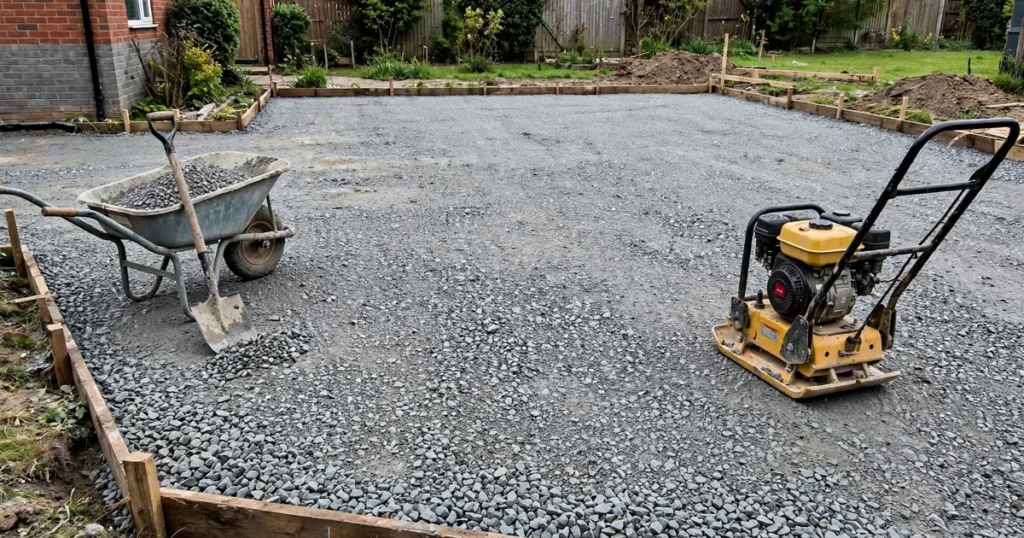
How Thick Should Gravel Be Under Concrete?
The gravel layer under a concrete slab is called the subbase, and it does more work than most people realise. It spreads the load over a wider area of ground, stops the concrete sinking into soft soil, and breaks the capillary path that draws ground moisture up into the slab. Get the depth wrong and even a perfectly mixed slab will crack or settle.
The guidance is simple. This article gives the depths, explains MOT Type 1 versus Type 3, works out a real tonnage example, and finishes with a compaction checklist.
The Short Answer
Gravel under a concrete slab should be 100 to 150mm deep after compaction. For a typical garden slab or shed base, 100mm of well compacted MOT Type 1 is enough. Driveways and heavy loads need 150mm. At 100mm depth, each square metre needs about 0.16 tonnes of MOT Type 1, so a 20 square metre slab takes roughly 3.2 tonnes.
Why Concrete Needs a Gravel Subbase
Concrete is strong in compression but brittle. If the ground is soft in one spot and firm in another, the slab bridges the soft spot and eventually cracks. A compacted gravel subbase evens out those differences and turns patchy soil into a firm, uniform platform.
The subbase also handles water. Gravel does not wick moisture the way soil does, so it breaks the capillary rise that would keep the underside of the slab damp. On clay soils this matters, because clay swells when wet and shrinks when dry. The gravel cushions the slab against that movement.
Finally, the subbase gives you something to compact. You cannot compact loose topsoil into a reliable foundation, but you can compact crushed stone into a surface that barely moves under a plate compactor. That firmness is what the slab relies on.
How Deep: 100mm or 150mm?
Depth is always measured after compaction, because loose gravel settles by roughly a fifth. Tip 125mm loose to finish at 100mm compacted.
| Use | Compacted depth | Material |
|---|---|---|
| Garden shed base | 100mm | MOT Type 1 |
| Patio or path slab | 100mm | MOT Type 1 |
| Domestic driveway | 150mm | MOT Type 1 |
| Base on soft or clay soil | 150mm | MOT Type 1 |
| Waterlogged ground | 150mm | Type 3 |
For almost every domestic job, 100mm of MOT Type 1 is the answer. Go to 150mm when vehicles will drive over the slab, when the shed will hold heavy workshop kit, or when the ground is soft enough that your boot leaves a deep print. Thicker than 150mm is overkill for a home project.
One common mistake is pouring extra concrete instead of extra subbase. On soft ground, a thicker slab with no gravel still cracks. The strength of the build comes from the ground up.
MOT Type 1 vs Type 3
In the UK, hardcore is sold to specifications set by the Department for Transport. The two you will see at the merchant:
- MOT Type 1 is graded crushed stone from 40mm down to dust. The fines lock together under compaction, so it sets almost like concrete. This is the default choice under slabs.
- Type 3 is open graded, with the fine dust missing. Water passes straight through it, so it suits waterlogged ground. It does not lock together as tightly.
For a standard shed base, patio or driveway, order MOT Type 1. Only reach for Type 3 if the ground is genuinely waterlogged and you need drainage through the subbase itself. Crushed concrete, sold as recycled Type 1, is a cheaper alternative that compacts well. Check it is properly graded and free of soil, timber and plasterboard.
Worked Example: Tonnage for a 20 Square Metre Slab
Area times depth gives volume, and volume times compacted density gives weight. At 100mm depth, one square metre of subbase is 0.1 cubic metres of compacted stone. Compacted MOT Type 1 weighs roughly 1.6 tonnes per cubic metre, so:
0.1 x 1.6 = 0.16 tonnes per square metre.
For a 20 square metre slab: 20 x 0.16 = 3.2 tonnes.
Add 10% for waste and uneven ground: 3.2 x 1.1 = 3.52, so order about 3.5 tonnes. In bulk bags, which hold roughly 0.85 tonnes each, that is four to five bags. Loose tipped loads are cheaper per tonne if you have somewhere to tip.
| Depth (compacted) | Volume per m2 | Tonnes per m2 |
|---|---|---|
| 100mm | 0.10 m3 | 0.16 |
| 150mm | 0.15 m3 | 0.24 |
Densities vary a little between quarries, so treat 1.6 tonnes per cubic metre as a typical figure and round your order up. Spare hardcore always finds a use. Running short means a second delivery charge.
For the concrete to go on top, our slab concrete calculator works out volume and bag count from your slab dimensions. To see what else goes wrong on DIY pours, read our guide to common concrete mistakes.
Compaction Checklist
Loose gravel is just expensive decoration until it is compacted. Run through this list:
- Excavate to firm, undisturbed ground. Remove all topsoil, turf and roots.
- Spread stone in layers no thicker than 75mm. Thicker layers stay loose underneath.
- Compact each layer with a plate compactor, two or three slow passes over the whole area. Hire one for the day.
- Water very dry stone lightly before compacting. Damp stone locks together better.
- Check levels after each layer with a spirit level and string line. Fix dips now.
- The finished surface should feel rock hard. If your boot leaves a print, compact again.
What Happens If You Skip the Gravel?
Without a subbase, the slab bears directly on ground that varies in firmness. Wet winters soften one corner, dry summers shrink the clay under another, and the slab rocks and cracks. Skipping gravel also skips the moisture break: soil wicks water up into the concrete, and a permanently damp slab rots timber bearers. The subbase is the cheapest part of the job. A few tonnes of MOT Type 1 costs far less than breaking out and re pouring a cracked slab.
Frequently Asked Questions
Can I use pea gravel under concrete?
No. Pea gravel is rounded and never locks together, so it shifts under load. Use angular crushed stone such as MOT Type 1.
Do I need gravel under a thin slab?
Yes. Thin slabs are more fragile, not less, so uniform support matters even more. Keep 100mm of subbase and keep the slab at 100mm too.
Should the gravel extend beyond the slab?
Yes, about 100mm past the slab edge on all sides. This supports the slab edges, which are the weakest part, and stops the edge undermining into soft soil.
Can I compact the subbase by hand?
For a small path, a hand tamper works. For a shed base or anything bigger, hire a plate compactor for the day. The hire cost is small next to the concrete sitting on top.
Is hardcore the same as MOT Type 1?
Roughly. Hardcore is the general term for broken brick, concrete and stone used as fill. MOT Type 1 is hardcore graded to a specification, so it compacts predictably. For under concrete, always specify graded Type 1 rather than random rubble.
How much MOT Type 1 should I order?
Work it out at 0.16 tonnes per square metre for 100mm depth (0.24 for 150mm), then add 10% for waste. Order the full amount in one delivery to keep haulage costs down.
Conclusion
Gravel under concrete should be 100 to 150mm deep after compaction: 100mm of MOT Type 1 for garden slabs and shed bases, 150mm for driveways and heavy loads. Work out tonnage at 0.16 tonnes per square metre for 100mm depth, add 10% for waste, and compact in thin layers with a plate compactor. It is the cheapest insurance in the whole build. A slab on a proper subbase stays flat and crack free for decades, while a slab poured straight onto soil is a repair job waiting to happen.
Sources
- The Concrete Society: Good Concrete Guides
- The Concrete Centre (MPA): Specification guidance
- ACI PRC-302.1-15: Guide to Concrete Floor and Slab Construction
About the author
Kaleemullah Formulas use standard geometry and published bag yields; sources are linked in each article.