
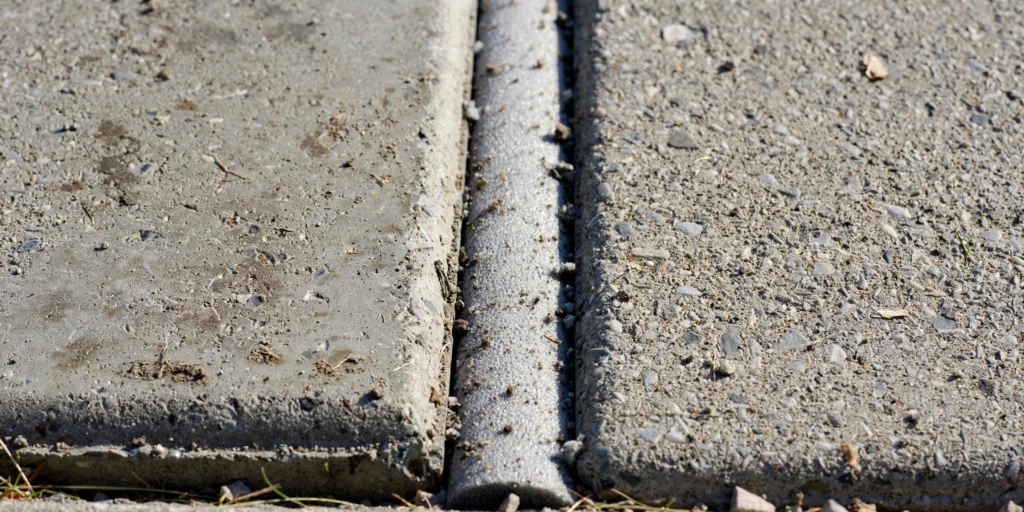
Expansion joints, also called isolation joints, are gaps built into a concrete slab so it can move without cracking or pushing against nearby structures. For most domestic driveways and patios, closed-cell polyethylene foam is the best all-round filler: it compresses easily, resists water and rot, and costs little. Bitumen-impregnated fibreboard is the traditional choice and still suits wider joints, while cork and sponge rubber suit specialist work. Do not confuse expansion joints with control joints: control joints are shallow cuts that force cracks into straight lines, while expansion joints are full-depth separations letting the slab move against buildings, columns and existing concrete.
Expansion joints vs control joints: the key difference
Concrete shrinks as it cures, then expands and contracts with temperature. With nowhere to move, pressure builds and the slab cracks randomly or pushes against whatever sits next to it. Mixing up the two solutions is one of the most common DIY concrete mistakes.
A control joint (also called a contraction joint) is a shallow groove, about a quarter of the slab depth. It creates a deliberate weak point so shrinkage cracking follows a neat straight line. Control joints stay in the slab and separate nothing.
An expansion joint, properly called an isolation joint, goes through the full slab depth. It completely separates one piece of concrete from another, or from a wall, column or pipe, using a compressible filler so the slab can move without pressing on the structure beside it. Different materials, different purposes: keep them clearly separated in your planning.
Where domestic slabs actually need expansion joints
Not every slab needs expansion joints. Many guides overstate the requirement, leading homeowners to cut up sound patios for no reason. The honest rule: you need an isolation joint wherever the slab could push against something that will not move.
- Against a building: a patio or path meeting a house wall needs a joint along the wall, so the slab never presses on brickwork or foundations.
- Around columns and posts: isolate a garage or carport slab from every column, pier and drainpipe base.
- New concrete meeting old: an extension needs a joint between the two pours, because they move at different rates.
- Long runs: a long driveway or path benefits from transverse joints every 3 to 4.5 metres, breaking it into independently moving sections.
- Middle of a small freestanding slab: rarely needed. Control joints handle shrinkage here; extra isolation joints just create weak spots.
Still planning? Check your slab thickness too, because joint depth relates to slab thickness.
Filler material comparison
| Material | Compressibility | Moisture resistance | Typical use |
|---|---|---|---|
| Bitumen-impregnated fibreboard | Good, recovers partially | Moderate; bitumen coating resists water but can degrade over decades | Traditional choice for driveways, paths and commercial slabs |
| Closed-cell polyethylene foam | Excellent, springs back well | Excellent; does not absorb water or rot | Best all-round option for patios, driveways and paths |
| Cork (plain or self-expanding) | Good | Good; naturally resistant to decay | Specialist and heritage work, some commercial floors |
| Sponge rubber | Excellent | Good | Heavy-duty and industrial joints, bridge decks |
| Recycled PVC foam | Good | Excellent | Modern alternative where a long service life matters |
The main filler materials in detail
Bitumen-impregnated fibreboard is what most builders picture as expansion joint filler: cane or wood fibres soaked in bitumen, sold in strips that stand on edge before the pour. It compresses well and has decades of history. Its weakness is longevity in wet ground, where the fibres can eventually break down and leave a gap that collects soil and weeds.
Closed-cell polyethylene foam is the modern default for domestic work. Its sealed cells absorb almost no water, so it will not rot or feed weeds. It compresses and rebounds cleanly, cuts easily, and costs little. Most DIYers should simply buy this.
Cork falls under the same ASTM D1751 standard as fibreboard and sponge rubber. It has a long history in commercial flooring, but for a home patio it is overkill.
Sponge rubber has the best compression recovery of the group, which suits bridges and industrial floors. It is harder to find in DIY quantities and costs more, so it rarely suits a driveway. Recycled PVC foam is a newer water-resistant option; treat it as a premium alternative where available.
Buy strips that match your slab depth, with the top 6 to 12 mm below the finished surface for sealant. Before ordering, use a slab concrete calculator to confirm slab dimensions and concrete volume, since joint layout affects the pour plan.
Where expansion joints are needed vs not needed
| Situation | Expansion joint needed? | Why |
|---|---|---|
| Patio poured against a house wall | Yes | Slab must never press on the building |
| Driveway extension joining an old drive | Yes | New and old concrete move differently |
| Around garage columns or gate posts | Yes | Isolates the slab from fixed points |
| Long straight driveway or path | Yes, at intervals | Breaks a long slab into moving sections |
| Middle of a small freestanding patio | No | Control joints handle shrinkage here |
| Interior domestic floor slab | Rarely | Temperature swings are small indoors |
Finishing joints with backer rod and sealant
Preformed filler does the structural job, but the top of the joint still needs weatherproofing. The standard practice: set the filler below the surface, press in a backer rod (a round foam cord), then gun a flexible sealant over the top. The rod controls sealant depth and stops bottom bonding, so the sealant can stretch as the joint moves.
For joints under about 12 mm wide, many installers skip preformed strips and use backer rod plus sealant alone. Polyurethane is the workhorse for exterior concrete: it bonds well, stays flexible and can be painted. Silicone handles UV very well but usually cannot be painted. Polysulphide suits commercial floors and is overkill for a home drive.
Sealant options for finished joints
| Sealant | Best for | Flexibility | Paintable |
|---|---|---|---|
| Polyurethane | Driveways, patios, paths | High | Yes |
| Silicone | Joints with strong sun exposure | Very high | Usually no |
| Polysulphide | Commercial and industrial floors | High | Yes |
| Butyl rubber | Budget repairs, low-movement joints | Moderate | Yes |
Installing filler correctly
- Fix filler strips before the pour with stakes or adhesive, so wet concrete cannot push them over.
- Keep the top of the filler 6 to 12 mm below the finished slab level to leave room for the sealant.
- Pour one side of the joint at a time and do not let concrete slump over the top of the filler.
- After curing, press backer rod in so the sealant bead sits at roughly half the joint width in depth.
- Apply sealant on a dry day with the joint clean and dust-free, per the product data sheet.
- Never fill an expansion joint with mortar or rigid concrete. That locks the joint solid and defeats its entire purpose.
Frequently asked questions
Which type of filler should I choose for a driveway joint?
For a domestic driveway, closed-cell polyethylene foam is the safest choice: it compresses and rebounds well, absorbs almost no water, will not rot, and is cheap and easy to cut. Bitumen-impregnated fibreboard is the traditional alternative, but it can degrade in persistently wet ground.
What is the difference between an expansion joint and a control joint?
A control joint is a shallow groove creating a planned weak line, so shrinkage cracks appear straight and neat. An expansion joint (isolation joint) goes through the full slab depth, completely separating the concrete from a building, column or another slab so each moves independently. Different jobs; not interchangeable.
What does ASTM D1751 cover?
ASTM D1751 is the standard specification for preformed expansion joint fillers in concrete paving and structural work, covering sponge rubber, cork, self-expanding cork and recycled PVC. A filler meeting this standard has been tested for compression, recovery and weathering.
How deep should expansion joint filler sit?
The filler top should sit 6 to 12 mm below the finished surface, leaving space for a backer rod and sealant bead. Filler left flush or above the surface gets damaged by traffic and looks untidy.
Can I just use sealant without a preformed filler?
For joints up to about 12 mm wide, yes: backer rod with polyurethane or silicone sealant is standard practice. For wider joints, a preformed filler does the compressible work and the sealant is just the weatherproof cap. Sealant alone in deep joints wastes money and performs worse.
Do I need expansion joints in a small patio?
Usually not in the middle of the slab: a small freestanding patio mainly needs control joints for shrinkage cracking. You do need an expansion joint wherever the patio meets something fixed, such as a house wall or existing slab, so the new concrete can never push against it.
Conclusion
Expansion joint filler is a small detail with an outsized effect on slab life. Remember the distinction: control joints guide cracks, expansion joints allow movement. Use a compressible filler such as closed-cell foam or fibreboard wherever the slab meets a fixed structure, cap it with backer rod and sealant, and never fill the gap with anything rigid. Done properly, the joints vanish and the concrete moves freely for decades.
About the author
Kaleemullah Formulas use standard geometry and published bag yields; sources are linked in each article.