
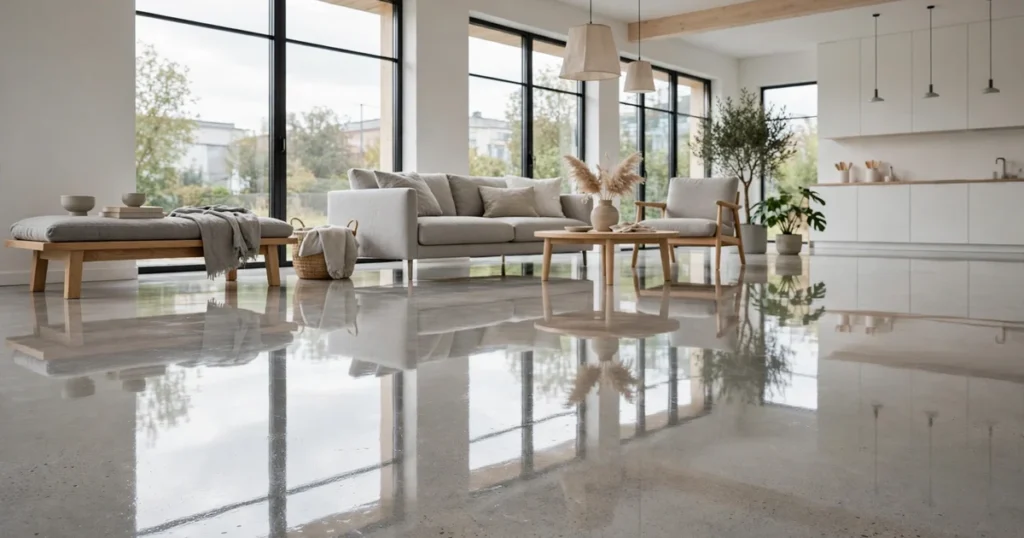
How much does polished concrete cost? For a poured and polished floor in the UK, expect £120 to £150 per square metre (Checkatrade, verified by CIOB and RICS estimators). In the US, most work falls between $3 and $12 per square foot, with decorative floors $15 to $20 or more. But the headline range hides two separate choices that most guides wrongly treat as one: the gloss level (finish Levels 1 to 4) and the aggregate exposure (cream, salt-and-pepper or rock cut).
| Finish level (CPC) | Gloss reading | UK (£/m²) | US ($/ft²) |
|---|---|---|---|
| Grind-and-seal | Sealed, low sheen | £20-40 on existing slab (MyBuilder) | Lower end of range (HomeGuide) |
| Level 1: Flat/ground | 0-9 | £20-40 (MyBuilder basic) | $3-6 (HomeGuide) |
| Level 2: Satin/honed | 10-39 | ~£50 existing; £120-150 new (Checkatrade) | $4-8 (HomeGuide) |
| Level 3: Polished | 40-69 | £120-180 (Premier) | $5-10 (HomeGuide) |
| Level 4: Highly polished | 70+ | £150-200+ plus extras (Premier; MyBuilder) | $6-15, decorative $15-20+ (HomeGuide) |
Gloss bands from the ASCC CPC appearance chart; price bands attributed per row. The UK and US are separate markets, so never convert one into the other.
The two decisions every price guide mixes up
Most guides treat “finish” as one thing, but the Concrete Polishing Council defines two independent specifications.
1. Gloss level: how reflective the floor is
The CPC appearance chart grades polished concrete on reflection and light behaviour, not the abrasive sequence (a distinction the trade press at Construction Canada stresses). The four levels: Level 1, Flat/ground (gloss 0 to 9, matte); Level 2, Satin/honed (10 to 39, the most popular choice for homes); Level 3, Polished (40 to 69, clear reflective shine); Level 4, Highly polished (above 70, mirror finish). Distinctness of image is measured under ASTM D5767, with a haze index below 10.
One US guide uses its own uncited 1 to 4 bands. Ask your contractor to quote against the CPC levels instead.
2. Aggregate exposure: how much stone shows
Exposure is graded separately in Classes A to C (the older Class D is now folded into Class C, per Craftsman Concrete Floors). Class A, cream is the lightest, cheapest grind. Class B, salt-and-pepper exposes fine aggregate. Class C, rock cut grinds deepest and costs the most. Variation in the finished floor is inherent, not a defect.
You can combine any gloss level with any exposure class: Level 2 satin with rock-cut aggregate, or Level 4 mirror gloss with cream. Any quote that names a price without stating both is incomplete.
Why higher finish levels cost more: the grit ladder
Each level means more machine passes with finer abrasives: Level 1 stops below 100-grit resin, Level 2 works up to around 400 grit, and Level 3 runs to 800 grit and beyond (Concrete Network). Between stages the contractor applies a densifier, a lithium or sodium silicate that reacts with free lime to harden the pores (Heidelberg Materials). That is what separates true polished concrete from a coating: the shine is mechanical, with no film on the surface.
UK polished concrete prices in detail
UK pricing is the best documented of any market. 2026 guides from Checkatrade, Heidelberg Materials, MyBuilder and Premier Concrete Design:
- New floor, poured, finished and polished: £120 to £150 per m² (Checkatrade; Heidelberg Materials quotes the same band). Budget the slab itself first with our concrete cost calculator.
- Polishing an existing slab: around £50 per m² (Checkatrade).
- Typical installer range: £100 to £200 per m², most jobs £120 to £180 (Premier Concrete Design).
- Basic polish: £20 to £40 per m²; decorative finishes: £30 to £60 per m² (MyBuilder).
- Prep, levelling and repairs: £15 to £30 per hour extra (MyBuilder).
US polished concrete prices
US installers broadly agree on $3 to $12 per square foot, decorative floors $15 to $20+. HomeGuide publishes its own bands of $3 to $6, $4 to $8, $5 to $10 and $6 to $15; treat those as HomeGuide’s figures. Check whether the number covers a new pour or polishing an existing slab.
Worked examples: what real projects total
Worked totals from the sourced ranges above, assuming a sound slab.
40 m² open-plan living space, Level 2 satin, Class B exposure: 40 × £120 to £150 = £4,800 to £6,000. Checkatrade independently cites a 40 m² open-plan room from £4,800, which lands exactly on this math.
The same room at Level 4 with dye and a saw-cut pattern: 40 × £150 to £200 = £6,000 to £8,000 before pattern extras. The jump is the extra grit steps and decorative work.
The same room as grind-and-seal: 40 × £20 to £40 = £800 to £1,600. Cheaper up front, but it is a topical sealer that needs reapplying, not a polish.
A small single garage: Checkatrade’s average is £2,093 (range £760 to £3,426). Small areas cost more per square metre because mobilisation, edging and protection spread over fewer metres.
A small bathroom: Checkatrade’s bathroom average of £304 (range £153 to £455) shows how minimum charges bite on tiny jobs.
What drives the price up or down
| Cost driver | Effect on price |
|---|---|
| Flatness | An uneven slab needs extra passes before polishing begins |
| Aggregate exposure depth | Class C rock cut needs deeper grinding than Class A cream |
| Gloss level | Each CPC level adds finer grit steps and machine time |
| Dye, stains and saw-cut patterns | Priced as extras, often per linear metre for cuts |
| Edging and obstacles | Columns and doorways mean slow hand work at the edges |
Hidden add-ons and the quote checklist
Watch for line items some quotes bury or omit: crack and joint repairs, coating removal, levelling, dye or stain, decorative saw cuts, and sealing.
- Which CPC finish level (1 to 4), in writing?
- Which exposure class (A, B or C)?
- Is surface preparation and crack repair included, and at what rate?
- What do dye, stain and saw-cut patterns add?
Two quotes at different prices are often quoting different finish levels. Pinning down the level and exposure class is the fastest way to compare like with like.
Grind-and-seal is not polished concrete
A grind-and-seal floor is ground smooth and coated with a topical sealer. True polished concrete is refined through the grit sequence with a densifier and no surface film. Sealed floors cost less up front but need reapplying. The distinction matters when a cheap “polished” quote turns out to be a sealed grind.
DIY vs hiring a contractor
A floor grinder rents for roughly £50 to £150 per day (MyBuilder). DIY can work for a small utility room if you are comfortable with heavy machinery and dust extraction, but the edges need slow hand work and the grind must stay even. For living spaces or anything above a basic finish, a contractor’s experience is worth paying for. Ignore lifespan claims without a named source: one guide’s “50 to 100+ years” figure has none, so ask installers what they actually guarantee.
Frequently asked questions
What is the difference between grind-and-seal and polished concrete?
Grind-and-seal coats a ground slab with a topical sealer. Polished concrete is refined mechanically with a densifier; the shine is in the concrete itself. Sealed floors cost less now but need resealing; polished floors cost more up front and the finish lasts.
Is polished concrete slippery?
Level 4 high-gloss floors can be slick when wet, which is why many homes choose Level 2 satin in kitchens, bathrooms and entrance halls. Honed finishes keep more grip while still looking refined.
Does polished concrete work with underfloor heating?
Yes. Floors are commonly poured over heating pipework; Premier notes typical floors are around 100 mm thick with pipes roughly 80 mm below the surface.
Will a polished concrete floor crack?
All concrete can crack. Good preparation, control joints and a sound slab keep the risk low, and hairline cracks can be repaired first. Ask what crack repair your quote includes.
Does deeper aggregate exposure raise the price?
Yes. More exposure means grinding deeper, which adds machine time and labour. Class A cream is cheapest for this reason.
What should a polishing quote spell out?
The CPC finish level (1 to 4), the exposure class (A, B or C), whether preparation and repairs are included, and the price of dye or decorative work. Without the level and exposure class, two quotes cannot be compared fairly.
Conclusion
Polished concrete cost comes down to two spec decisions: gloss level and aggregate exposure. Get both named in writing on every quote and use the worked examples above as a reality check. Budget the pour with our concrete cost calculator, cure the slab with our curing guide, and check concrete costs per cubic yard for the material side.
Sources
- ASCC Concrete Polishing Council appearance chart: https://ascconline.org/Portals/ASCC/CPC-Appearance-Chart-10_2_25 (Corrected)_1.pdf
- Construction Canada on CPC levels: https://www.constructioncanada.net/refined-concrete-vs-polished/
- Craftsman Concrete Floors on exposure Classes A/B/C: https://www.craftsmanconcretefloors.com/styles-of-polished-concrete-floors/
- Concrete Network on grit progression per level: http://www.concretenetwork.com/concrete/polishing/levels.html
- Checkatrade polished concrete floor cost guide (CIOB/RICS-verified): https://www.checkatrade.com/blog/cost-guides/polished-concrete-floor-cost/
- Heidelberg Materials UK on polished concrete floors and densifiers: https://www.heidelbergmaterials.co.uk/en/ready-mixed-concrete/technical-information/polished-concrete-floors
- MyBuilder polished concrete floor cost guide: https://www.Mybuilder.com/carpets-lino-flooring/price-guides/polished-concrete-floor-cost
- Premier Concrete Design on UK pricing and floor build-up: https://www.premierconcretedesign.co.uk/polished-concrete-floors
Last verified: October 2026.
About the author
Kaleemullah Formulas use standard geometry and published bag yields; sources are linked in each article.