
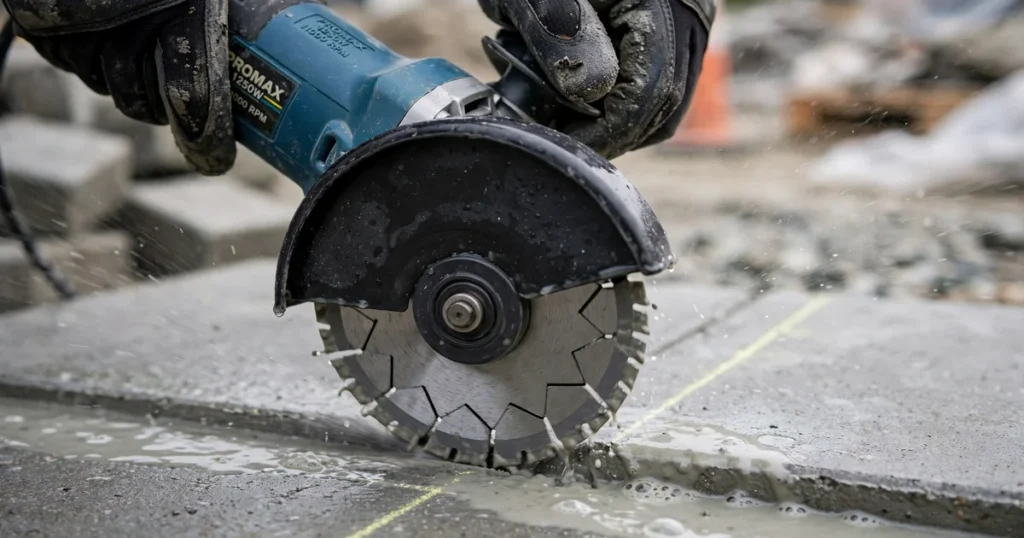
Yes, an angle grinder can cut concrete, but only within honest limits. With a segmented diamond blade, a 115 mm (4.5 in.) grinder cuts about an inch deep per pass: ideal for scoring and splitting pavers, blocks and tiles, and for trimming edges, but it cannot cut through a 4-inch slab in one pass. This guide covers blade selection, the OSHA dust-control rules, wet versus dry cutting, and the slurry, guard and kickback warnings.
Choosing the right blade
Concrete needs a laser-welded segmented diamond blade with deep gullets. The segments do the cutting, and the gullets vent heat and flush out slurry and dust as the blade spins. Thin continuous-rim or turbo tile blades clog and overheat on concrete; they are made for tile, not for a material that eats blades. Blade manufacturers sell grinder blades in the 105 to 230 mm range, so buy one that matches your grinder.
Bond hardness matters too: the metal matrix holding the diamonds must wear at the right rate to keep exposing fresh diamond, or the blade glazes over or wears out in minutes.
| Material you are cutting | Bond to choose | Why |
|---|---|---|
| Abrasive or green (freshly cured) concrete, asphalt | Hard bond | Soft abrasive material wears the bond fast, so a hard bond keeps the diamonds seated |
| Cured concrete, reinforced concrete | Soft to medium bond | Hard cured material needs the bond to wear so fresh diamonds are exposed |
Then the wet-versus-dry rating, a rule competitors state but never explain: dry-rated blades can be used with or without water, but wet-rated blades must only be used wet, because they rely on water for cooling. Run a wet-only blade dry and you destroy it. For DIY flexibility, buy a dry-rated blade.
Wet or dry: what the evidence says
Several ranking guides call dry cutting “the preferred choice” because it makes less mess, then tell you to wear a dust mask. That advice is backwards. Peer-reviewed research (Thorpe et al. 1999) found that wet cutting on handheld saws cuts respirable dust by 94 to 96% compared with dry cutting. The UK Health and Safety Executive, in its May 2026 silica crackdown, reported that dry fabrication produces 5 to 10 times higher respirable crystalline silica exposure than wet methods.
The verdict: cut wet whenever you can. Dry cutting is acceptable only with proper dust extraction and a properly fitted respirator, not a paper mask, and water also cools the blade, extending its life.
The OSHA silica rules, quoted properly
Silica dust is the serious hazard in concrete cutting. The US Occupational Safety and Health Administration sets a permissible exposure limit of 50 micrograms per cubic metre of respirable crystalline silica as an 8-hour time-weighted average. Its construction standard, 29 CFR 1926.1153, includes Table 1, which lists the required controls for each task. Entry (xii) covers handheld grinders used for jobs other than mortar removal, and it is far more specific than “wear a mask”:
| Control option | Required specification |
|---|---|
| Integrated water delivery | Water delivered continuously to the grinding surface |
| Shroud plus dust collection (alternative) | Shroud with a dust collection system providing at least 25 CFM per inch of wheel diameter, a filter with 99% or greater efficiency, and a cyclonic pre-separator or filter-cleaning mechanism |
The respirator requirement depends on duration and location: outdoors with water delivery, no respirator is required for up to 4 hours; indoors with a dust-collection shroud beyond 4 hours, use a respirator with APF 10. Note the engineered-stone caveat: the HSE’s May 2026 ruling made dry cutting of engineered stone unacceptable in the UK with APF 20 protection under strict controls. That ban applies to engineered stone, not ordinary concrete, but in the UK concrete cutting still needs silica control under COSHH, and wet methods remain best practice.
Depth limits and technique
A 4.5-inch grinder manages roughly an inch of depth per pass, so forget slicing through a slab. For pavers, blocks and tiles, score about an inch deep along the marked line on both faces, then split with a cold chisel and a lump hammer. Two controlled passes beat one forced deep cut, which overheats the blade and risks binding.
For cutting concrete that is already laid, mark the line with chalk, score it shallow first to establish the groove, then deepen it in successive light passes. If you need a full-depth cut through a 4-inch slab, such as for a new control joint or a patch removal, rent a walk-behind saw or a cutoff saw. Trying to force an angle grinder through four inches of concrete is how blades bind and grinders kick back.
Guard, grip and kickback
Never remove the guard: it must sit between you and the blade. Keep the blade perpendicular to the work, let the tool do the work instead of forcing it, and clamp the workpiece so it cannot shift mid-cut. Kickback happens when the blade pinches; a straight, steady feed and a firm two-handed grip keep it under control. Always unplug the grinder, or remove the battery, before changing blades.
Do not forget the slurry
Wet cutting produces alkaline slurry, and no competitor guide we reviewed mentions what to do with it. Do not let it run into storm drains or across lawns, where it damages plants and waterways. Dike the work area with rags or a low berm so the slurry pools, let the solids settle, scoop them out, and dispose of them under your local waste rules. On a driveway, a wet-vacuum makes cleanup straightforward.
When to rent a bigger saw
The angle grinder is the right tool for pavers, blocks, tiles, edge trimming and shallow scoring. Rent a walk-behind or handheld cutoff saw when you need full-depth cuts through slabs, long straight runs in a driveway, or repeated deep cuts where a grinder would take all day. For more on planning slab work properly, see our slab thickness guide, and if you are adding new joints, read our guide on filling expansion joints.
Frequently asked questions
Can a 4.5-inch angle grinder cut through concrete?
Not through a full slab. It cuts about an inch deep per pass, so it scores and trims concrete beautifully but cannot cut through a 4-inch slab in one pass. Score both sides and split with a chisel, or rent a cutoff saw for full-depth cuts.
What type of blade cuts concrete on an angle grinder?
A laser-welded segmented diamond blade with deep gullets, sized for your grinder. Match the bond to the material: hard bond for abrasive or green concrete, soft to medium bond for cured or reinforced concrete. Buy a dry-rated blade for wet-or-dry flexibility.
Should I cut concrete wet or dry with an angle grinder?
Wet, whenever possible. Wet cutting reduces respirable dust by 94 to 96% compared with dry cutting, cools the blade, and extends blade life. Dry cutting is acceptable only with proper dust extraction and a fitted respirator.
What respirator do I need for cutting concrete?
Follow OSHA Table 1. Outdoors with water delivery, no respirator is required for up to 4 hours. Indoors with a dust-collection shroud beyond 4 hours, use a respirator with APF 10. A paper dust mask is not adequate for dry cutting.
Can I use a wet-rated diamond blade dry?
No. Wet-rated blades rely on water for cooling, and running one dry destroys the blade and overheats the grinder. Dry-rated blades can be used wet or dry, which is why they are the better DIY choice.
What should I do with the slurry from wet cutting?
Contain it, let the solids settle, scoop them out, and dispose of them under your local waste rules. Do not wash alkaline slurry into storm drains or onto lawns.
Conclusion
An angle grinder with a segmented diamond blade is the right tool for scoring, splitting and trimming concrete, and cutting wet with the guard on makes it safe and efficient. Respect its depth limits, quote the silica rules instead of improvising them, contain your slurry, and rent a cutoff saw when the job outgrows the grinder. Before you start, it is worth reading our roundup of common DIY concrete mistakes so the cut goes in the right place first time.
Sources
- OSHA 29 CFR 1926.1153 Table 1 (silica exposure controls)
- OSHA silica PEL and Table 1 summary (50 µg/m³ 8-hour TWA)
- Thorpe et al. 1999 via Annals of Work Exposures and Health (wet methods cut handheld-saw dust 94-96%)
- HSE May 2026 (engineered-stone dry-cutting crackdown, 5-10x higher dry exposure)
- Blade manufacturer FAQ (segmented laser-welded blades, bond selection, wet/dry ratings)
Last verified: October 2026.
About the author
Kaleemullah Formulas use standard geometry and published bag yields; sources are linked in each article.