
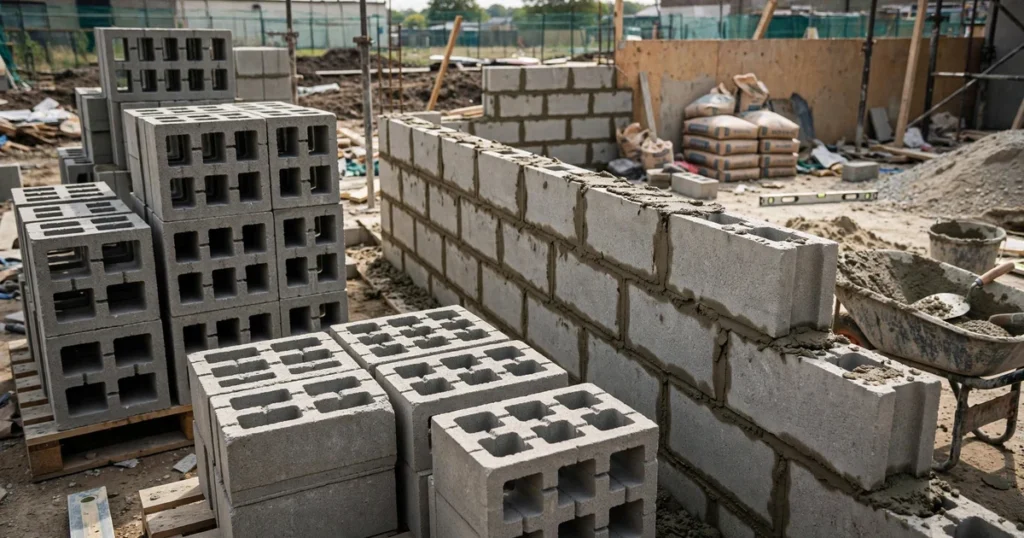
Ordering blocks is a balancing act. Too few and the bricklayer stands around while you make a second trip. Too many and you are stuck storing a pallet for a year. This guide gives you the wall-length method, worked examples for both UK breeze blocks and US standard blocks, and the mortar estimates most guides leave out.
For footings under the wall, see our concrete calculator.
The short answer
Measure your wall in square metres (or square feet), then multiply. For UK standard breeze blocks (440 by 215 mm), allow 10 blocks per square metre. For US standard blocks (8 by 8 by 16 in), allow 1.125 blocks per square foot. Add 5 to 10 percent for cuts and waste.
The wall-length method in three steps
Step 1: measure the wall. Measure the total length of the wall in metres and the finished height in metres. Multiply them for the wall area. A garden wall 5 m long and 1.2 m high is 6 m². For a wall with corners, measure each straight run separately and add them.
Step 2: multiply by the block rate. Use 10 blocks per m² for UK standard blocks, or 1.125 blocks per ft² for US blocks. A 6 m² wall needs 60 UK blocks. A 100 ft² wall needs 113 US blocks (100 times 1.125, rounded up).
Step 3: add waste. Add 5 percent for a simple straight wall, 10 percent for a wall with corners, piers, or steps where cuts are common. Then round up to the nearest convenient order. Nobody orders 63 blocks. You order 65 or 70.
Subtract large openings like gateways from the wall area before you multiply. Skip small openings under half a square metre: the waste allowance covers them.
UK worked example: breeze blocks at 10 per square metre
UK standard concrete blocks, usually called breeze blocks, measure 440 mm by 215 mm on the face and are typically 100 mm thick, laid flat. Where does the 10 per square metre rule come from?
- The block face is 440 by 215 mm, an area of 0.0946 m².
- Divide 1 m² by 0.0946 and you get 10.57 blocks per square metre.
- Mortar joints are 10 mm, so each block effectively occupies 450 by 225 mm, or 0.10125 m². Divide 1 m² by 0.10125 and you get 9.88 blocks per square metre.
- Round to 10 blocks per m². That is the trade rule.
Worked example: a garden wall 6 m long and 1.5 m high.
- Wall area: 6 times 1.5 = 9 m².
- Blocks: 9 times 10 = 90 blocks.
- Waste at 10 percent for corners and cuts: 90 times 1.1 = 99.
- Order: 100 blocks.
Thicker walls use thicker blocks. A 140 mm or 215 mm block still measures 440 by 215 mm on the face, so the 10 per square metre rule still applies. What changes is the mortar quantity, not the block count.
US worked example: 8 by 8 by 16 inch blocks
US standard concrete masonry units are nominally 8 by 8 by 16 inches. Nominal means the 8 by 16 inch face includes the mortar joint, so the block face itself is slightly smaller. The nominal face area is 8/12 by 16/12 feet, which is 0.8889 ft².
- Divide 1 ft² by 0.8889 and you get 1.125 blocks per square foot.
- A 100 ft² wall needs 100 times 1.125 = 112.5, rounded up to 113 blocks.
Worked example: a retaining wall 24 ft long and 4 ft high.
- Wall area: 24 times 4 = 96 ft².
- Blocks: 96 times 1.125 = 108 blocks.
- Waste at 7 percent: 108 times 1.07 = 115.6.
- Order: 116 blocks, or 120 if your supplier sells in lots.
If your wall is solid-filled with concrete or rebar, run the numbers through our wall concrete calculator to work out the fill.
Quick block count table
| Wall area | UK breeze blocks (440x215mm) | US blocks (8x8x16 in) |
|---|---|---|
| 2 m² (21.5 ft²) | 20 blocks | 25 blocks |
| 5 m² (54 ft²) | 50 blocks | 61 blocks |
| 10 m² (108 ft²) | 100 blocks | 122 blocks |
| 15 m² (161 ft²) | 150 blocks | 182 blocks |
The table is before waste. Add your 5 to 10 percent on top. For the US column, the conversion used is 1 m² = 10.764 ft², then 1.125 blocks per ft².
The mortar estimates everyone skips
Blocks are only half the order. Without mortar you have a dry stack. These are rough estimates for planning, not exact mix design. Always check the mix ratio printed on the bag.
UK, 1 to 4 cement to sand mix. A common rough guide is about 0.008 m³ of mortar per square metre of 100 mm block wall. For the 9 m² garden wall above, that is 9 times 0.008 = 0.072 m³ of mortar. At a 1 to 4 mix, one 25 kg bag of cement yields roughly 0.03 m³ of mortar, so allow 3 bags of cement (0.072 divided by 0.03 = 2.4, rounded up) and about 4 to 5 bags of building sand.
US, pre-mixed mortar bags. A widely used rough rule is that one 80 lb bag of mortar mix lays about 35 to 40 standard 8 by 8 by 16 blocks. For the 116-block retaining wall above: 116 divided by 35 = 3.3, so order 4 bags. Buy one extra. Running out of mortar mid-course with a loaded wall is worse than carrying one spare bag.
Mortar joints are 10 mm (3/8 in) in both systems. Thicker joints eat mortar fast and weaken the wall, so keep them consistent.
Ordering tips that save a second trip
- Half blocks. Corners and ends need half blocks. Check whether your supplier stocks half blocks before you cut full ones with a bolster.
- Pallets. Blocks come palletised: typically around 72 per pallet for US standard blocks, and 80 to 100 per pallet for UK blocks. If your count lands near a full pallet, round up to it.
- Damage. Blocks chip in transit. Order a few extra beyond your waste allowance for badly broken ones.
- Match the batch. Blocks from different production batches can vary slightly in shade. For fair-faced work, order everything at once.
- Capping. If the wall has a coping or cap, count those units separately using the same method.
Frequently asked questions
How many concrete blocks do I need per square metre?
Ten standard UK blocks (440 by 215 mm) per square metre, laid flat. This includes the 10 mm mortar joints. Add 5 to 10 percent for cuts and waste.
How many 8 by 8 by 16 blocks are in 100 square feet?
About 113 blocks: 100 times 1.125, rounded up. Add 5 to 10 percent for waste, which brings it to roughly 119 to 125 blocks.
Do mortar joints change the block count?
The rates above already include mortar joints. The US nominal size includes the 3/8 in joint, and the UK 10 per m² rule is worked from the 450 by 225 mm jointed module. Do not add joints on top of the rates.
How much mortar do I need for concrete blocks?
As a rough guide: one 80 lb bag of US pre-mixed mortar lays about 35 to 40 standard blocks. For UK work at a 1 to 4 mix, one 25 kg bag of cement yields about 0.03 m³ of mortar, which covers roughly 3 to 4 m² of 100 mm block wall.
How many blocks fit on a pallet?
It varies by supplier, but typically around 72 standard blocks per pallet in the US and 80 to 100 per pallet in the UK. Confirm with your supplier before ordering delivery.
Should I order extra blocks?
Yes. Order 5 percent extra for simple straight walls and 10 percent for walls with corners, steps, or piers. Chips in transit and miscuts are the main reasons DIY builders run short.
Courses per wall height
| Wall height | UK courses (215 mm block + 10 mm joint) | How to count |
|---|---|---|
| 1.0 m | 5 | Height divided by 225 mm, rounded up. |
| 1.5 m | 7 | Height divided by 225 mm, rounded up. |
| 2.0 m | 9 | Height divided by 225 mm, rounded up. |
| 2.4 m | 11 | Height divided by 225 mm, rounded up. |
US blocks run about 1.4 courses per foot of height (8 in block plus a 3/8 in joint). The top course is cut to fit.
Conclusion
Count your blocks by wall area, not by guessing. Measure length by height, multiply by 10 per square metre (or 1.125 per square foot), add your waste percentage, and order the mortar at the same time. Ten minutes of maths saves a second delivery charge.
About the author
Kaleemullah Formulas use standard geometry and published bag yields; sources are linked in each article.