
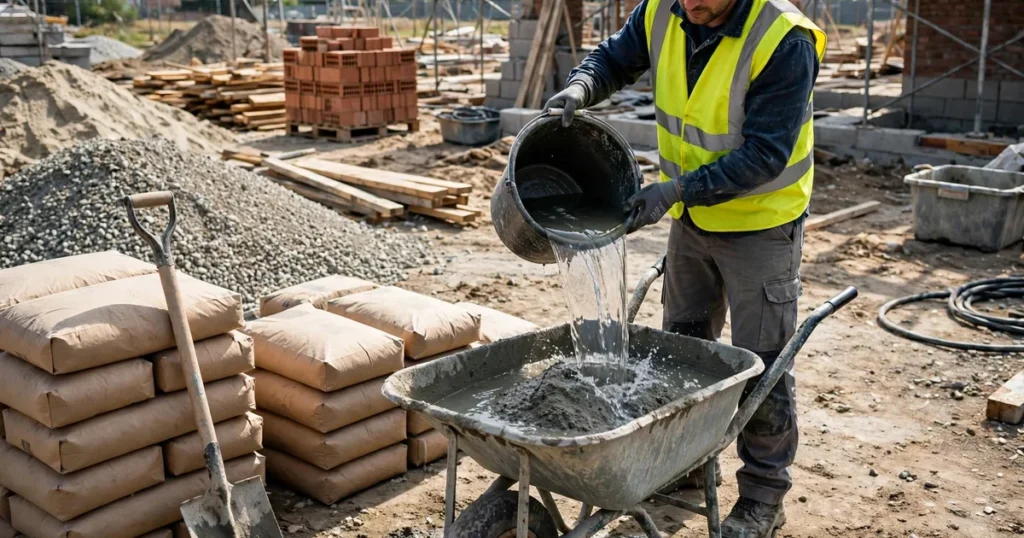
One number decides more about your concrete than any other: how much water you use for each kilo of cement. Too little and the mix is stiff and hard to place. Too much and the concrete is weak, porous and short lived. The water-cement ratio is the weight of water divided by the weight of cement in a mix. A lower ratio gives stronger, denser concrete, and a higher ratio gives weaker, more porous concrete. For most domestic work, aim for a ratio of 0.5 or lower, and never add water on site to make a stiff mix easier to place.
The short answer
Work out the ratio by dividing the litres of water by the kilos of cement, since 1 litre of water weighs 1 kg. For example, 180 litres of water with 400 kg of cement gives 180 divided by 400, which is 0.45. A ratio of 0.4 to 0.5 suits most structural and driveway work. A ratio of 0.55 to 0.6 suits light, non-structural work such as blinding or mass fill. Above 0.6, strength and durability fall away fast. If a mix is too stiff at the right ratio, use a plasticiser, not extra water. Our 1:2:4 mix ratio guide shows how the ratio sits inside a common site mix.
What the ratio means
Cement needs water to harden, a reaction called hydration, which needs only about 0.25 parts of water to 1 part of cement by weight. In practice you need more, since a mix at 0.25 would be too dry to place. The extra water makes the mix workable, but any water the cement does not use stays in the concrete, then dries out and leaves pores. Those pores make concrete weaker, let water and frost in, and let steel rust faster. That is why the ratio matters more than the amount of cement. Adding cement to a wet mix does not fix it; only less water, or a plasticiser, does.
Typical ratios by job
Use the table as a starting point, not a design. Structural work, exposed work and anything that must last in frost needs a lower ratio than light, sheltered work. Always follow the design or the supplier mix for structural concrete, and use these figures only for small domestic jobs where no design exists.
| Job | Typical ratio | Notes |
|---|---|---|
| Blinding, mass fill | 0.6 to 0.7 | Non-structural, sheltered only |
| Paths, light slabs, fence posts | 0.55 to 0.6 | Light loads, no frost exposure |
| Patios, shed bases, general work | 0.5 to 0.55 | Good all round domestic range |
| Driveways, garage floors, footings | 0.45 to 0.5 | Needs strength and durability |
| Exposed slabs, frost, heavy loads | 0.4 to 0.45 | Use air entrainment for frost |
| High strength, structural | 0.35 to 0.45 | Needs a plasticiser, designed mix |
BS 8500 sets maximum ratios by exposure class, with lower limits where concrete faces frost, water or chemicals. CivilEngPro notes a BS 8500-2 maximum of 0.65 for normal weight concrete in moderate exposure, 0.60 for reinforced concrete, and 0.45 for prestressed concrete. Those are maximums, not targets. A good domestic mix sits well below them.
How the ratio affects strength
The link between ratio and strength is called Abrams law, after Duff Abrams, who set it out in 1919: for a given set of materials, strength falls as the ratio rises. Building Supply Today gives a clear example, with a ratio of 0.40 giving about 50 MPa and a ratio of 0.70 giving about 20 MPa, a fall of about 60 percent. Exact figures depend on cement, aggregate and curing, so do not treat them as a promise. The direction is what matters: a little extra water costs a lot of strength. It also raises permeability, how easily water passes through hardened concrete. Engineers Views notes that each 0.05 rise in ratio roughly doubles permeability, based on research by Powers in 1958. More pores mean more frost damage and faster rusting of steel.
Water per 25 kg bag
On site, measure water in litres per bag of cement. The table uses a 25 kg bag, the common UK size, and assumes dry aggregate. Wet sand holds water, so damp sand needs less added water. Check the mix by eye and feel, and note how much water you used, so the next batch matches.
| Target ratio | Water per 25 kg bag | What it feels like |
|---|---|---|
| 0.4 | 10 litres | Very stiff, needs a plasticiser |
| 0.45 | 11.25 litres | Stiff, holds its shape |
| 0.5 | 12.5 litres | Workable, like stiff porridge |
| 0.55 | 13.75 litres | Easy to place, slumps readily |
| 0.6 | 15 litres | Wet, flows easily, weak when set |
For a bagged concrete mix, follow the water amount on the bag, not this table. The bag maker has already allowed for the aggregate in the bag. For a site mix, use a bucket, not a hose, and add about two thirds of the water first, then the rest slowly while mixing. Our hand mixing guide shows that method step by step.
Worked example with the water-cement ratio tool
Use the site water-cement ratio calculator to check your mix. Take a small driveway slab needing 300 kg of cement per cubic metre at a ratio of 0.5. The water needed is 300 times 0.5, which is 150 litres per cubic metre. For 2 cubic metres, that is 600 kg of cement and 300 litres of water. Now suppose a labourer adds 20 litres per cubic metre to make it flow. The ratio becomes 170 divided by 300, which is 0.57, and strength falls sharply. That one bucket per cubic metre has undone the design. If the mix is too stiff, use a plasticiser or a slower pour, not the hose.
The site-added water trap
The most common way a good mix becomes a bad slab is water added on site: the mix has stiffened, the sun is hot, the pour is behind schedule. The damage is done in seconds and cannot be undone by mixing longer. Extra water also causes bleed water, which rises to the surface as concrete settles. A little bleed is normal, but a lot means the mix was too wet, and trowelling while it is present traps a weak, dusty layer on top. If the mix stiffens, do not add water. Remix it, add a plasticiser, or reject the load. A rejected load is cheaper than a weak slab.
Mistakes to avoid
- Adding water to a stiff mix. Use a plasticiser instead.
- Measuring water with a hose. Use a bucket and keep a note of the amount.
- Ignoring wet sand. Damp aggregate adds water you cannot see.
- Trowelling over bleed water. Wait until it has gone, or the surface will dust.
- Mixing batches with different water amounts. The slab will cure unevenly.
- Trusting a ratio without checking the mix. Look at it, feel it, and test it.
Frequently asked questions
What is a good water-cement ratio?
For most domestic work, 0.5 or lower is good, and 0.45 to 0.5 suits driveways, footings and garage floors. Lighter work can use 0.55 to 0.6. Structural work needs a designed mix, often 0.35 to 0.45.
How do I calculate the water-cement ratio?
Divide the weight of water by the weight of cement. Since 1 litre of water weighs 1 kg, divide litres of water by kilos of cement. For example, 150 litres divided by 300 kg is 0.5.
Does more water make concrete stronger?
No. More water makes concrete weaker and more porous. Only the water the cement needs for hydration helps. Extra water leaves pores when it dries out.
Can I add water to concrete on site?
Do not. It raises the ratio and cuts strength. If the mix is too stiff, use a plasticiser, remix it, or reject the load. A small amount of water costs a lot of strength.
What ratio should I use for a driveway?
Aim for 0.45 to 0.5, with air entrainment if the driveway faces frost. Order ready-mix to a designated mix, such as C30 or PAV1, rather than guessing a site ratio.
Does the ratio affect curing?
Yes. A high ratio mix bleeds more, dries faster on the surface and needs more careful curing. A low ratio mix needs water or a curing compound too, since it dries out faster. Keep both covered and damp.
Conclusion
The water-cement ratio is the simplest check in concrete and the easiest to get wrong. Keep it at 0.5 or lower for most domestic work, measure the water with a bucket, and never add water on site to fix a stiff mix. Get the water right and the rest of the mix has a chance. Get it wrong and no amount of cement, curing or finishing will save the slab.
Sources
- Building Supply Today: Water-Cement Ratio
- CivilEngPro: What Is the Water-Cement Ratio?
- The Civil Studies: Water-Cement Ratio Formula, Table and Best Practices
- Concrete Calculator Max: Concrete Mix Ratios Explained
- Engineers Views: Concrete Mix Design Guide
Last verified: November 2026.
About the author
Kaleemullah Formulas use standard geometry and published bag yields; sources are linked in each article.