
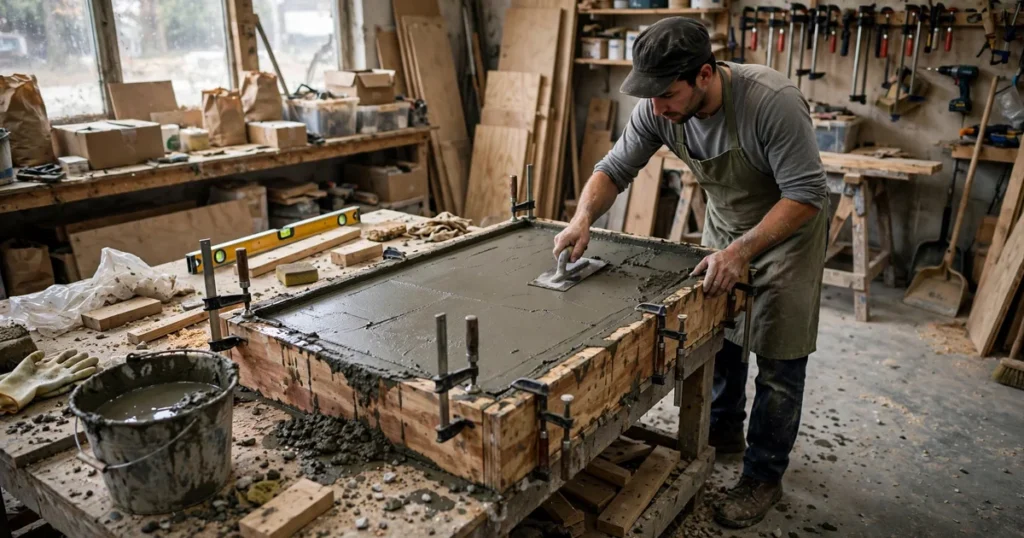
How Much Concrete Do You Need for a Countertop? A Worktop Build Guide
Concrete countertops, called worktops in the UK, have gone from a niche industrial look to a mainstream kitchen choice. They cost far less than stone when you cast them yourself. The catch is that a countertop is a precision pour: the volume is small, the finish has to be perfect, and you need the right number of bags before you start mixing.
Direct answer: A standard 3 metre by 600mm by 40mm kitchen worktop needs about 0.072 cubic metres of concrete. That is five 80lb bags in the US, or seven 25kg bags in the UK, with a small allowance for waste. To find your own volume, multiply length by width by thickness in consistent units.
How to work out countertop volume
The formula is simple: volume = length x width x thickness, with all three in the same unit. For metric work, convert millimetres to metres first.
Worked example (3m x 600mm x 40mm): 3 x 0.6 x 0.04 = 0.072 cubic metres (2.54 cubic feet, or 0.094 cubic yards).
For an L-shaped worktop, split it into two rectangles, work out each volume and add them. The corner overlap gets counted twice, which slightly overestimates. That is fine: a small surplus beats running short mid-pour.
How many bags of concrete for a countertop
Bagged concrete is sold by weight, but what matters is the yield per bag:
- 80lb bag = 0.60 cubic feet
- 60lb bag = 0.45 cubic feet
- 40lb bag = 0.30 cubic feet
- 25kg bag = 0.0117 cubic metres
- 20kg bag = 0.0094 cubic metres
Divide your volume by the yield and round up, adding 5 to 10 percent for waste. The table below already includes the waste allowance.
| Worktop size | Volume | 80lb bags (US) | 25kg bags (UK) |
|---|---|---|---|
| 2m x 600mm x 40mm | 0.048 m3 | 4 | 5 |
| 3m x 600mm x 40mm | 0.072 m3 | 5 | 7 |
| 2.4m x 650mm x 50mm | 0.078 m3 | 6 | 8 |
| 3m x 900mm x 50mm island | 0.135 m3 | 9 | 13 |
For other sizes, run your dimensions through our concrete bag calculator. Batching your own mix from cement, sand and aggregate? Our concrete mix ratio calculator breaks down the ingredients.
One weight check before you cast: concrete weighs about 2,400kg per cubic metre, so the 3m worktop above weighs roughly 173kg. Make sure you have enough people for the lift.
What mix to use
Standard gravel concrete suits a 40mm slab poorly. The coarse aggregate makes a smooth finish hard to achieve. Better choices:
- High-strength bagged mix: dense surface that polishes well, widely available in the US.
- Sand and topping mix: a finer blend suited to thin sections.
- Countertop-specific mix: blended for this exact job, often with glass fibre included. In the UK, ask a builders merchant for mixes rated for thin sections.
- Site-batched 1:4 cement to sharp sand: the traditional UK approach, with glass fibre added.
Whatever you choose, keep the water content low. The mix should be workable but firm, like thick porridge. Excess water weakens the surface and increases cracking.
Building the formwork
Casting upside down in a mould gives the best finish: the smooth face forms against the mould and trowel marks end up hidden underneath.
- Use melamine-faced boards for the mould base. They release cleanly and give a flat finish.
- Seal every joint and screw hole with silicone. Wet concrete finds every gap.
- Build sides from straight timber screwed to the base, so the mould comes apart without prying against fresh concrete.
- Coat the inside with a release agent or a light wipe of vegetable oil.
- Fix sink and tap cut-outs (foam or timber block-outs) firmly in place, and mark their positions on the outside of the mould.
- Brace long moulds so the sides stay straight under the weight.
Take your time here. Almost every defect in a finished worktop traces back to the formwork: a leak, a bowed side, or a block-out that shifted during the pour.
Reinforcement
A 40mm slab of plain concrete will crack at the first knock or thermal shock from a hot pan. Reinforcement is not optional.
- Lay steel mesh or thin rebar in the middle of the slab, keeping it at least 10mm clear of each face.
- Add glass fibre to the mix to control shrinkage cracks. It is cheap insurance.
- Reinforce around sink and hob cut-outs. These are stress points, so add extra bars or fibre at every opening.
Keep all steel fully embedded. Any bar near the surface will rust and stain.
Mixing and pouring
Mix in batches small enough to place before the previous batch starts to set.
- Dampen the mould lightly first so it does not suck water from the mix.
- Fill in one continuous session. Cold joints between batches show as lines.
- Rod the concrete with a timber offcut or rebar offcut to drive out trapped air, working corners and edges.
- Tap the outside of the formwork with a mallet to release bubbles against the mould face.
- Screed level with a straight edge, then trowel once the surface firms up.
Curing and sealing
Concrete needs moisture to harden. Let it dry too fast and the surface goes weak and dusty.
- Cover the cast with plastic sheeting as soon as the surface is firm.
- Keep it covered and damp for at least 7 days.
- Demould after 24 to 48 hours, then continue curing the exposed faces.
- Concrete keeps gaining strength for about 28 days, so avoid heavy use and hot pans in the first month.
Once cured, seal the worktop. Unsealed concrete stains from oil, wine, coffee and citrus. Choose a food-safe sealer made for kitchen surfaces. Penetrating sealers soak in and keep a natural matt look; topical sealers give more stain protection but can look plasticky. Reapply every one to two years, or when water stops beading on the surface.
FAQs
How thick should a concrete countertop be?
Most DIY countertops are 38 to 50mm thick. A 40mm worktop suits standard cabinets and keeps weight manageable. A 50mm slab weighs 25 percent more than a 40mm one of the same size.
Can I use regular bagged concrete?
You can, but the coarse aggregate gives a rougher finish with more pinholes. A high-strength mix, sand and topping mix, or countertop-specific blend is easier to finish at 40mm thick.
How long before I can use the worktop?
Light use is fine after 7 days of proper curing. Allow the full 28 days before heavy use, hot pans or harsh cleaners. Seal after 7 to 14 days, once the surface is dry to the touch.
Do concrete countertops stain?
Yes, unless sealed. Concrete is porous and absorbs oil, wine, coffee and acids like lemon juice. A food-safe sealer prevents most staining, but wipe spills promptly and use boards and trivets.
How heavy is a concrete worktop?
About 2,400kg per cubic metre. A 3m by 600mm by 40mm worktop (0.072 cubic metres) weighs roughly 173kg. A 3m by 900mm by 50mm island (0.135 cubic metres) is around 324kg. Plan the lift and the cabinet supports.
Is a concrete worktop cheaper than stone?
Usually yes, when you cast it yourself. Materials run to a handful of bags plus timber, mesh and sealer. Expect a full weekend for formwork and casting, plus a week of curing before installation.
Countertop weight by thickness
| Slab thickness | Weight per m² | What it means |
|---|---|---|
| 30 mm | 72 kg | Light, but needs careful reinforcement and a flat cabinet run. |
| 40 mm | 96 kg | The standard worktop thickness; check cabinets can carry it. |
| 50 mm | 120 kg | Heavy; confirm cabinet fixings and consider extra support. |
| 60 mm | 144 kg | Very heavy; only with a properly supported base. |
Weights use a concrete density of 2,400 kg per m³. A 3 m by 600 mm worktop at 40 mm weighs about 173 kg before cut-outs.
Conclusion
A concrete worktop is one of the most rewarding DIY concrete projects because the maths is simple and the result is genuinely useful. Work out your volume, order the bags with a small waste allowance, build the formwork carefully, reinforce around every cut-out, cure patiently and seal before first use.
Sources
About the author
Kaleemullah Formulas use standard geometry and published bag yields; sources are linked in each article.