
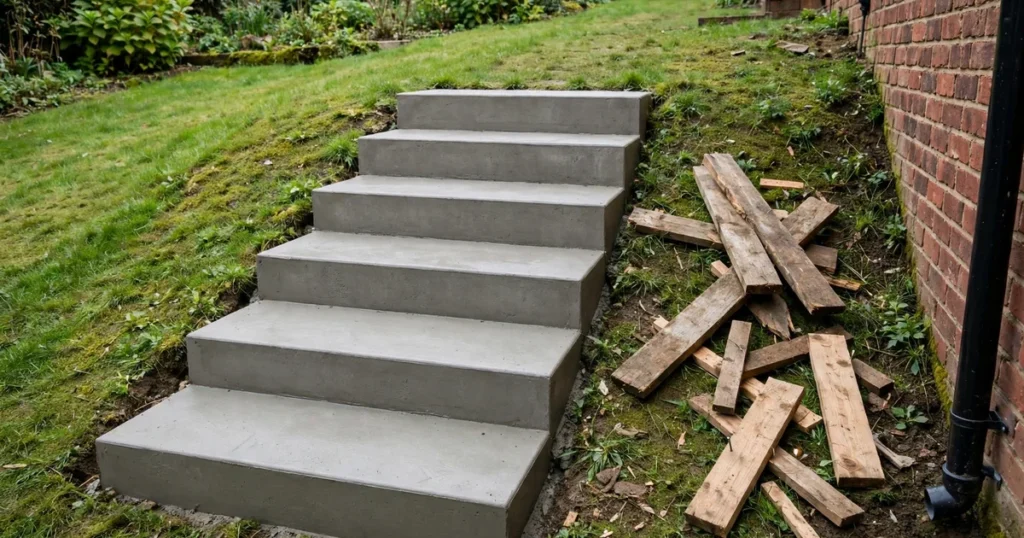
Concrete steps in the UK cost between £250 and £500 per finished step for a professionally built flight, with precast steps costing far less if you lay them yourself. For a flight of five poured concrete steps, expect to pay roughly £1,200 to £3,000 installed. Access and groundwork matter more than the concrete itself, and the volume maths matters too, because a popular online calculator gets it badly wrong.
How much do concrete steps cost per step?
There is no single UK price for a concrete step, because a step can mean a precast unit, a poured concrete core, or a poured core finished with stone or porcelain. Trade2Base gives per-step rules of thumb that work as a sanity check on any quote. Its figures assume a single flight on reasonable ground, and they exclude foundations, retaining, drainage, balustrade, lighting and removal of old steps.
| Step type | Cost per step | Typical flight of 5 steps |
|---|---|---|
| DIY precast step units | About £50 per step for the unit | £250 to £400 plus mortar and base |
| Cast in situ, bare concrete | £200 to £400 | £1,000 to £2,000 |
| Brick or block with paving tread | £250 to £500 | £1,200 to £3,000 |
| Stone or porcelain clad | £450 to £900 | £2,500 to £6,000 |
Sources: Trade2Base for the brick, stone and high specification figures; WotBlock for the precast unit price; SlabCalc and EngineerFix for the US comparison. The cast in situ row is an estimate built from Trade2Base and the US figures, and it should be treated as a planning range, not a quote.
For comparison, US sources put poured concrete steps at $200 to $500 per step installed, and precast at $100 to $350. The UK and US figures are in the same range, but do not use US dollar prices as UK prices.
Precast vs cast in situ: which should you choose?
Precast means the step units are cast in a factory or yard and delivered ready to lay on a mortar bed, much like laying oversized bricks. Cast in situ means the steps are poured on site into timber formwork with steel reinforcement inside. London Stone Step, a UK specialist, explains the trade off clearly. Precast is the cheapest route, because you pay mostly for units, mortar and sub-base materials. Poured steps cost more in labour because of the formwork and curing time.
| Factor | Precast step units | Cast in situ poured steps |
|---|---|---|
| Cost | Lower, units plus mortar | Higher, formwork and labour |
| Strength | Good for garden and entrance steps | Very strong, monolithic flight |
| Shapes | Fixed sizes only | Any size, curve or width |
Precast suits a straight flight of standard steps in a garden or at a front door. A UK supplier, WotBlock, sells four step precast stair sections 1,600 mm long, 800 mm tall and 800 mm wide, with a 200 mm rise and run, for just over £200 each, about £50 per step for the unit before delivery, mortar and the base. Cast in situ suits long or wide flights, curved steps and uneven ground. The bare concrete is rarely the finished surface, so budget for a tread finish on top.
The stairs formula trap: a popular calculator is wrong
A UK competitor, concretecalculator.uk, states that the volume of steps is rise times run times width times the number of steps. That formula is wrong for solid steps, and the error is large.
The correct formula for solid steps is: tread x riser x n(n+1)/2 x width. Each step is a different size. The bottom step is the biggest, the top step is the smallest, and the volume grows as a triangular series, not a straight multiple.
Take five steps with a 280 mm tread, a 170 mm riser and a 1.2 metre width. The wrong formula gives 0.29 cubic metres. The correct formula gives 0.86 cubic metres. The wrong answer is only 33 percent of the true volume, so a user who followed it would order a third of the concrete needed and run out mid-pour.
The same site uses yet another formula on its dedicated stairs page, modelling hollow steps with 150 mm thick slabs, and never clearly labels which method each formula applies to. Our stairs calculator labels solid steps clearly and uses the correct formula.
Worked example: five solid steps with the stairs tool
Here is the maths for a garden flight: five steps with a 280 mm tread and a 170 mm riser, 1.2 metres wide, poured as solid steps on a small base slab.
- Step volume: 1.2 x 0.28 x 0.17 x (5 x 6 / 2) = 1.2 x 0.28 x 0.17 x 15 = 0.86 cubic metres.
- Base slab under the flight, 1.2 metres by 1.4 metres by 100 mm: 0.17 cubic metres.
- Total volume: 0.86 plus 0.17 = 1.03 cubic metres.
- Add 10 percent for waste and uneven ground: 1.03 x 1.1 = 1.13, so order 1.2 cubic metres.
- Concrete at £90 to £110 per cubic metre for standard grade: £108 to £132.
- Formwork timber, reinforcement and sundries: roughly £80 to £150.
- Installed total: £1,000 to £2,000 for cast in situ, or £250 to £400 plus laying for precast units.
The concrete itself costs about £120. The money goes on formwork, labour, groundwork and the finish. A quote that skips the base slab or the reinforcement looks cheap until the steps settle or crack.
One more check before you order. Building Regulations guidance in Approved Document K caps private stair risers at 170 mm and sets a minimum going of 250 mm. Measure the total rise first and divide it into equal risers of 170 mm or less.
What else adds to the bill?
- Groundwork. Steps on a slope need a level base, and steps on soft ground need excavation and hardcore.
- Removal of old steps. Breaking out and disposing of existing concrete steps is a separate job. Trade2Base allows about £250 for it, plus skip and tipping costs.
- Handrail. A metal handrail adds several hundred pounds. Steps above a certain height need a rail under Building Regulations.
- Cladding and finish. Stone or porcelain cladding can double the cost of a flight. A non-slip nosing costs less and matters more for safety.
- Drainage. Steps that trap water at the bottom will suffer frost damage and algae. Allow for a fall away from the house.
- Delivery. At 1.2 cubic metres the order falls below most ready-mix minimum loads, so a short load surcharge may apply. Our guide to ready-mix delivery costs explains the fee.
DIY or hire a professional?
Precast steps are a realistic DIY job for a small flight. You dig a level base, lay a compacted sub-base and a mortar bed, and set each unit level, working from the bottom up. Two people can lay a five step flight in a day. Cast in situ steps are harder: the formwork must be accurate, the reinforcement must sit in the right place, and the pour must be continuous. If you have never built formwork, hire a groundworker for a poured flight. For the build method, see our guide to building concrete steps.
Frequently asked questions
How much do concrete steps cost in the UK?
Between £250 and £500 per finished step for a professionally built flight, according to Trade2Base. A five step flight costs roughly £1,200 to £3,000 installed.
Are precast concrete steps cheaper than poured steps?
Yes. Precast units are cast in a factory and laid on a mortar bed, so you pay mostly for the units and the laying. Poured steps cost more in labour because of the formwork and curing time.
How do I work out how much concrete I need for steps?
Use tread x riser x n(n+1)/2 x width, where n is the number of steps. Add the base slab, then add 10 percent for waste.
How high can each step be?
Building Regulations guidance caps private stair risers at 170 mm. Divide the total rise into equal risers of 170 mm or less.
Do concrete steps need reinforcement?
Yes, for poured steps. Steel bars inside the flight tie the steps together and stop cracking. Precast units are already reinforced in the factory.
How long do concrete steps last?
Decades, if the base is sound, the concrete is the right grade and water drains away. The usual failures are settlement from a poor base, frost damage from trapped water, and cracking from missing reinforcement.
Conclusion
Concrete steps cost £250 to £500 per finished step professionally built, or far less if you lay precast units yourself. The volume maths matters more than the price per step, because the wrong formula leaves you a third short on concrete.
Sources
- Trade2Base, Garden Steps Costs UK, https://www.trade2base.com/blog/garden-steps-costs-uk
- London Stone Step, Concrete Garden Steps: Ideas, Cost and How They Are Made, https://www.londonstonestep.co.uk/guides/concrete-garden-steps/
- SlabCalc, Concrete Steps Cost (2026), https://www.slabcalc.co/calculators/concrete-steps-cost-calculator
- EngineerFix, How Much Do Concrete Steps Cost?, https://engineerfix.com/how-much-do-concrete-steps-cost/
- ConcreteCalculator.uk stairs formula, verified against ~/workspace/concrete-site/competitor-gaps.md
- HM Government, Approved Document K, Protection from falling, collision and impact (riser and going limits for private stairs)
Last verified: November 2026.
About the author
Kaleemullah Formulas use standard geometry and published bag yields; sources are linked in each article.