
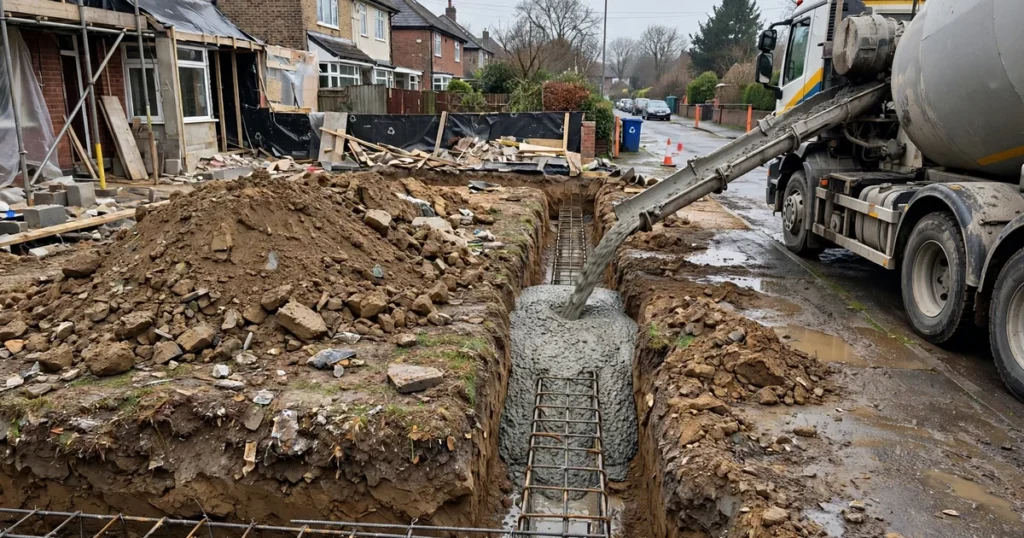
Concrete foundations in the UK cost between £70 and £300 per square metre of footprint, and the average cost to lay new house foundations is around £7,000. For a typical single-storey extension, expect roughly £4,500 to £6,500 for strip or trench fill foundations on good ground. The type, depth, ground and amount of hand digging all move the price, which is why published ranges disagree so much.
How much do concrete foundations cost in the UK?
Foundations are priced in two different ways, and mixing them up is the main reason quotes look inconsistent. Some sources price per square metre of building footprint, others per linear metre of trench. A small extension has a lot of trench relative to its floor area, so its cost per square metre looks high, while a large house looks low.
MyJobQuote puts the average cost to lay new house foundations at around £7,000, and a typical single-storey extension at £4,500 to £6,500 according to FindTheNeedle. BestBuilders puts foundations alone at £120 to £220 per square metre of footprint. MyJobQuote gives a wider range of £70 to £300 plus per square metre, priced by trench length, depth and concrete volume rather than by square metre.
| Foundation type | Cost per linear metre | Cost per m2 of footprint | Typical total |
|---|---|---|---|
| Strip, machine dug | £95 to £115 | £70 to £170 | £3,100 to £3,500 |
| Strip, hand dug | £170 to £220 | £140 to £280 | £5,000 to £6,500 |
| Trench fill, machine dug | £130 to £160 | £84 to £230 | £3,600 to £6,000 |
| Raft | Not applicable | £100 to £300 | £6,000 to £15,000 |
| Piled | Not applicable | £300 to £600 plus | From £12,000 |
Cost by foundation type
Strip foundations
Strip foundations are the cheapest option on stable ground. The builder digs a trench under each load bearing wall and pours a concrete strip about 225 to 300 mm deep at the bottom. Checkatrade puts machine dug strip foundations at £95 to £115 per linear metre, and hand dug at £170 to £220. MyJobQuote prices a 5 by 2.5 metre strip foundation at 1 metre deep at £3,100 to £3,500.
Trench fill foundations
Trench fill uses the same trench but fills it almost to the top with concrete, so the bricklayer can start sooner. It is the most common foundation for UK extensions today. It uses far more concrete than a strip, so it costs more per linear metre. Checkatrade puts machine dug trench fill at £130 to £160 per linear metre, and hand dug at £220 to £280.
Raft foundations
A raft is a reinforced concrete slab that spreads the load of the whole building across the footprint, used on poor or made up ground and where the water table is high. For slab build up, see our guide to slab thickness. MyJobQuote puts raft foundations at £150 to £300 per square metre, BestBuilders at £180 to £300, and Checkatrade at £200 to £260, with a typical total from £7,000.
Pad foundations
Pad foundations are isolated concrete blocks under individual columns or posts. They suit porches, carports and garden rooms. A single pad is cheap, often a few hundred pounds including digging and concrete. The volume is small, so a pad job often uses bagged concrete, and a short load surcharge can apply. See our guide to calculating concrete for footings for the volume maths.
Piled foundations
Piling is the most expensive option, used only where the ground is very poor or close to large trees. BestBuilders puts piled foundations at £300 to £600 plus per square metre, and MyJobQuote puts them from £12,000 for an average extension project.
What is in the price? A component breakdown
A foundation quote is not just the concrete. The table below breaks a typical trench fill foundation into its parts.
| Component | What it covers | Typical share of the total |
|---|---|---|
| Excavation | Machine or hand digging, spoil removal | 25 to 35 percent |
| Concrete | Ready-mix supply and pour | 20 to 30 percent |
| Steel reinforcement | Mesh or bar in rafts and pads | 5 to 15 percent |
| Labour | Setting out, formwork, pouring, finishing | 25 to 35 percent |
| Building Control and testing | Inspection, concrete cube tests if specified | Small, often separate |
Hand digging pushes excavation and labour up sharply, which is why Checkatrade shows hand dug strip at £170 to £220 per linear metre against £95 to £115 machine dug. The concrete itself is usually only a quarter of the bill.
Worked example: strip foundations for a 5 by 4 metre extension
Take a single-storey extension 5 metres by 4 metres, with strip foundations under the three new walls: 13 linear metres of trench, 600 mm wide, with a 300 mm deep concrete strip.
- Concrete volume: 13 x 0.6 x 0.3 = 2.34 cubic metres.
- Add 10 percent for waste and over excavation: 2.34 x 1.1 = 2.57, so order 2.6 cubic metres.
- Concrete at £90 to £110 per cubic metre for standard grade: £234 to £286.
- Installed cost at Checkatrade rates of £95 to £115 per linear metre machine dug: £1,235 to £1,495.
The gap between machine and hand digging is the single biggest saving available on a strip foundation. If a machine can reach the trench, use one.
Worked example: trench fill for the same extension
The same 13 linear metres of trench, 600 mm wide, now filled with concrete to 1 metre deep.
- Concrete volume: 13 x 0.6 x 1.0 = 7.8 cubic metres.
- Add 10 percent waste: 7.8 x 1.1 = 8.58, so order 8.6 cubic metres.
- Concrete at £90 to £110 per cubic metre: £774 to £946.
- Installed cost at Checkatrade rates of £130 to £160 per linear metre machine dug: £1,690 to £2,080.
At 8.6 cubic metres the order is above the usual ready-mix minimum load, so no short load surcharge applies. For the strip example at 2.6 cubic metres, a surcharge may apply, so check with the supplier.
What pushes the price up?
- Clay soil and trees. Reactive clay near mature trees is the classic cost trap. BestBuilders notes that foundations may need to go 1.5 to 3 metres deep.
- Hand digging. Machine access can halve the per linear metre rate. Tight access and existing services force hand digging.
- Building Control. Building Control inspects the open trench and can demand deeper or wider foundations than planned. Budget for the possibility.
- Water and drainage. A high water table means pumping, and drains crossing the footprint may need diverting or bridging.
- Access and spoil. Removing spoil from a site with no space for a skip costs more, and a long barrow run adds labour.
- Depth rules. MyQS notes that building regulations require a minimum depth of 1 metre for strip and trench fill foundations in most situations.
How to keep foundation costs under control
Get a soil investigation before you budget. A trial pit costs little and tells you the soil type, the water level and whether trees are a problem. Get three itemised quotes on the same specification. Ask what happens if Building Control asks for deeper foundations, and get the answer in writing. Never reduce foundation dimensions without written confirmation from the structural engineer.
Frequently asked questions
How much do concrete foundations cost in the UK?
Between £70 and £300 per square metre of footprint, or £95 to £160 per linear metre of trench machine dug. The average new house foundation costs around £7,000.
What is the cheapest type of foundation?
Strip foundations are cheapest on stable ground, at £95 to £115 per linear metre. Trench fill costs more because it uses more concrete.
How deep do foundations need to be in the UK?
At least 1 metre deep in most situations. Clay soil and nearby trees can push the depth to 1.5 to 3 metres.
How much concrete do I need for foundations?
Multiply trench length by width by depth in metres, then add 10 percent for waste. A 13 metre strip trench 600 mm wide and 300 mm deep needs about 2.6 cubic metres.
Do I need a structural engineer for foundations?
Yes, for anything beyond a small porch or garden structure. The engineer sets the type, width, depth and reinforcement, and Building Control checks the work against the approved drawings.
Are foundation costs quoted with or without VAT?
It varies, so ask. Some guides include VAT and some exclude it, so confirm in writing.
Conclusion
Concrete foundations cost £70 to £300 per square metre, but that range only makes sense once you know the type, the depth and the ground. Strip is cheapest on good ground, trench fill is the common choice on clay, and raft and piled foundations are for poor ground at a much higher price.
Sources
- MyJobQuote, Foundation Cost: How Much Will a Foundation Builder Cost?, https://www.myjobquote.co.uk/costs/laying-foundations
- BestBuilders, Concrete Extension Cost 2026 UK, https://www.bestbuilders.co.uk/guides/costs/how-much-does-a-concrete-extension-cost-in-2026-uk
- Checkatrade, How Much Does a New Home Foundation Cost in 2026?, https://www.checkatrade.com/blog/cost-guides/new-home-foundation-cost/
- FindTheNeedle, How Much Does a Concrete Foundation Cost in the UK?, https://www.findtheneedle.co.uk/companies/promix-concrete-ltd/blog/how-much-does-a-concrete-foundation-cost-in-the-uk-
- MyQS, How to Price Groundworks and Foundations in the UK, https://www.myqs.ai/blog/how-to-price-groundworks-and-foundations-uk
- Trade2Base, Groundwork Costs UK, https://www.trade2base.com/blog/groundwork-costs-uk
Last verified: November 2026.
About the author
Kaleemullah Formulas use standard geometry and published bag yields; sources are linked in each article.