
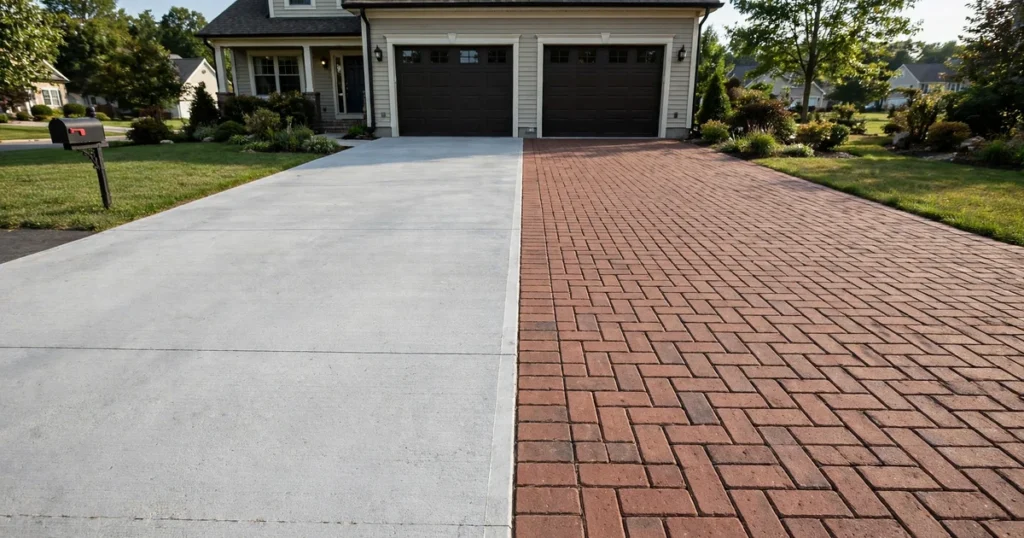
Both concrete and pavers make excellent driveways, and most comparison pages quietly sell you one of them. The honest answer: a concrete driveway costs less to install but may cost you more over 25 years if it cracks and needs early replacement, while pavers cost more upfront but are cheaper to repair because single units can be lifted and replaced. The right choice depends on your budget, your soil, and how much maintenance you are willing to do.
The Short Answer
Poured concrete usually wins on installed cost. Interlocking pavers usually win on repairability and kerb appeal. Over a 25 year horizon the lifetime totals often end up closer than the installation quotes suggest, once you factor in repairs and one replacement cycle.
The catch is that the industry disagrees with itself on lifespan. Contractors typically report 25 to 30 years for a well built concrete driveway. Paver suppliers claim 50 years or more for pavers with maintenance. Neither figure is settled science, and both depend heavily on base preparation, climate, and how well the driveway is looked after. Anyone quoting a single precise number for either material is selling something.
Costs below are presented as planning ranges, not quotes. Real prices vary by region, site access, and how much base work your ground needs. In the US, a plain concrete driveway typically runs 6 to 15 dollars per square foot installed, while interlocking pavers typically run 10 to 25 dollars per square foot. In the UK, concrete driveways typically run 50 to 100 pounds per square metre, and block paving typically runs 80 to 140 pounds per square metre. These are approximate ranges for budgeting, not firm estimates.
Head-to-Head Comparison
| Factor | Poured concrete | Interlocking pavers |
|---|---|---|
| Installed cost (US) | 6 to 15 dollars per ft² | 10 to 25 dollars per ft² |
| Installed cost (UK) | 50 to 100 pounds per m² | 80 to 140 pounds per m² |
| Reported lifespan | 25 to 30 years (contractor reports) | 50+ years claimed (supplier claims, with maintenance) |
| Repair cost when damaged | High (patching shows; full slab sections may need replacement) | Low (lift and replace individual units) |
| Installation time | Faster (pour and finish) | Slower (laid by hand, unit by unit) |
| Curing wait before use | Several days before driving on it | Usable almost immediately after compaction |
| Appearance options | Plain, stamped, or stained | Wide range of shapes, colours, and patterns |
| Drainage | Impermeable unless permeable mix used | Permeable options available (joint gaps drain water) |
| Stain resistance | Oil stains soak in if unsealed | Stained units can be swapped out |
The table above uses planning ranges because installed prices move with local labour rates and ground conditions. A driveway on clay that needs deep excavation costs far more than one on firm, level ground, whichever surface you choose. Our concrete cost per cubic yard guide breaks down the material side of the maths if you want to price the concrete option yourself.
Lifetime Cost: A Worked 25-Year Example
Take a typical two-car driveway of 60 square metres (about 650 square feet). Using the mid points of the planning ranges above, here is one honest way the 25 year maths can look. Your numbers will differ, but the structure of the comparison is what matters.
| Cost item | Concrete | Pavers |
|---|---|---|
| Installation (planning range) | 3,000 to 6,000 pounds | 4,800 to 8,400 pounds |
| Sealing over 25 years | 400 to 800 pounds (2 to 3 reseals) | 400 to 800 pounds (2 to 3 reseals) |
| Repairs | 0 to 1,500 pounds (crack repairs, possible partial replacement) | 100 to 400 pounds (lift and relay settled or stained units) |
| Replacement within 25 years | Possible at year 25 to 30 | Unlikely if maintained |
| 25-year planning total | 3,400 to 8,300 pounds | 5,300 to 9,600 pounds |
Two honest caveats. First, if your concrete driveway reaches 30 years without major cracking, the concrete option wins the lifetime comparison outright. Second, if your pavers were laid on a poor base and settle badly, the paver option can end up the most expensive driveway you ever buy. Base preparation decides more of the outcome than the surface material. This is the point most vendor comparisons skip, because a good base costs money either way.
Installation Compared
A concrete driveway is excavated, formed, based with compacted aggregate, poured, and finished in a few days of site work, then it needs curing time before you drive on it. Most contractors ask for 3 to 7 days before vehicle traffic. Thickness matters here: 100 mm (4 inches) suits cars, while heavier vehicles want 150 mm. Our guide to how thick a concrete driveway should be covers the loading question in detail.
Pavers are excavated, based, screeded with bedding sand or grit, laid by hand in the chosen pattern, edged with restraints, and compacted with a plate compactor. The work is slower because every unit is placed individually, but the driveway is usable as soon as the crew leaves. The critical detail is the edge restraint. Pavers spread sideways under load if the edges are not locked in, and that is the single most common cause of paver driveway failure.
Maintenance Compared
Concrete maintenance is mostly about sealing and crack management. Reseal every 5 to 7 years to keep water and de-icing salts out, clean oil spills promptly before they stain, and address small cracks early so water cannot get in and freeze. Once a concrete slab cracks badly or heaves, repair is expensive and the fix is usually visible.
Paver maintenance is about joints and settlement. Top up jointing sand or polymeric sand as it washes out, pull weeds before roots lift units, and lift and re-bed any units that settle. The big advantage is that a stained or cracked unit is a five minute swap, not a repair bill. The big disadvantage is that neglect shows fast: empty joints let units wander and weeds take hold.
Which Suits Your Situation
- Tight budget, simple layout: concrete. The installed cost is hard to beat, and a well built plain slab lasts decades.
- You care about looks and kerb appeal: pavers. The pattern and colour options are far wider, and they read as premium to buyers.
- Expansive clay soil or freeze-thaw climate: pavers edge ahead. Individual units tolerate small ground movements that would crack a rigid slab.
- You want the driveway usable immediately: pavers. No curing wait.
- Steep slope: be careful with both. Concrete needs the right finish for traction, and pavers need serious edge restraint on a gradient.
- You hate ongoing maintenance: concrete, honestly. It asks less of you year to year than a paver surface does.
- Comparing with a third option: if asphalt is also on your shortlist, our concrete vs asphalt driveway comparison puts the two poured surfaces side by side.
FAQs
Which lasts longer, concrete or pavers?
Industry reports are inconsistent. Contractors typically report 25 to 30 years for a concrete driveway, while paver suppliers claim 50 years or more with proper maintenance. Both figures assume a well built base. In practice, the base and the climate matter more than the surface material.
Are pavers really worth the extra cost?
They can be, if you value repairability and appearance. Lifting and replacing a few damaged units costs far less than repairing a cracked slab. But if the base is poor, expensive pavers fail just as surely as cheap concrete, so spend on the base first.
Can you drive on pavers immediately?
Yes. Once the pavers are laid, edged, and compacted, the driveway is usable right away. Poured concrete needs several days of curing before it should carry vehicle traffic, which is a real scheduling factor if you only have one parking space.
Which is better for drainage?
Permeable paver systems drain water through the joints into a designed base, which can reduce runoff and help with local drainage regulations. Standard poured concrete is impermeable. Permeable concrete mixes exist but cost more and need specialist installation.
Do pavers sink over time?
They can settle if the base was poorly compacted or the edge restraints fail. The fix is straightforward: lift the affected units, add and compact bedding material, and re-lay. This is one of the genuine advantages of a unit pavement over a monolithic slab.
Which adds more resale value?
There is no reliable published figure for this. Estate agents generally regard a tidy, well maintained driveway of either type as a plus, and premium-looking pavers may photograph better. Do not expect either option to pay for itself at resale on its own.
Conclusion
There is no universal winner. Concrete is cheaper to install and asks less of you afterwards. Pavers cost more upfront but forgive mistakes and age gracefully when maintained. Get your base built properly, use the planning ranges above to budget honestly, and choose the surface that fits your budget, your soil, and your tolerance for maintenance.
Last verified: October 2026.
About the author
Kaleemullah Formulas use standard geometry and published bag yields; sources are linked in each article.