
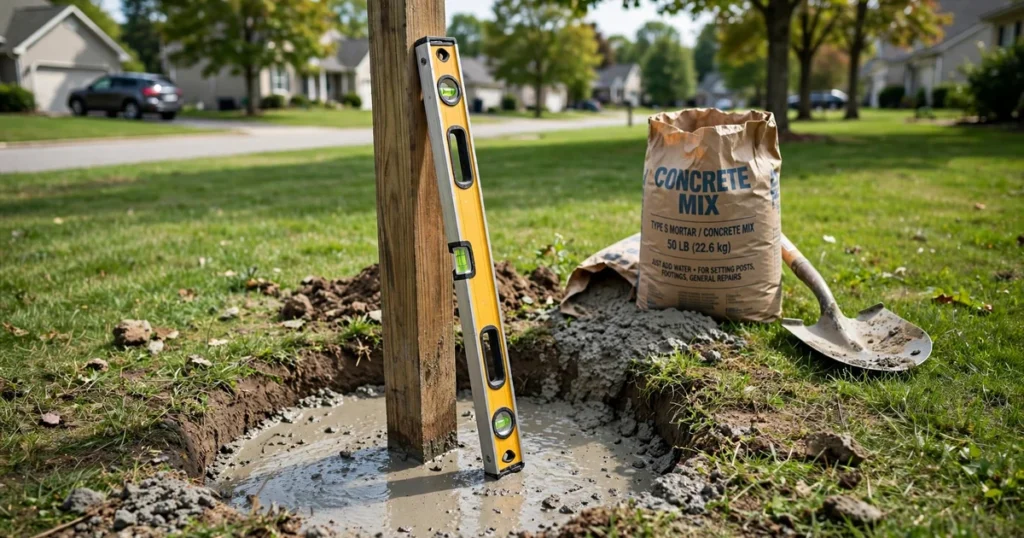
Most mailbox posts need one or two 50 lb bags of bagged concrete mix. An 8 inch diameter hole that is 24 inches deep holds about 0.70 cubic feet of concrete, which is roughly 2 bags, and the post itself takes up a little of that space, so 2 bags is the safe buy. If your hole is wider or deeper, the number climbs fast, so use the table below rather than guessing.
The Short Answer
For a standard mailbox post, plan on 1 to 2 bags of 50 lb concrete mix, or a single 60 to 80 lb bag as an equivalent. This assumes a hole roughly 8 inches across and 18 to 24 inches deep, which covers the vast majority of residential mailbox installations.
A 50 lb bag of concrete mix yields about 0.375 cubic feet of concrete. That figure comes from the bag itself, so check your brand’s label, because yields vary slightly between manufacturers. An 80 lb bag yields about 0.6 cubic feet. In the UK, a 20 kg bag yields about 0.01 cubic metres.
A common question is whether one bag is really enough. It depends on your soil. In firm, undisturbed ground you can dig a neat hole and the table figures hold exactly. In loose or crumbly soil the hole ends up wider than you dug it, which eats extra concrete, so buying one spare bag is cheap insurance against a half-filled second trip to the merchant.
Why do answers online range from 20 lb to 200 lb? Because nobody agrees on the hole size. A narrow hole needs very little concrete, while a wide, deep hole can swallow five bags. The maths below removes the guesswork, and you can scale your bags per cubic yard figure up or down for any project.
Hole Volume to Bags: The Worked Table
The volume of a round hole is pi times the radius squared times the depth. Divide that volume by the bag yield, and you have your bag count. The worked example: a 12 inch diameter hole, 24 inches deep. Radius 6 inches, so 3.1416 times 36 times 24 equals about 2,714 cubic inches, which is 1.57 cubic feet. Divide 1.57 by 0.375 and you get 4.2, so buy 4 to 5 bags of 50 lb mix.
The tables below already do this arithmetic for common hole sizes. The figures are the hole volume itself. The post will displace a small amount of concrete, so treat the bag count as a ceiling and round up only one extra bag for safety.
| Hole diameter | Hole depth | Hole volume (ft³) | 50 lb bags | 80 lb bags |
|---|---|---|---|---|
| 6 in | 18 in | 0.29 | 1 | 1 |
| 6 in | 24 in | 0.39 | 1-2 | 1 |
| 8 in | 18 in | 0.52 | 2 | 1 |
| 8 in | 24 in | 0.70 | 2 | 2 |
| 8 in | 30 in | 0.87 | 3 | 2 |
| 10 in | 24 in | 1.09 | 3 | 2 |
| 10 in | 36 in | 1.64 | 5 | 3 |
| 12 in | 24 in | 1.57 | 4-5 | 3 |
| 12 in | 36 in | 2.36 | 7 | 4 |
For UK readers, the same maths in metric. A 20 cm diameter hole, 60 cm deep, has a volume of about 0.019 cubic metres, which needs 2 bags of 20 kg mix.
| Hole diameter | Hole depth | Hole volume (m³) | 20 kg bags |
|---|---|---|---|
| 15 cm | 45 cm | 0.008 | 1 |
| 20 cm | 60 cm | 0.019 | 2 |
| 25 cm | 60 cm | 0.029 | 3 |
| 30 cm | 75 cm | 0.053 | 6 |
One more planning point for cold regions. Set the bottom of the concrete below your local frost line, or seasonal frost heave can tilt the post. In most of England the frost depth is shallow, roughly 450 mm, so a 600 mm deep footing is normally fine. In northern US states the frost line can sit 900 mm or deeper, which is why the 36 inch rows exist in the table. If you mix your own instead of bagged mix, our 1-2-4 mix ratio guide shows the proportions.
How to Set the Post, Step by Step
- Check before you dig. In the US, call 811 before you dig anywhere near a kerb. In the UK, contact the relevant utility services if you are digging deeper than a spade’s depth near any services.
- Dig the hole. A post-hole digger gives a clean round hole. Go to your planned depth, plus a 50 mm gravel layer at the bottom for drainage in wet ground.
- Set and brace the post. Drop the post in, plumb it with a spirit level on two faces, and brace it with two or three stakes and screws so it cannot drift while the concrete sets.
- Mix to the right consistency. Bagged mix needs roughly 2.5 litres of water per 50 lb bag, but follow the bag, not this sentence. The mix should hold its shape like thick porridge, not flow like soup.
- Fill and rod. Pour the concrete around the post, not just down one side. Rod it with a stick or rebar offcut to drive out trapped air pockets.
- Slope the top. Shape the concrete surface so it slopes away from the post. Standing water at the base rots timber and corrodes steel.
- Leave it alone. Let it set for at least 24 hours before hanging a mailbox or loading the post. Fast-setting mixes are usable sooner, per their label.
If you are pricing several small jobs at once, run the numbers through our concrete calculator to total your bags before you visit the builders’ merchant.
Mistakes That Cause Leaning Posts
- A hole that is too shallow. The classic cause of lean. As a rule, bury one third of the post’s above-ground height, and never less than 450 mm for a mailbox post.
- Too much water in the mix. Soup-like concrete shrinks more as it cures and sets weaker. It also settles unevenly, and the post follows it.
- Skipping the bracing. Even a small pour can nudge a post off plumb while you work. Brace first, pour second.
- Concrete mounded toward the post. A saucer that funnels rain to the base speeds up rot and corrosion. Always crown the top away from the post.
- Digging only as wide as the post. A hole barely wider than the post gives the concrete no collar to grip the soil. Aim for a hole 3 times the post width.
- Pouring dry mix and hosing it. Some fast-setting mixes allow dry placement, but standard mix poured dry cures unevenly and ends up weaker than properly mixed concrete.
FAQs
Can I set a mailbox post without concrete?
Yes, for light mailboxes in stable soil you can tamp crushed stone around the post in layers. It drains better and the post can be replaced easily. Concrete is the better choice in loose or sandy soil, on windy sites, or where frost heave is a problem.
How deep should a mailbox post be?
Bury at least one third of the above-ground post length, with a minimum of 450 mm (18 inches) for a standard residential post. In areas with deep frost, the base should sit below the local frost line, which can mean 900 mm or more in northern US states.
How long does concrete take to set around a post?
Standard bagged mix reaches initial set in a few hours and supports light loading after about 24 hours. Full strength develops over roughly 28 days. Fast-setting products are usable sooner, typically within an hour, per the manufacturer’s label.
Should gravel go under the concrete in a post hole?
A 50 to 75 mm gravel layer under the concrete helps drainage in clay or waterlogged soil and gives the footing a stable base. It is optional in free-draining ground, where the concrete can bear directly on undisturbed soil.
Is one 80 lb bag enough for a mailbox post?
For a standard 8 inch diameter hole up to about 24 inches deep, yes. An 80 lb bag yields about 0.6 cubic feet, and that hole holds about 0.70 cubic feet, with the post itself displacing some of that volume. For wider or deeper holes, buy two.
Can I use leftover concrete from another job?
Yes, as long as it is fresh and workable. Concrete that has started to stiffen should never be retempered with extra water for a post footing, because the weakened mix undermines the whole point of concreting the post in.
Conclusion
A mailbox post is a small job that goes wrong only when the hole size is guessed. Measure the hole, run the volume maths, and buy one extra bag for insurance. Two bags of 50 lb mix covers the standard case, the post stays plumb, and the job is done in an afternoon.
Last verified: October 2026.
About the author
Kaleemullah Formulas use standard geometry and published bag yields; sources are linked in each article.