
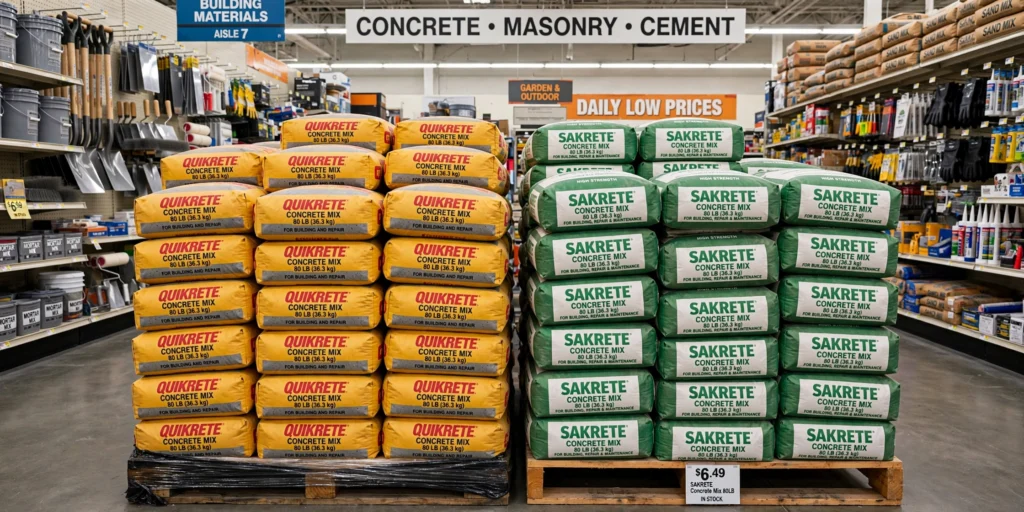
If you are staring at a yellow Quikrete bag and a red Sakrete bag, here is the short version: both standard mixes are rated at about 4,000 PSI after 28 days, so on strength the two are effectively a tie. The real differences are smaller: aggregate texture and finish, product range, price per bag, and which store stocks them. This guide compares them head to head and flags honestly where other sources disagree.
The direct answer
For most DIY jobs, the brand matters less than the specific product you pick. Buy the mix with the right strength rating, compare the price per bag, and grab whichever is in stock locally. There are genuine differences worth knowing, especially if you want a smooth trowel finish or need a specialist mix like a countertop blend.
Strength comparison: a tie at 4,000 PSI
The most important spec on any bag is compressive strength, measured in PSI (pounds per square inch). Here is where both brands stand.
| Mix type | Quikrete | Sakrete |
|---|---|---|
| Standard concrete mix (28-day strength) | About 4,000 PSI | About 4,000 PSI |
| High-strength variants | 5,000+ PSI options available | 5,000+ PSI options available |
| Fast-setting mixes | Set in 20-40 minutes | Set in 20-40 minutes |
| Walk-on time (standard mix) | About 24 hours | About 24 hours |
That 4,000 PSI figure is the one fact reliable sources agree on. It is plenty for patios, walkways, footings, steps and posts, and both brands also sell 5,000+ PSI variants for heavy-duty work.
A warning about other articles: they contradict each other. Some claim one brand’s standard mix is only 2,500 PSI, others quote fast-setting strengths up to 7,000 PSI, and claimed additive contents cannot be verified from the bag. Read the label on the bag you are holding: that rating is the only spec that counts.
Workability and finish: Quikrete usually feels smoother
This is the most consistent real-world difference across sources. Quikrete’s standard mix uses a finer, more uniform aggregate blend, giving a creamier feel and an easier trowel finish. Sakrete’s standard mix tends to run slightly coarser, so it takes more effort to get a flat, clean surface.
When does this matter? For visible surfaces like a patio, walkway or steps, where the finish is on show, the finer mix is genuinely easier for a beginner to work with. For footings, deck supports or setting posts, the finish barely matters, so this difference effectively disappears. One caveat: exact aggregate varies by manufacturing region for both brands, so bags from different plants can feel slightly different. If you are pouring a large visible slab, buy all your bags from the same store batch.
Product range: Quikrete is broader
Quikrete offers the wider catalogue. Beyond the standard mix, it sells fast-setting, high-strength, crack-resistant and countertop mixes, plus project guides that walk beginners through common jobs. Sakrete’s range is narrower and focused on the core mixes most DIYers actually buy: standard, high-strength and fast-setting.
| Product type | Quikrete | Sakrete |
|---|---|---|
| Standard concrete mix | Yes | Yes |
| Fast-setting mix | Yes | Yes |
| High-strength (5,000+ PSI) | Yes | Yes |
| Crack-resistant mix | Yes | Yes |
| Countertop and specialty mixes | Wider selection | Narrower |
| Beginner project guides | Yes | Limited |
The practical takeaway: if your project needs something unusual, like a countertop mix, check which brand actually stocks it near you before you commit to a plan. For ordinary slabs, posts and repairs, both ranges cover you.
Setting times: what to expect
Standard mixes from both brands follow the same rough timeline: workable for the better part of an hour, firm enough for foot traffic in about 24 hours, and still gaining strength for weeks. Fast-setting versions from both brands set in 20 to 40 minutes, which is ideal for posts because you can pour the dry mix in the hole, add water and move on.
Do not confuse “set” with “cured”. Setting means the mix has hardened enough to hold its shape; curing is the chemical process that builds full strength, and it takes about 28 days for both brands. Keep new concrete damp for the first few days, especially in hot or windy weather, so it reaches its rated strength.
Price and availability
Per-bag prices are generally similar between the two brands, and prices move with region and retailer. The smartest comparison is not brand versus brand but project versus project: work out how many bags your volume needs with our bags per cubic yard calculator guide, then multiply by the shelf price at your store. That total is what you are actually choosing between.
On availability in the US, Quikrete is widely sold at Home Depot and Sakrete is widely sold at Lowe’s, with both brands also appearing in independent hardware stores. This varies by region, so check local stock before you plan a big pour. Note that at least one popular article reverses this retailer pairing, which tells you how carefully some of these comparisons are written. Verify at your store, not on a blog.
Bagged mix lasts about 12 months stored dry, less if stored damp. Do not stockpile bags in a damp garage for next year; check old bags for lumps before mixing, since hardened lumps mean the cement has reacted with moisture.
If you are deciding between bagged mix and a delivered load for a bigger job, read our bags vs ready-mix comparison first. And if you want to understand what is actually inside the bag, our 1-2-4 mix ratio explained guide breaks down the cement, sand and aggregate proportions.
Which should you buy? By project type
Forget brand loyalty and match the product to the job. Here is the quick version:
| Project | Recommendation |
|---|---|
| Fence or mailbox posts | Tie: buy whichever fast-setting bag your store stocks |
| Patio or walkway (smooth finish) | Quikrete standard mix: easier trowel finish for beginners |
| Footings or deck supports | Either brand’s standard 4,000 PSI mix |
| Driveway or heavy loads | Either brand’s high-strength (5,000+ PSI) variant |
| Countertop or decorative work | Quikrete: broader specialty range |
| Minor repairs and patching | Either; buy a small bag and test the colour match first |
For most jobs the honest answer is that the performance difference between the two brands is small. Choose based on the strength rating printed on the bag, the price at your store, and what is actually on the shelf. A 4,000 PSI bag of either brand, mixed and cured properly, will outlast a premium mix that was mixed too wet and left to dry out in the sun.
Frequently asked questions
Is Quikrete stronger than Sakrete?
No. Both brands’ standard concrete mixes are rated at about 4,000 PSI compressive strength at 28 days, so strength is effectively a tie. Both also sell high-strength variants at 5,000 PSI and above. Match the bag’s rating to your job instead of choosing on brand name.
Which is better for setting fence posts?
It is a tie. Both brands sell fast-setting mixes designed for exactly this job: pour the dry mix into the hole, add water, and it sets in 20 to 40 minutes. Buy whichever one your store has in stock.
Can I mix Quikrete and Sakrete together in one pour?
It is not recommended. The two brands use different aggregate blends and additives, so mixing them can give unpredictable setting times and an inconsistent finish. Use one brand for the whole pour.
How long does a bag of concrete mix last in storage?
About 12 months if stored dry, and less if stored damp. Keep bags off damp floors and sealed from humidity. Before using an old bag, check for hard lumps: lumps mean moisture has got in and the mix may not reach full strength.
Do I need a high-strength mix for a residential driveway?
For a standard residential driveway carrying cars and light trucks, a 4,000 PSI mix is the usual choice and perfectly sufficient. Consider a 5,000+ PSI variant if the driveway will take heavy vehicles or faces harsh freeze-thaw cycles.
Why do websites disagree about Quikrete vs Sakrete?
Because manufacturing varies by region, product lines change over time, and some pages repeat old or unverified claims, like reversed retailer pairings or wrong PSI figures. The label on the bag in your store is the reliable source; treat blog comparison tables as a starting point, not gospel.
Conclusion
Quikrete and Sakrete are both solid, widely available brands, and for standard mixes the honest verdict is a draw on strength. Quikrete has the edge on finish workability and product range; Sakrete holds its own on the core mixes at a generally similar price. For your project, read the bag, count your bags, check the shelf price, and buy what suits the job. Done properly, either brand gives you concrete that lasts for decades.
Last verified: October 2026.
About the author
Kaleemullah Formulas use standard geometry and published bag yields; sources are linked in each article.